Wednesday, May 22, 2013

Blooming Apples In The South Lower Gardens


Spring 2013 is a winner for Apples . . . unlike last year . . .  and this year, luckily, we did not get a killing frost to the fragile flowers. Hopefully last nights hail did not damage the forming fruit. These blooms have all but faded now but were like fragrant clouds within the gardens for a couple of weeks. Featured here are the Apple trees in our lower, east-facing, south garden that runs down into the blueberry fields. I was lucky to have inherited these trees when moving here and have cared for them for over thirty years now.


Our Apple Gateway is mightily floriferous and we look forward to the bounty of fruit.


A Yellow-rumped Warbler enjoys a dead branch for a perch.


Baltimore Orioles open the apple blossoms to find treats within.


Yellow-bellied Sapsuckers drill for sweet sap that flows within the old Apple trunks.


Looking up from the blueberry field there is a multitude of new spring hue and texture in leaves and blooms.


Standing beneath the Apple Gateway looking up towards the 1790 farmhouse, Magnolia soulangeana, and majestic two-hundred-year-old Rock Maples. 


Male Baltimore Oriole (above) and female (below) favor the Apple blossoms for gleaning tasty insects.


A 'bonsai' Apple appears to be growing from of an outcropping of granite.


Our most majestic Apple offers an interesting form and delicious fruit.
 The 'bonsai' apple is over to the left . . . a Shagbark Hickory in the background of the upper garden.


I have not taken the fruit to an expert to identify, but they are heirloom varieties 
akin to McIntosh, Cortland and Roxbury Russet with one of the Gateway apples reminding me of a Golden Delicious.


Light, wind and mist embrace trees wearing white blossoms or leafy greens and there is such a diversity of life flitting in and out of the bountifulness of branches.  Crusty, languid limbs of Apple stately stand about our surroundings throughout the seasons . . .  like charcoal drawn sentinel beings slicing the air while their supportive fleshy roots reach deeply down into the dark, moist, restorative, loamy womb of our earth. They are our connection to that which dwells within a soulful, regenerative realm beneath the lively, light-filled, surface layer we stride upon. 'Trees of knowledge' nourishing body and spirit and like a good friend, offering a solid something to lean into. I love these dear old friends . . . that never stop giving . . . inspiring in their beauty and deliciously beneficial in their sustenance for all life.


Monday, May 20, 2013

Early Spring 'Star' Magnolia Stellata


Magnolia stellata's primitive multi-petaled, milk-white and blush-striped blooms are the first flowers to fully unfurl within our garden shrubberies. Eighteen petals fall free of their furry calyx, multiplied by hundreds, to paint this small tree brightly. She stands along our second terraced garden stretching easterly amongst sentient statues of Apples and Birch yet to exhale their buds at the time these photographs were taken. A gift of Peace from Japan to the United States, Magnolia stellata's tiny white flags quietly wave with the wind and her presence on our hillside offers a placid passage from the snowy chill of winter into the riot of warmer colors to come when spring's breath covers the landscape. I love to sit beneath the many stars and look towards the other trees nearby.


Grey Birch and one of the Apples of our 'Gateway' in the blueberry fields. 


Our oldest Apple above and below.


A Shag-bark Hickory stands in the upper garden. 


Tree Swallow calls, songs and duets fill the early spring sky with grace and gurgling as females wrangle.


Looking up from the blueberry field, where within the heath this day . . . I eyed an Eastern Pine Elfin.
 To the left before the 'Star' Magnolia, one of the Apples of the 'Gateway' stands and the other is featured below with stellata blossoms in the background.


A one-hundred year old Apple is dwarfed by the two-hundred year old Rock Maples.


Another Apple in the rock garden near a smaller stellata seems diminished by the giants.


Crown of Apple, Rock Maple and stellata merge into pink weeping cherry.


Tree Swallow couple's favorite cherry branch perch.


When the Magnolia stellata is fully blown open . . .  other buds begin bursting too. 


Still needing more pruning, the 'bonsai' Apple spreads over the large boulders of the old rock garden.


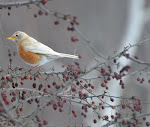
Spring is filled with song and alarm calls from hundreds of birds. I noted this robin's frightful clamor and took camera and self out to see what was the matter. 
Going towards the direction it was eyeing I found the reason for its piercing notes. It is always good to listen and watch what goes on in our gardens.


A Broad-winged Hawk perching high up in one of the Rock Maples. 
A buteo who fancies small mammals (most welcome to our voles and rabbits!) and birds is a just cause for fright from a robin.


Times seems to fly by so quickly these days . . . spring is in full dress here now and next I will share the Apples all abloom. 

I took a break from my gardens and went to the ocean for a week repose and when I returned hundreds of birds had returned too . . .  only instead of my being here to greet their return they wondered at mine. I felt lost for a bit but back on track and will not make the same mistake of going away at such a magical time again. I must learn how to simply relax here in my own realm. Sound familiar? 

Wednesday, May 1, 2013

Flower Hill Farm Butterflies of 2012 ~ Grand Finale


Twenty twelve was really an amazing butterfly year here at Flower Hill Farm in Western Massachusetts. In the early spring there was an influx of Red Admirals filling the apples trees and lilac bushes. Then later on  Painted Ladies were sighted here in large numbers during the summer months feeding on a diversity of blooms. Normally the Painted Ladies are more 'irregular emigrants' in Massachusetts but last year there were record numbers reported all over the northeast. 

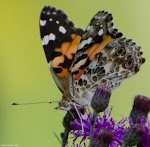
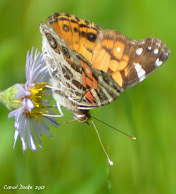
Painted Lady

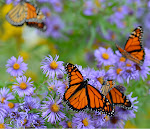
Painted Ladies

At times there were over fifty flitting about the gardens and fields . . . particularly striking when back lit by the sun.

Pearl Crescents

Pearl Crescents are in the same subfamily of 'True Brushfoots' (Nymphalinae), as the larger Painted Ladies and they too are often enjoyed here on our farm in numbers of over fifty during the summer. Tiny Pearl Crescents are utterly enchanting flying about the middle meadow garden and fields . . . especially when their brown-orange colors are enriched by the light of the sun.

Pearl Crescents

American Copper

Last year was a great year for first sightings too. 
Some butterflies are so tiny that they are easily missed. 

Eastern Tailed-Blue and American Copper

Little treasures fill our eyes when we take the time to look. 

Eastern Tailed-Blue

Painted Lady (folded wings), Eastern Tailed-Blue, Painted Lady (open wings),
Common Ringlet, American Copper, Giant Swallowtail,
Little Wood Satyr, Common Wood Nymph, Question Mark

All of the butterflies above were added to my list for the first time last year. 

Eastern Swallowtails

Eastern Tiger Swallowtails are always a delight in flight.

Giant Swallowtail 

The most spectacular in size and drama of my new sightings was this Giant Swallowtail. Our warmer climate is expanding the territory of these magnificent butterflies, as again record counts were reported throughout the northeast last year. This was the only giant that I was lucky enough to see in the gardens and I did worry for its safety as the Cat Bird's beak opened in awe, as did my mouth, at the strangeness and size of this swallowtail. I literally chased the Cat Bird away but that would have only been a temporary deterrent. I did not chance to see the butterfly again. 

Eastern Tiger Swallowtail  

The smaller Eastern Tiger Swallowtail not only differs in size but also has a very different pattern on its wings . . . the only time it might be confused with its cousin the giant is when the wings are folded.

Flower Hill Farm Butterflies of 2012

Other than a couple of skippers, this is the collection of butterflies I was able to catch sight of throughout last year in our gardens and fields. Twenty-two or so species is only a small amount of the one hundred three butterfly species known to inhabit Massachusetts. I will continue to work with my land and gardens to provide a more diverse habitat that hopefully will attract many new butterflies to Flower Hill Farm.

Learning to identify the caterpillars, their host plants and the overwintering habits of various butterflies, will go a long way to securing their success in our gardens. I am especially indebted to the Massachusetts Butterfly Club for their highly educational and beautiful website along with the invaluable Mass Audubon's Butterfly Atlas. I have been able to identify and learn about all the butterflies in this series by visiting the two websites above. I am thrilled to now be a member of the Massachusetts Butterfly Club which is a chapter of the North American Butterfly Association.

Connecting with other butterfly enthusiasts is a wonderful way to learn more about butterflies and how we can all help preserve habitat for these remarkable creatures.

Mourning Cloaks are not among the list above as I did not see one last year. This April did, however, bring at least six from their overwinter hiding places, but not one was close enough to capture with my camera. It is exciting to begin a new season of butterfly watching and I hope my list will grow along with my unbridled enthusiasm for these spirited gifts of nature.

Wishing all a happy May and a bountiful butterfly season!


Related Posts with Thumbnails