Showing posts with label Crabapple Orchard. Show all posts

Wednesday, January 8, 2014

A Frightfully Frigid Winter Interlude


Winter is becoming a bit freaky across the country creating whirlwinds of bone-chilling chaos and disasters in many states.

Here, icicles dangling like dangerous claws, can be likened to imaginary bars of winter's bitter prison blocking healing warmth. 


Pruning will fill up much of February and March if days warm enough to hold pole clippers and saws.


What was I thinking to plant a climbing hydrangea on the beautiful Shagbark Hickory . . . a good trim here and there will open to view some of the striking textured bark. Still, winter does reveal the beauty of this marriage. It is summer when the groovy Shagbark is lost to me. Lichen alters another tree's bark, as noted in the distance, on a sound and solid oak.


Bearing up to the cold, resident buteos choose cherry and oak, standing tall within the north and easterly fields, as their lookout perches. A juvenile Red-shouldered Hawk eyes the frozen solid ground, and the human not too far away within warm barn-studio walls.


The Red-shouldered Hawk feels uncomfortable with my presence and so takes flight towards the forest and river below.


Our more frequently viewed buteo, sighted just a few minutes after the Red-shouldered flew off, prefers the distance of an oak firmly holding along the eastwardly slope. Red-tailed Hawks are always welcome by this community member but not so appreciated by most birds of our habitat.


Red-tailed Hawk 


I am never surprised to see crows, blue jays and even hummers and tree swallows chasing buteos. New Year's Eve day showed me yet another bird or flock of birds in chase of a hawk. Cedar Waxwings are barely visible in the top tier of the oak the Red-tailed Hawk is also occupying.


A closer look above and their shapes become perceptible but not their mood for only moments after this shot, and too quick for my capture, about twenty or so waxwings were in hot pursuit of the Red-tailed Hawk.


Soon, after the chase, the Cedar Waxwings began doing what waxwings are most often seen in pursuit of . . .  harvesting and gulping down little crabapples. I did not know they had such pluck to chase a hawk away.


I am shooting through a glass pane and still cannot escape the watchful wary eye of at least one of the waxwings. 


The crabapples are delicious and nutritious treats . . . with or without snow cream. 
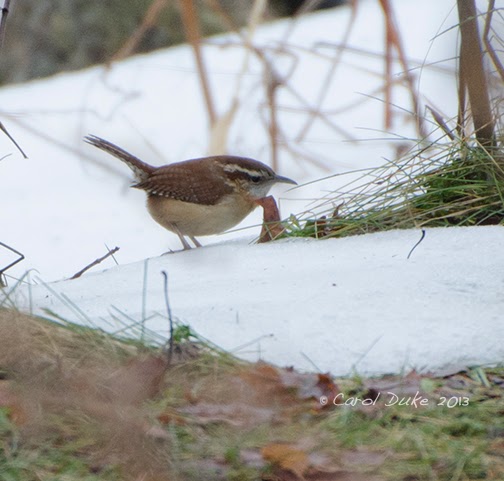

Another winter surprise is the sighting of a Carolina Wren . . . I had no idea they overwinter here and have been told, by a serious ornithologist, that if it gets too cold the wrens will just die, for they will not think to fly further south. This little fellow already made it through the minus 13 F night a bit ago. It is about 4 degrees Fahrenheit right now, as I write, and I do wonder how this Carolina Wren is keeping warm. I hope homeless folks too are able to find safe shelters in order to stay warm throughout this chilling winter spell. 


Friday, December 20, 2013

A Winter Focus ~ Cedar Waxwing Ornaments and Long Nights Moon


The nakedness of winter's landscape can sometimes seem cold and lonely, when suddenly, whoosh, all together in flight, a flash of fluttering life lifts the spirit high towards outermost tips of a beloved Black Cherry tree. Offering light and enchantment to the lucky viewer, a flock, an 'ear-full', a 'museum' of over sixty Cedar Waxwings alight, sprinkled along the top of the skeletal cherry canopy, resembling delicate ornaments bedecking leafless limbs. 


A closer focus reveals hints of waxwing antics, patterns and forms. A group that may rest and then be off together, a burst of beaks, trebles and feathers, winging through the crisp air down to our crabapple orchard.


Surrounded by colors of autumn and captured through glass, so as not to frighten the timorous Cedar Waxwing, I cannot quite focus the bright yellow tip of its tail or the yellow wash covering its downy belly. Tiny apples are hanging temptations, little-bitty baubles, winter apples waiting to be plucked. Only these are nourishing . . . vital winter food for the waxwings, robins and wild turkeys too.


Every inch of branch, twig and dried stalk, wearing icy snow-coats all across the fields, groan of winter's beauty. 


During a storm . . .


After a partly sunny day . . . snowy mantles melt away.


Into wonder of long black nights, native cherry, charcoal raven touching crumbling cerulean sky, tickling the 'Full Cold Moon'. A joyous interlude between dark and light.


Rising up from swirling surf of clouds, following the setting sun, the 'Long Nights Moon' sails across the painted pastel sky.


Night folds us into our dreams until daybreak, shattering the dark, while scattering light and soft puffs of rosy pink, awakens a new day. An old, softened mountain slumbers still beneath a mantle of lavender smog, as days, nights and solstices dissolve one into the other.


Dreamy underwater illusions, a world of sediments worn down over millenniums, torrents of lava flows from time and crust torn apart. A deep plentiful supply filling an ancient tectonic rift . . . pressure forced up molding forms Native American-like silhouette looking up longingly, for millions of year, towards the sky. A segment of the Metacomet Ridge, of the Mount Holyoke Range dreaming since days of dinosaurs, within my view.

Presently, with placid anticipation, life moves through a calendar of months making what it can of each. Filling the hours minute by minute, spilling seconds by the spoonfuls. It is all over in a wink.

Winter Solstice 2013 is marked on our calendars for tomorrow December 21st, for those of us in the northern hemisphere, the exact moment is never certain, when the shortest day will give birth to the longest night of the year. After a few days, we will note the lengthening of light, as a rebirth, a celebration of our sun, leads us deeper into winter. Peace and Goodwill and Good Day to All.


Wednesday, November 20, 2013

Last Autumnal Breaths of Cadmium and Aureolin Yellow with Palm Warbler Only Passing Through


Last breaths of cadmium and aureolin yellow 
falling through another season of autumn . . . 
 as it falls through us . . . only passing through it all . . . 
Rock Maples stand mighty and tall.


Miscanthus yellow blazes sigh with tassels reaching upwards ten feet high. 


Standing nearby, soft rustling songs become more an undertone as lengthy, waving blades . . .  yellow . . .  then fade, and float towards the leafy floor. 


A brighter, fleeting yellow reflecting tones of our November garden and landscape . . . little Palm Warbler . . . only passing through, where I used to believe you stayed and bred your brood. You are headed south now to the southerly edges of the United States or perhaps you prefer the Caribbean after spending summer months in the brisk provinces of Canada.


I last sighted one of your kind in the month of April on his way to points further north. There was such a promise of green back then and plenty of food to keep this sunny songbird content in lingering within our community for a cluster of days.


I can see you are a different bird all together from the Palm Warbler I so delighted in this spring. Wishing you a safe journey to wherever you choose to overwinter and hopefully with vernal vegetation anew, I will be here to see your cheery, cadmium yellow plumes mirroring clumps of merry daffodils.


Tree Swallows do return and remain every spring and summer, raising spirited broods here in the south field within the weathered walls of our rustic nest box . . . now being choked by bittersweet as it takes its last gulps of duller yellow.


Our weepy cherry's yellow canopy now lies in a buttery carpet around its twenty-year old main stem.  


Asparagus gone wild, flames cobalt-yellow before our Metasequoia gone russet about the north field. 


A couple of our crabapple trees, within the small orchard, make shiny, yellow spheres . . . tiny apples tasty to birds, throughout the winter months.


While on the ground, beneath our oldest apple tree, the vermilion stream of fruit has become a favorite rivulet for our resident White-tailed Deer to step into. Soon the flow of apples will run dry and that is, as it should be.

Beware brown eyes . . . it is the hour of hunting season of your clan . . . by man . . . who hopes to eat you, apples and all. And I could say . . . if with integrity and honor this beautiful beast comes to be . . .  venison . . . that too might be . . . as it should be. Still, I will continue to whisper . . . "Stay close and you will be safe." Heed yellow's warning . . . with your usual caution . . . stepping through the land beyond this land.


Sunday, May 26, 2013

Blooming Apple and Crabapple Orchard in North Gardens


Days of rain and cooler temperatures are allowing me to catch up with the virtual gardens. In real time we are beginning the last week of May . . . the month seems to have bolted by with little rain and cool temperatures that held a multitude of blossoms longer.


Stepping back into earlier spring again and walking away from the south gardens and the Apple Gateway out towards the north field, beneath the serpentine Black Cherry 'Michael's Tree' (holding the meticulously woven Baltimore Oriole nest) and White Birch, we approach the north garden's edge and our sixth older Apple wearing a white canopy of soft blooms.


The Apple stands, holding up blossoming arm-like limbs, beside quince along the fringe of the Crabapple Orchard. Seeing the giant Rock Maples from the north gives a different perspective of these majestic trees. Deciduous Dawn Redwood's graceful branches reach into the photograph (on left) from the north field trying to touch the Apple that seems to be stretching towards it too. In truth the Metasequoia is much farther away and the Apple needs more serious pruning. I am standing in the north field looking over to the gardens and house.


Now, looking further to the right, I stand near a younger Rock Maple and have my camera pointed more into the orchard that fills the space on the north side of the barn.


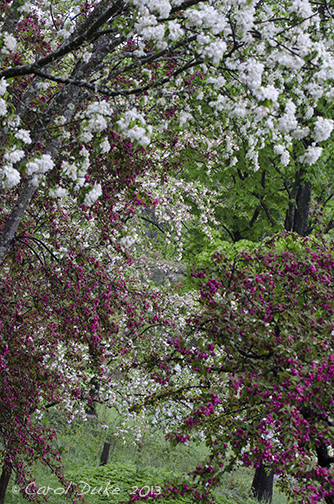
One path leads up into the garden offering a view of the fleecy textures of quince, apple, pine and crabapple just beginning to unfurl their sepals and petals. The rosy petals in the taller crabapple will turn pure white as seen below. The sweetness of the fragrance is heavenly.


Layers of quince, apple and crabapple flowers fully unfurl. All are members of the Rose (Rosaceae) family that dates back millions of years. Apples and Crabapples are of the genus Malus.


Various crabapple varieties blooming at different times. I wish I had better records and could name the varieties I planted nearly twenty years ago.


Looking through the Crabapple Orchard from the barn studio, the colors fill the windows and doors.


A Tufted Titmouse bathed in light and blooms sings for his mate. Who could resist?


Walking up towards the old farmhouse and looking back,viburnums and lilacs add another texture to the landscape.


Now, moving away from the Crabapple Orchard into other parts of the north garden and looking back.


The edge of the Crabapple Orchard and the north garden ablaze of blooms, seen while walking up yet another path from the north field . . . this one leading into the middle gardens, which I will share later this week.


Crabapple flowers are favored by foraging birds . . . especially the female Baltimore Oriole, who is taking a break from weaving her beautiful nest.


Woe be it for any little caterpillar, but the apples appreciate this steward. Crabapples are valued for their beauty and also they are an important food source during the spring and winter months for birds and butterflies. The small fruit is particularly preferred by Cedar and Bohemian Waxwings, Robins, Pine Grosbeaks, Wild Turkeys and some small mammals.


Just behind the farmhouse and the little studio looking down towards the Crabapple Orchard. The Weeping Crabapple (in the foreground) behind the studio is all budded out and will soon turn pure white. In real time they are fading and falling with the rain.


Looking out the barn studio door towards the north field and White Birch. The bright light on the white bark reflects the whiteness of some of the crabapple blooms. The late blooming lilac just before the quince is now fully blossomed with droopy blooms from the weight of rain and more rain.


The dozen crabapples that make up our Crabapple Orchard create a wildlife habitat in and of itself. Countless birds are often seen within the blooming branches gleaning for insects. Robins, warblers and even hummingbirds build their nests in the crabapple canopies and during the winter, Cedar Waxwings have a special technique of tossing and catching the tiny round fruit, which helps sustain them throughout the winter months. The branches also hold the weight of Wild Turkeys, especially when the ground is covered with snow, and help them survive the long winters here. All of this action, as well as, the fragrance and beauty of the crabapples offer us mere humans great joy.


Related Posts with Thumbnails