In my last few posts I have been focusing on winter feeding. Now lets see how the crabapples play an equally important role in feeding birds throughout the growing season. This may be a familiar view to many of my readers, for it is the eastern corner of the Crabapple Orchard, where numerous Robins, Goldfinches and Cedar Waxwings were revealed feasting on the tiny crabapples in my last several posts. Now we are stepping ahead into spring . . . whilst in the middle of two severe winter storms . . . a profusion of spring blossoms unfurl and it is not long before birds begin harvesting insects the flowers attract. Of course countless bees depend on the nectar too . . . there will be an upcoming post about the bees that live here.

It is so magical coming out of the long winter months to the sudden symphony of birds calling, singing and flying in and amongst the numerous shrubberies and tress. Thousands of fragrant and colorful blooms fill the little orchard and delight both the gardener and a variety of wildlife. Here a Scarlet Tanager is not only admiring the beauty but seeking out his lunch too.
I am not sure who this fellow is . . . perhaps a flycatcher of one sort or another. I do not believe it is a Phoebe. It must be lovely up there with the copious canopy of florescence.
Indigo Buntings return with the unfurling Crabapple blossoms, for as the flowers awake so too many morsels of protein in the forms of tiny insects that reside in and about the flowers. Many birds are seen in the flowering trees gleaning the abundant arthropods. What great garden helpers they are!
All through the spring, summer and fall months birds harvest insects that favor the dense foliage of Malus . . . the mystery Crabapple. I wish I could share the species with you. Today I would buy native crabapples . . . then again . . . perhaps my orchard is made up of hardy native stock, for they were grown locally and planted over twenty years ago. The bird pictured here appears to have something in its beak. Alas I cannot be sure of what to call this bird either. Any suggestions much appreciated. Maybe a young Vireo?
In the winter months the apples are a vital food for many birds. This Goldfinch watched other birds eating crabapples and then one day . . . well . . . this molting fellow seems to be enjoying his snack. It is always good to be open to trying new things.
The Crabapple's fruit hardly looks like a 'crab' so how it came by this name is another mystery to me. All apples are in the rose family . . . that is no mystery to most of us. Here at Flower Hill Farm the orchard grows right across from one of its distant cousins.
Rosa rugosa
During the summer, roses spill a delicious perfume within the gardens and are a great feeder of bees. I have often seen Hummingbirds visit these lovely flowers too. Perhaps they were the youngsters attracted to the beauty and sweet fragrance.
In a good year with plenty of sun and rain Rosa rugosa will produce a bounty of hips rich in vitamin C. As we saw in my last post, the Cardinals will enjoy dining on the fruit during the winter months.
The hip will turn bright red when fully ripened. I never notice the birds eating them until the hips are dry and somewhat shriveled up as they are in the winter.
The prickers of Rosa rugosa do not seem to bother this female Northern Cardinal.
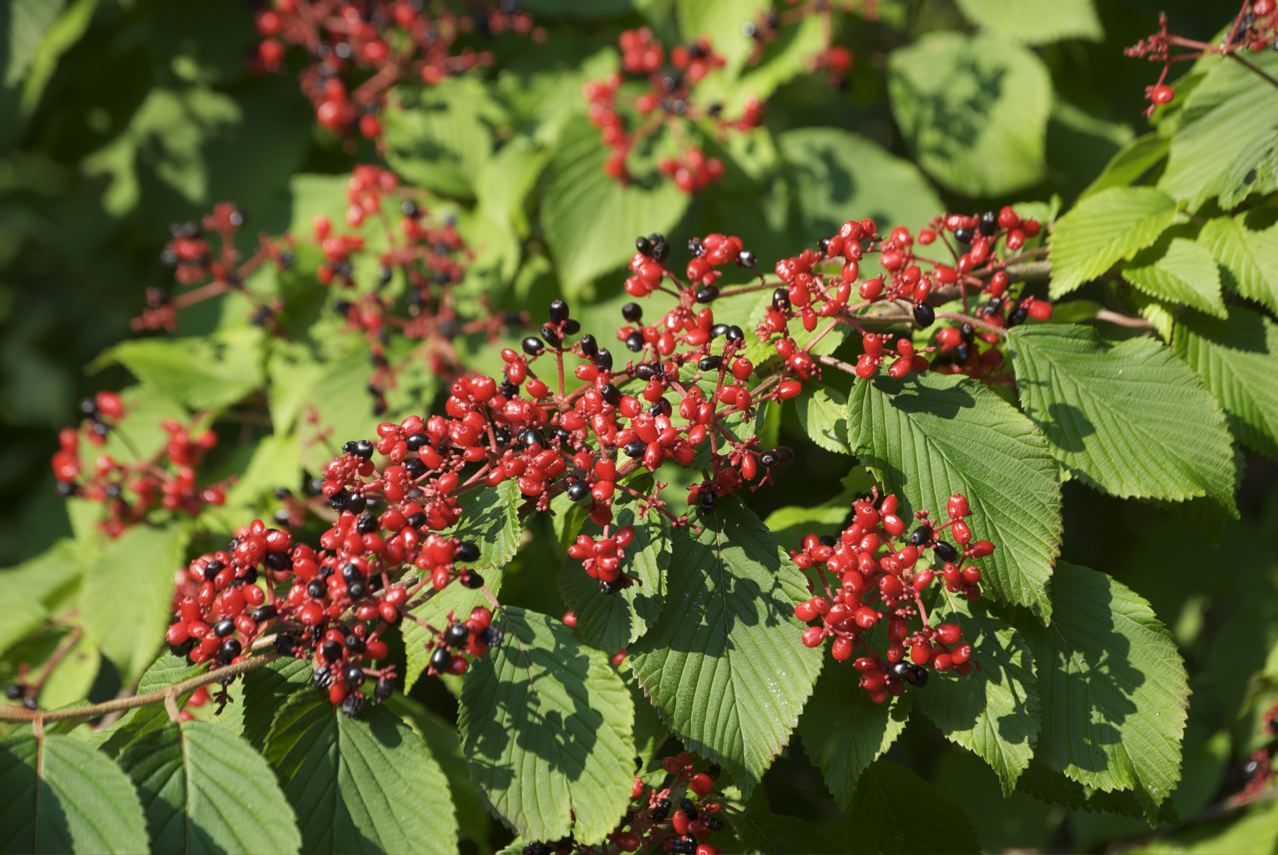
Spreading sumptuously out beside the Rosa and a Lilac is a favorite Viburnum showing its splendid habit of stretching horizontally with an abundance of bloom. Butterflies and bees will sip these then later the berries entice a medley of birds. I have two planted in this cluster of shrubs to assure a hearty crop of fruit. I believe it is a variety of Viburnum plicatum tomentosum.
It is rare that the berries last this long for the fruit to mature to its black color. The two photos above may be from another doublefile Viburnum that lives out in the front garden . . . the leaves do look a bit smaller than those on the shrubs below. The flowers and fruit are very similar.
The second Viburnum shrub in this cluster planting peeks out from behind a Viburnum burkwood and an old fashion Hydrangea bush. The red berries make quite a stunning show . . . but one must not get attached, for after all, they are food for the birds. I do enjoy both the drama of the color and the birds coming and going as the vibrant berries disappear.
Gray Catbirds are extremely fond of these clustered shrubs and often build their nests inside the leafy cover. They are then most conveniently located to these luscious berries. You may have to look carefully twice, but there is a Catbird in this photo.
I have not noticed the Indigo bunting eating them often. It is possible he was just checking the berries out to see what all the fuss was about. Note that I have left a dead branch on the Viburnum . . . this gives the birds a place to perch and is a great spot for me to see and photograph them.
Cedar Waxwings find these berries very much to their taste buds delight too! The fruit is ripening just at about the time the blueberries are going by. Or I should say about the time the birds have eaten all of their share of the blueberries! The garden is an ongoing living bird feeder. I will share more shrubs, trees, and plants in my next posts that are also great food for birds.














.JPG)


