Showing posts with label Buckeye Butterfly. Show all posts

Friday, April 5, 2013

Flower Hill Farm Butterflies of 2012 ~ Viceroy and Common Buckeye


The striking Viceroy Limenitis archippus, can be sighted in flight, here in Massachusetts, from around the end of May till the beginning of October.
Birds are now searching out the overwintering, hibernating, bird droppings-like caterpillars in their neatly constructed leafy 'tents' of apples, cherry or willow leaves. Like the Red-spotted Admiral they cleverly create a hibernaculum by drawing out silk from their bodies and securing leaves to twigs or branches so that they cannot fall. The third instar caterpillars then neatly fold the leaves creating a silky tunnel around their tiny bodies and proceed to sleep through most of fall, winter and well into spring.


Viceroys are consider common and abundant in Massachusetts. It would seem that the birds are fooled by the Viceroy's fastidious overwintering tents, as many caterpillars are able to emerge from their dry leafy homes and munch along the fresh green leaves that open in spring. Many successfully then hide out in their again bird poop-like chrysalis forms and after about ten days become butterflies.
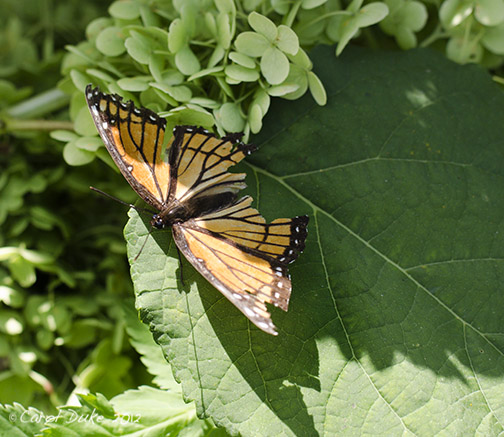

Viceroys are designed to confuse birds and other predators by mimicking the toxic Monarch butterfly. I guess some birds do not attend the 'Butterflies Not To Eat' seminars or perhaps they learn to spit out the toxic body parts. The photograph above illustrates that to mimic is not always a guarantee to sail through life peacefully. I often see the Viceroy's cousin the Red-spotted purple (scroll down to last post) with tattered wings too, even though that butterfly form of the Red-spotted Admiral is suppose to be a mimic of the Pipevine Swallowtail.

Monarch butterfly on Left . . . Viceroy on Right

Though a viceroy is not as high in rank as a monarch, the butterflies do end up confusing people too. There are many differences but besides being smaller, the easiest identification mark is the 'smile line' through the Viceroy's hindwing vertical lines. If the butterflies are too far away to see these details, you can always discern the spectacular soaring flight of a monarch from any other butterfly.


I was not able to get any close ups of the Viceroy in 2012. The two images above from previous years clearly show the horizontal line going through the vertical lines on the hindwings. The Viceroy may mimic the Monarch but does carry its own potently unpleasing taste to deter predators. 
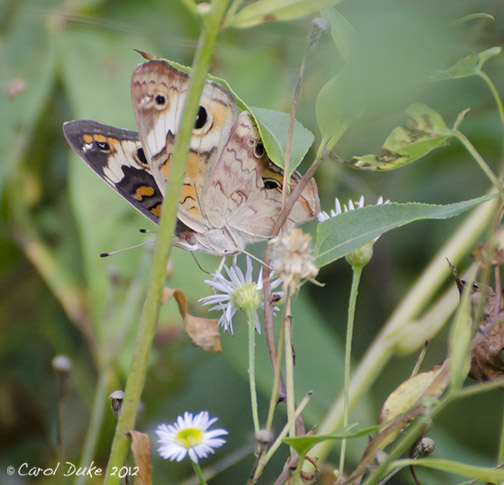

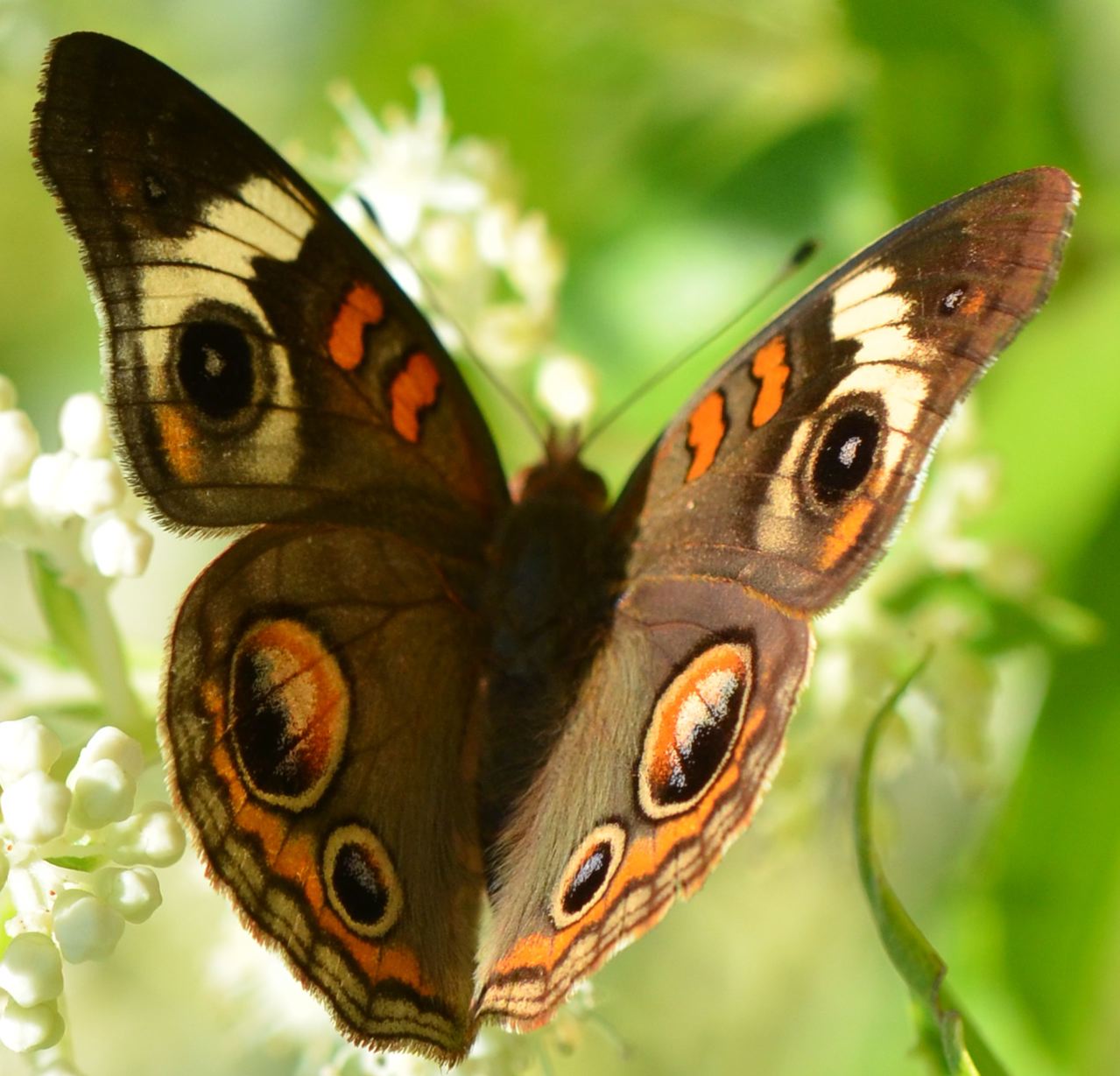
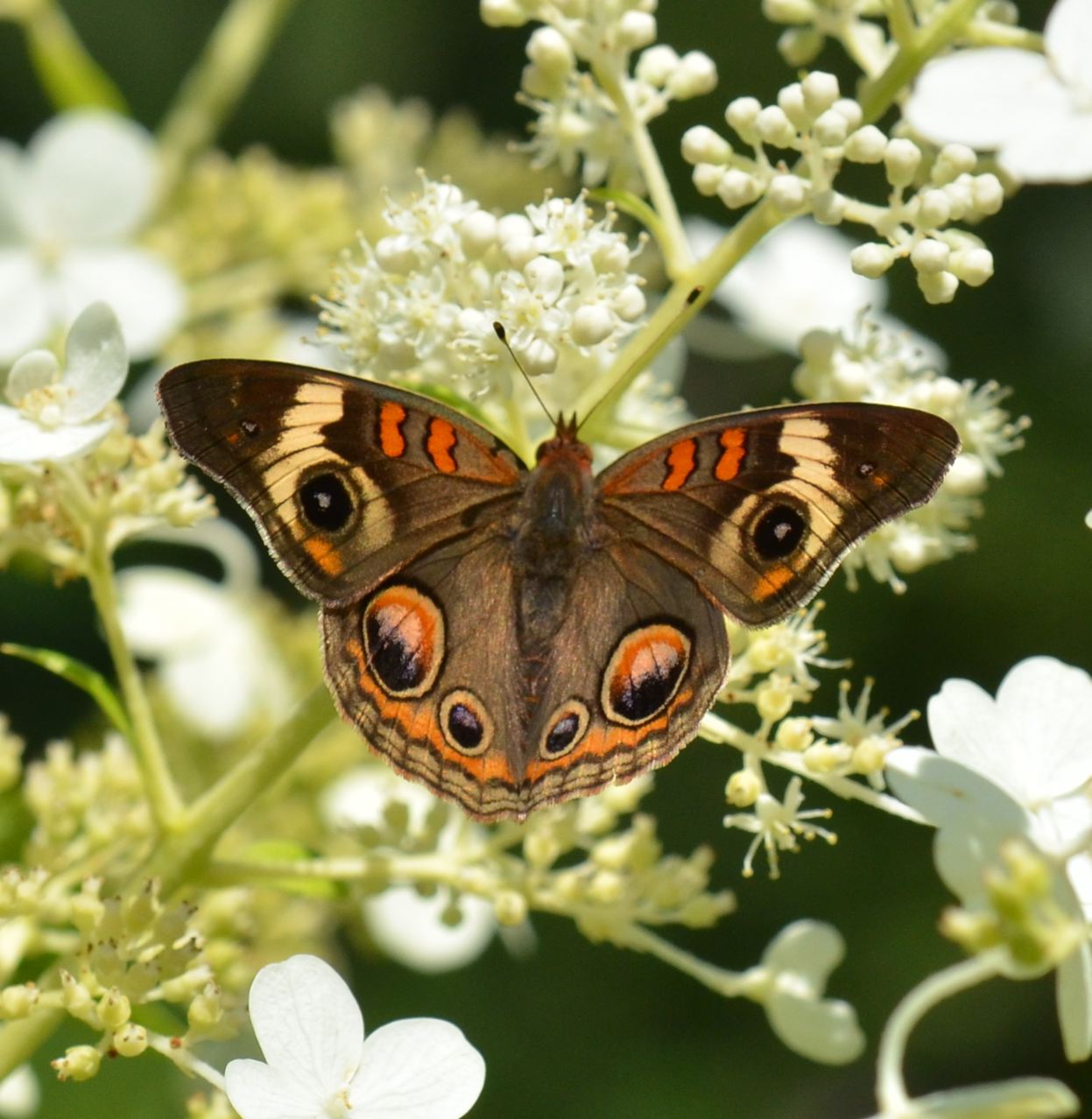
The Common Buckeye Junonia coenia, is not a mimic of any other butterfly but has it defense in its large eyes that might frighten any bird away. These migratory butterflies are not really so common here in New England. Some years they may be rare and others more abundant in numbers. I did not see but the one above in July of 2012 and could not get close to it. Butterfly hunting with a camera is hardly ever easy but the photographs below reveal a Common Buckeye from 2011 that was very close and allowed me to take over a dozen images.


The images above were from some of the photos that were my very first sighting here at Flower Hill Farm in July of 2011.  I was so thrilled the entire time I was clicking away. 

The Common Buckeye can be sighted in flight from July through September and then in large numbers in their fall migration. If you grow snapdragons or any of their family members please allow some of these butterflies larva to feed on the leaves. Caterpillars also eat Blue Toadflax, False Foxglove and other plantain family members. There may be other plants that please the Common Buckeye too so be sure to identify any caterpillars before you remove them. Who needs perfect plants anyway? The butterflies tend to favor the composite family. 


Gardening for butterflies can be so rewarding! 


These are all the butterflies (with open and folded wings) I have reviewed so far from my sightings at Flower Hill Farm in 2012. I have more to share. 

The temperatures in Western Massachusetts dipped down into the teens on Wednesday. I hope the emerging Mourning Cloaks were able to stay warm enough through the bitter cold night. 


Monday, January 30, 2012

Flower Hill Farm BUTTERFLIES OF 2011 ~ Favorite Buckeye


I was lucky to get so close to this fresh and perfect  Common Buckeye as it sipped nectar from, of all plants, a hydrangea.

Buckeye Junonia coenia


It was a joyous June day this past summer when I captured my first ever Buckeye! 
These beauties do not overwinter here but fly south as our beloved Monarchs. I have read that they hold their own in comparison to the Monarchs in extravaganza, as they stream through Cape May in the Autumn. I have yet to see that fabulous display!

Host plants for the caterpillars are numerous. Be sure to let some plantain grow! They love stonecrop too . . .  of the Crassulaceae family. Got figwort or vervain?! Be sure to share your mallow and verbena. Then you might find these stunning eyes looking back at you in your garden. 

I love doing reviews of birds and butterflies in the winter, for it brings spring and summer back into our lives. 
 Each winter day is growing longer by minutes. I enjoy seeing the sun as it inches more towards the north . . .  nearly climbing over Walnut Hill now every morning, where it had been rising over the Mount Holyoke Range  on the winter solstice.   


We are having a mild winter here in New England. Eastern Black Swallowtails might be sleeping in their chrysalises somewhere out in that white landscape. The birds have not been very active in the crabapples yet . . . I do miss all the colorful Robins, Cedar and Bohemian Waxwings and even the Bluebirds are not as numerous as in previous years. There must be plenty of food for them all elsewhere. I do delight in seeing our resident Red-tailed hawk most mornings as he or she basks in the sun.
Up next for the butterfly reviews will be the American Painted Lady.


Monday, September 12, 2011

Summer Seems To Flutter By Not Quite Letting Go


The air is crisper now as the harvest moon lights up the night sky.


The eclectic jungle of mine own plantings and that of natures intermingling is running wild and falling all over itself. 


I have only two Monarch caterpillars not yet morphed into their pupa phase, while I am daily releasing others that have fallen into their new wings. After slurping up their fill of nectar from around the gardens and dodging the dangerous beaks of birds, butterflies are flying south . . .  Mexico bound.


I still recall the excitement of seeing the tiny ones emerge from their finely etched egg casings. 


Onto a hairy landscape of Milkweed. 


Devouring its first meal . . . a protective now nourishing capsule. 


I marvel at how quickly they grow from instar to instar. 


Becoming more voracious eaters as they come closer to their final act. 


Nearly most of the summer has been filled with their wondrous antics and growth spurts. I have admired their courage too. Letting go when it is necessary to grow further is an important lesson these tiger-striped critters teach me over and again. They are gingerly about it sometimes and this one was no exception, holding on with only one proleg for over two hours, before finally allowing itself to fall head first into its new life.


Pulling up their familiar skin and trying to toss it free reveals a new beginning which was always within them. 


Times of stillness recur within any metamorphosis.  


Fresh in every way . . . new beginnings soon to fly . . . lighting up the sky. 


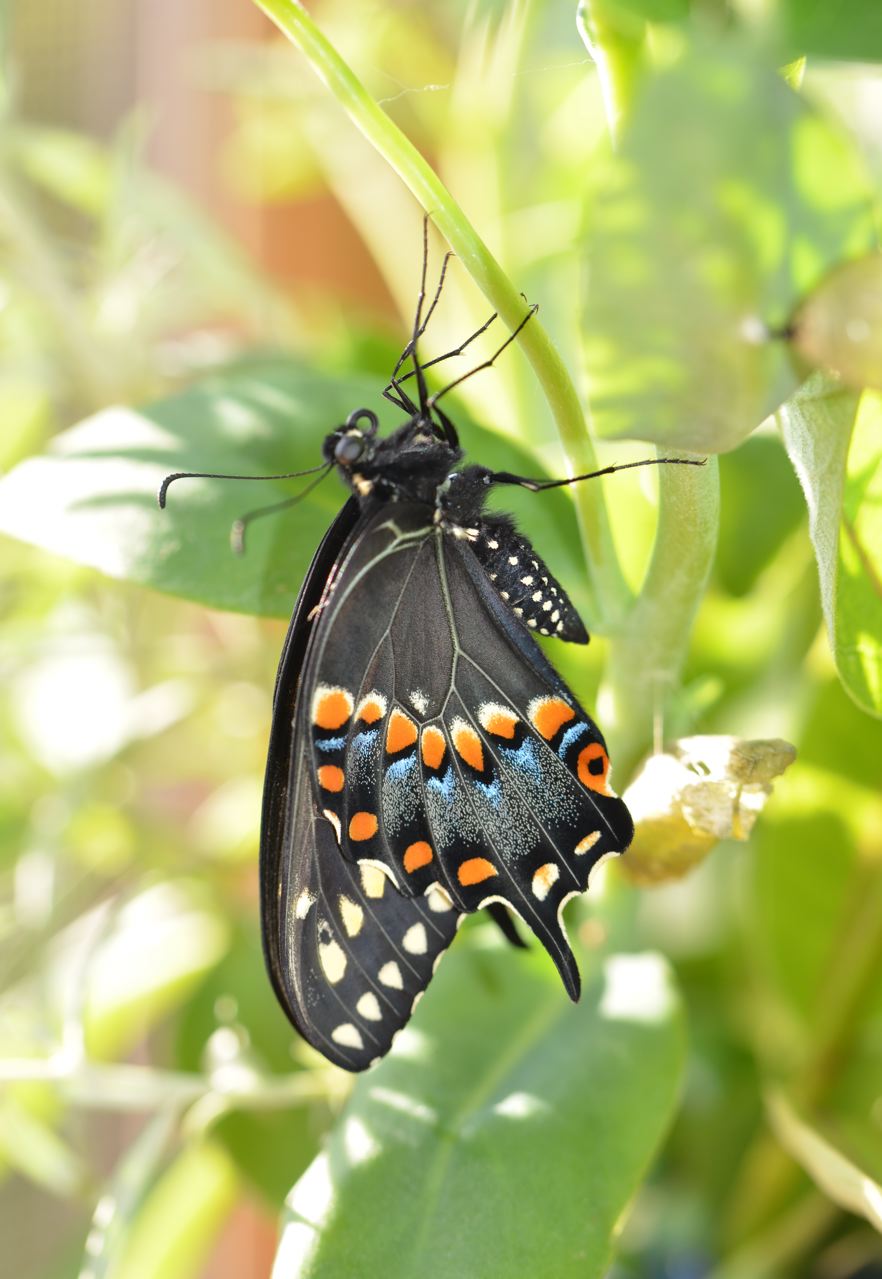
I recall fondly too the first Black Swallowtail butterfly egg I ever eyed. 


I delighted in getting to know the spritely fellow whose changes are more dramatic than my Monarch friends in wardrobe but not in speed of growth. 


I was very surprised to see this happen as I had thought to winter over with the chrysalis. 
I have offered two post on raising the Black Swallowtail. Here is the first . . . the second was just published today over at Native Plants and Wildlife Gardens.


Out in the garden Fritillary butterflies played out their lives unseen by me until their debut in fancy dress. 


Another first for me this summer . . . a Buckeye (Junonia coenia!) What a treat to finally see and capture this beauty in my own garden. They sure do not hold still for long. 


Buckeyes migrate too and my 'Audubon Society Field Guide to North American Butterflies' tells me that  in the fall around Cape May their numbers rival those of the migrating Monarchs. 
So summer here is flying by but these images remind me of some sweet moments with delicate creatures who are not afraid to let go and change. 
We can all be inspired by their tenacity and beauty.

Related Posts with Thumbnails