











Showing posts with label Milkweed. Show all posts
Showing posts with label Milkweed. Show all posts
Thursday, July 9, 2015
Wednesday, February 26, 2014
Monarch Migration Milkweed & Monsanto
It is hard to imagine that the words Monarch, Migration and Milkweed would have anything in common with a multinational chemical and biotech corporation like Monsanto. To see and hear the word Monsanto conjures up images of poisons, lies, manipulation, and now the possible loss of a momentous migration is added to the list of onslaughts to our environment, personal health and sacred connections to nature.

Monarch Butterfies are just one of the insects that fall prey to Monsanto made pesticides and herbicides. Many other important and treasured pollinators are killed as well. Consider a diverse community of wildlife living within a stand of milkweed.

It is sad to visualize a dense wet toxic veil of poison stealing across huge swaths of wildlife habitat growing alongside mono gmo crops and highways. Hundreds of species of milkweed have been killed by the insidious manipulations of Monsanto. For years farmer's allowed native plants to grow along corridors bordering their crop fields, but things have changed. GMO crops need more and more sprayings (where they promised there would be less need) and are threatening one of the wonders of our natural world. Droughts and cold fronts play a role in the demise of the Monarch Butterfly migration too. Monsanto carries most all of the blame for the killing of the essential host plants — milkweed.

Fragile life is wiped out or not ever allowed to begin when their host plant milkweed is absent.

Caterpillars never become instars or butterflies without milkweed.

Milkweed is more than just a host plant for the Monarch Butterfly. The dainty falling florets are important sources of nectar for the monarch and many other creatures. We need to recreate the lost habitat for all the life that depends on milkweed, and for the rights of the plants to live as well.


Hummingbirds are great pollinators too. Milkweed is ever giving.

Perhaps even more importantly, we could act against giants like Monsanto in how we spend our dollars in our daily lives. By asking questions and following our convictions in what we purchase, we can make changes one dollar at a time. One person at a time eventually adds up to millions of dollars not supporting harmful chemical corporations.
I hope we heed this warning of our beloved Monarch Butterflies, and that the decline that has been happening over the last decade will see a turnaround soon. I am fearful, but will persist in hoping that children and adults alike, along the migration route, continue to enjoy observing both the joyous metamorphosis and the incredible migration of the Monarch Butterflies.


Sunday, September 9, 2012
Monarch Butterfly Life Cycle: A Metamorphosis ~ Part One ~ The Capable Caterpillar
The mammoth Monarch Butterfly migration is underway.
Sightings are reported along rivers and hillsides, fields and meadows,
gardens and parks by lucky viewers seeing hundreds of these skilled navigators flying south.
Here at Flower Hill Farm there are numerous fresh Monarchs floating about the gardens each day.
I have counted up to thirty on one Buddleia,
while several are scattered feeding on Ironweed, Phlox and Liatris.
Yesterday I noted the pink florets of Sedum 'Autumn Joy'
dotted with both Monarch and Painted Lady butterflies along with hundreds of honey bees.
Many perfect days have passed where I might be found walking out into the gardens
with newly emerged Monarch butterflies
. . . happily observing as each gingerly takes their impressive first flight.
Each departure unique, joyous and somewhat staggering
as I had known these tiny magnificent creatures since they were
but even more minuscule eggs.
Which came first . . . the butterfly or the egg?
The Monarch Butterfly Metamorphosis begins with an egg and then the capable caterpillar and its miraculous feat of nurturing a chrysalis within.

First there is an egg
but how did it appear?
A female butterfly
fastened it to its host Milkweed leaf . . .
not needing to tend her young she flies away
with many more eggs to oviposit.

A day or two goes by and a teeny black head stirs within
independently chewing its way out into its hairy leafy world.


Reading caterpillar body intelligence . . . this one seems to say "Boy, this feels good."
The egg capsule was a very tight fit.

A newborns first yummy meal . . . munching its own nutritious clear egg casing.

Chomping many milkweed leaves . . . first instar to fourth instar.

Second instar compared in size to Milkweed or Oleander aphids.

Molting along the way and turning to eat their old clear black-striped skin in each new stage.
The ocelli or compound eye can be seen on the fourth instar above.
Too tiny to be seen an antenna is near each eye
. . . not to be confused by the two longer tentacles on the thorax and abdomen.
Its now clear head capsule will have black stripes soon too
forming a protective covering for the yellow head.

Fifth instars pausing between chomps as growth inside
forms transitional templates.
It is nearly time to unveil its hidden self.

First the caterpillar can be seen securing a silk mat and knob
with the help of its singular spinneret . . .
looking closely you can see it.
Expressive tentative tentacles take part in the drama of the act.

Meticulously extending out from the silk knob
the fifth instar pulls silk threads creating an anchor mat,
while true legs hold on to form the silk button its life will later depend on.

Courageous caterpillar free fall . . . holding fast to its handiwork.

Stretching and splitting skin behind the head giving birth to itself.

The caterpillar tracheae is a lovely lavender purple pulling up with the clear black-striped skin.
The chrysalis has its own spiracles or air holes and tracheae allowing it to breathe.
I find this palette inspiring for a painting.

Amazing to see what was already within the caterpillar.


Twitching and twisting, the forming chrysalis works the old skin up
and performs the amazing act of pulling out its shinny black cremaster,
feeling its way over the pile of skin . . . then
the ebony barbed appendage hooks into the carefully formed silk knob.

The old skin falls away looking like a dried up fly.

More twisting
. . . for the certainty of hundreds of hooks
being securely fastened within the silk.

Now . . . the shrinking act begins and all that resembles a caterpillar disappears.

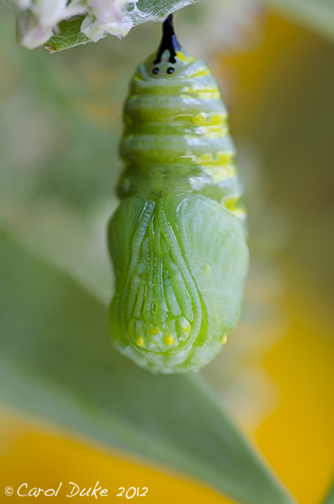
Viridescent fluid butterfly template
wings, antennae, legs and proboscis
all to be seen then disappearing into jade green.
A chrysalis is born.

A pearl necklace appears reminding all of the pure white toxic milky juice of milkweed.

The capable caterpillar is not forgotten but painted here in a design
of white, yellow and black. What are the colors found in the caterpillar?
A token of appreciation for all the many changes it had to go through?

Later the necklace appears golden . . . still the colors of the caterpillar shine.
Within a few hours a clear casing will harden to protect the chrysalis.
As I write this first installment to my
'Monarch Butterfly Life Cycle: A Metamorphosis' today,
two . . . now three Monarch butterflies are emerging
within a bouquet atop a table near the open French doors.
Oh, I just noticed the one that became like a tassel on a silk pillow in a chair next to the table too.
I see a fifth on a walking Iris plant near a cheery bouquet of sunflowers both on the same table.
So, five monarch butterflies emerge while I write about their beginning.
A caterpillar just completed spinning its silk knob and finally let go to dangle in a J
as all the butterflies hang like wet laundry drying their stained glass like wings.
Later, I will walk out into the gardens to release all these magical butterflies
before heading off to the Berkshires and the 'Temple of Music'
to hear chamber music at the South Mountain Concerts.
Life can be enchanting here in Western Massachusetts.
Next installment will be more on the captivating Chrysalis.
Sunday, August 12, 2012
Black Swallowtail Metamorphosis Misty August Garden
Black Swallowtail Papilio polyxenes
I will be sharing more of the magical Monarch Butterfly Metamorphosis . . .
but first I want to go back to earlier this spring and share the striking
Black Swallowtail Butterfly and its metamorphosis with you.
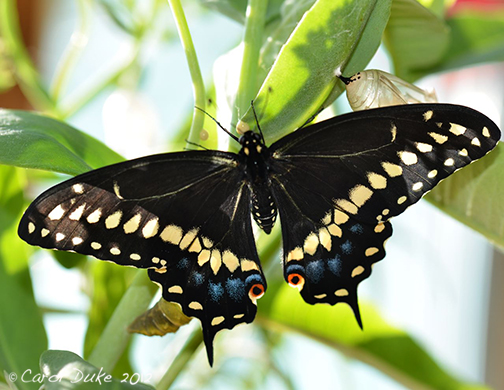
A male Black Swallowtail from last year . . . the first one I had the joy to raise.

I was delighted to eyed this female ovipositing this May.
She may have overwinter here in her pupa.

Once she flies away,
I discover an egg attached to Bishop's weed growing along the path.
Aegopodium podagraria is of the Apiaceae or carrot family.
I wish for millions of Black Swallowtail butterflies, for perhaps they can help me
manage the pernicious Bishop's weed.

The dark head of the tiny caterpillar can be seen in this photograph.
A new beginning about to emerge . . .

Having its first meal.


Second or third instar.


The Black Swallowtail caterpillar chooses the underside of an orchid leaf to unveil her chrysalis.


A perfect female Black Swallowtail

Releasing a healthy female into the late May gardens . . . perhaps she will become acquainted
with the lively male (below) already enjoying the garden milkweed.


Male Black Swallowtail
There are many more Black Swallowtails flying about the gardens
but I have not eyed another egg to bring inside.
This was the first 'inside' complete metamorphosis for the 2012 season . . .
a couple of months before I found my first Monarch egg in the garden path.
I have shared more information on the Black Swallowtail Butterfly's life cycle
in another post over at Native Plants and Wildlife Gardens.

Now nearly half way into August . . .
days go by bringing many scattered thunderstorms
sometimes dropping heavy downpours . . .
the gardens and trees so appreciate the rain.
Mornings are often misty, cool and soft.
Butterflies enjoy the sunny afternoons.
I continue to see many Monarchs, Black Swallowtails
and several other varieties of butterflies flitting about the native plants.
There is a small Monarch caterpillar community in my barn studio.
This morning I was working hard trying to capture a teeny caterpillar
emerging from its egg, while a female Monarch was flying about just
outside the window laying eggs on milkweed plants. Other caterpillars were
molting, while one was about to spin its mat and node so that it can hang
and unveil its chrysalis.
All this and more goes on within the small view of the garden above too . . .
truly miraculous to observe natures never ending small wonders.
Subscribe to:
Posts (Atom)


