Showing posts with label Middle Garden. Show all posts

Friday, October 18, 2013

Light and Leaves At Play In A Bright Autumn Landscape


It has been a gorgeous fall with leaves clinging to the trees far longer than I recall in recent years. The rain has held off, but the trees are slowly releasing their leaf fasteners and hundreds of their leafy members, like golden rain, are falling with the gentlest of breezes throughout the dry days and nights. The sounds of falling leaves . . . flights of leaves . . . piles of leaves . . . walking and kicking up leaves are all quintessentially 'Fall'. I am not one to run out and rake any away, however. 

The wind will have its way and scatter leaves throughout the gardens . . . some warm-yellow Black Cherry leaves will fly high in groups like small flocks of birds. Others will gently float downwards as they twirl similar to a kite descending free of its string and holder. Each tumble is uniquely choreographed by wind. The weight and form of the individually designed leaves, like those of dancers, will also determine their grace and movement in falling. Many will remain where they fall and may be used by some overwintering caterpillars for a cozy, safe place away from the cold and hungry eyes of birds or other predators. 
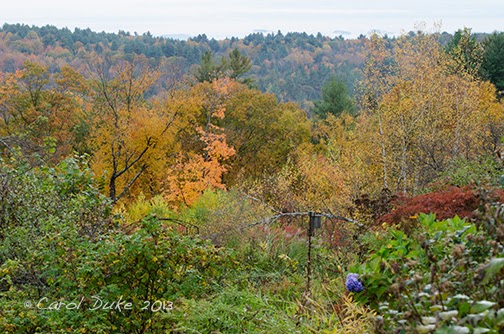

Light plays within the wide swath of forest and hillside casting its glow amongst the brightly colored canopies of Black, Gray and White Birch, Beech, Rock Maple, Oak, Black Cherry and more stately trees whose bare, crusty trunks and branches are revealed more each day as they shake their mantles free.


Sunsets bring about a particularly magical light show with an interplay of lights and shadows. Looking south easterly, towards Mount Tom, as the sun is setting in the west, slivers of light run along the ridges of hillsides . . . fleeing pursuing shadows.

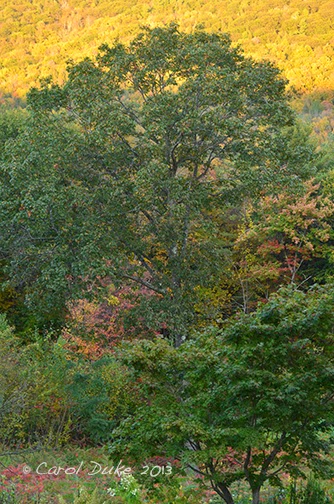

Ending days pour a honey golden light along Carey and Walnut Hill changing the landscape while creating a spectacle of wonder. Mighty Oaks are only just beginning to wear a sienna or amber hue.


Changes are more noticeable day by day though they are happening minute by minute . . . hour by hour.


Each day the colors move into their full brilliant tints.


An overcast sunset casts a particular chroma within the colorful grouping of birches and the carpet of sumac sprinkled beneath and around them.


A soft fuzzy light remains as the sun sails away. 


Then on the days when there are a few wispy clouds, the lavender shades paint a lovely veil across the sky as the sun disappears. Above is our surroundings just two nights before full moon with a wide angle view.


One night before full moon after a dreamy temperate day.


October's near full 'Hunter's Moon' rising over Walnut Hill just as the sun is sinking in the western sky. If you are observing the moonrise tonight you may notice something a bit strange as there will be a minor eclipse called a penumbral eclipse. It seems the change will be very subtle. 

The changes going on all around the countryside are hardly subtle, however, as life is greatly adjusting to the coming of winter. Crops of apples, winter squash and root veggies such as beets and carrots are being harvested and put away for winter storage. Critters are scurrying around too . . .  storing acorns and other nuts for the long winter months ahead. It is an exciting time of year that many may find depressing. The cold and fading light can bring one down but there is the magic of a fire and more time to read, write and paint await. Autumn is a season of letting go and going under and deeper within. 

As I write about all this beauty and being able to embrace the seasons . . . others are trying to find means to keep warm and survive the coming winter . . . such as refugees in Syria or thousands here at home in horrid circumstances. There is such an injustice . . . inequality in our world and my heart breaks for all those who cannot simply live in peace and who do not have the simple basic needs to be happy and healthy. I never stop being thankful for the beauty that surrounds me . . . nor the freedom I have to enjoy and reap the inspiration it nurtures.

I would like to share a couple of links that I find hopeful. Food Sovereignty Prize and Center For Humans & Nature - Expanding Our Natural & Civic Imagination

There is change happening moment by moment in our fight to make a better world too. The odds are just so stacked against us, but there is hope in expanding minds the world over.


Friday, August 23, 2013

A Sultry Summer August Day Full Moon and Clouded Sulphurs Play


August is a wild time of year in the gardens here at Flower Hill Farm. The daily lives of wild things blend and move about with ease. There is an understanding between the land and animals . . . we all take what we need . . . but never too much. I do wish to call a court in session to introduce charges against our resident rabbit's rabid rapacity, however.


We rarely see young bucks, such as this one, sporting unique antlers. He will shed the lopsided headpiece this winter or early spring of next year and begin to grow new ones. Careful attention must be paid to this teenager to be certain his curiosity does not get the better of my Liatris for a second time.

The deer have much to munch upon within the acres here, and many more surrounding, so they are kind to me and my gardens. I continue to cut oak, maple and birch saplings allowing new tender growth that deer find nutritious and delicious.


This is the main color show of the gardens now . . . last year Ironweed, Joe Pye weed and Rudbeckia were magnets to butterflies . . . this year there are mostly native bees . . . but few fluttering wings go by.


I did finally see one restless Monarch butterfly last week, but she did not approve of our older milkweed and moved on right away, in search of tender leaves to fasten her eggs upon. I miss the enchanting process of metamorphosis but do have one little Black Swallowtail ward who has now become a chrysalis. 


There were many Monarchs last year enjoying the nectar of Ironweed. The image above was taken a bit later in August than the one above it . . . so perhaps more butterflies will find their way here again.


Nearing the last week of August . . . but there is still time for frolicking. Clouded Sulphurs exhibit their tiny orange and black full moons, while sipping runaway marjoram and courting or cavorting in the field below the middle garden.


Wild Morning Glory is taking over the Bluebird nestbox . . . I am allowing it, as the larger Bluebird family has taken off, beyond the cotton clouds, for now. Nearby, Rudbeckia 'Herbstsonne' reaches for the light to a height of over seven feet. This great plant will never catch up to the stately tips of the Hydrangea paniculata it stands before.


Hydrangeas, though tired and somewhat spent, still offer sustenance to many pollinators. There has been not a plant/weed lifted from this area for all the days of summer. I am surprised by the diversity of small and simple flowers that seem to delight both butterfly and bee.


Our much beloved (NOT) rabbits devoured the planter plantings but now volunteers of pineapple basil, verbascum and salvia are content being squatters. The gardens are on their own this year . . . once the rabbits ate my first food plantings, sigh, I gave up and decided to just be on the land and see what happens when all is left to grow on its own. I do confess to cutting many winding, meandering tendrils of bittersweet, grape and bindweed.


 Apples are ripening and some falling . . . creating an edible carpet for wildlife. There are so many more than enough for us all. Last days for the daylilies too . . . as each day unfolds and closes another fresh and droopy bloom.


'Journey's End' final blooms . . . true Lilium reflecting summer's closure coming soon. Not far off
summer's end and beginning autumn, as syrupy sweet petals fade and fall.


The south field is overgrown with sumac, which will paint the landscape red in weeks to come and then all will be mowed revealing the form of land again by November. Here, the Tree Swallow nestbox is overrun by bittersweet. I recall less height to the field and wildflowers but weeks ago when a Tree Swallow pair tenderly care for their nestlings.

Migrations are in motion . . . today there were at least a hundred Tree Swallows swooping and scaling the sky just above these fields and spreading over towards the middle garden. I like to think that among the many are the two families of swallows from our north and south field nestboxes and they are all on their way to Cape Cod where I may chance to see them once again later in September.


Lavender giants boldly tearing through the sky in dusky twilight . . . our Rock Maples on the south side of the 1790 farmhouse are ever dramatic and inspirational . . . to the painter in me especially.


Upon the edge of the north field looking south . . . a simple place to be . . . to watch waves in canopies of trees and the great blue yonder . . . while chasing ephemeral light stretching over Mount Tom in the Pioneer Valley beyond.


August is nearly full as is its swollen, golden, 'Sturgeon' or 'Blueberry' moon . . . yet, many surprises are to be found in moments lived within the realm of our wondrous Mother Nature. Summer seems longer in moments.  Shall we seize the moment then . . . for as long as each new day gives forth fresh butterflies and our young resident hummingbirds are still dipping and humming into my dreams . . .  I cannot say summer is gone.


Saturday, June 29, 2013

Swaths Of Purple Siberian Iris Within The Middle Meadow Garden Butterflies and Birds


Looking back over the month of June, iris sepals unfurl and fall creating waves of hues from lavender to deep purple . . . filling the Middle Meadow garden with hundreds of blooms lasting nearly three full weeks as new buds continue to open.


Eastern Tiger Swallowtails Papilio glaucus or Canadian Tiger Swallowtail Papilio canadensis add to the spectacle in complementary colors. On most days I count over twenty of these bright colored butterflies floating about the gardens and when they dip deep into the iris their wings become like sepals and petals.  


A wide angle lens makes everything seem smaller and farther away. 


Up close again a female Ruby-throated Hummingbird enjoys reaching in between the folds too.


Bluebird nestlings cry out above the iris from within their nest box. 


The parents are waiting for me to move on before taking their harvests to their young.


Silver-spotted Skipper feeding on Garden Heliotrope while a Spicebush Swallowtail dives into an iris.


I am guessing Eastern Tiger Swallowtail but whatever the name these creatures fill the gardens and fields in numbers during the month of June delighting in wildflowers, as well as, an array of blossoms from native and non native cultivated perennials and shrubberies. Swallowtails and other butterflies are eye candy for birds and it pains me to see their tattered wings as the days unfold. Such is life for those critters lower on the food chain.


Imagine these images with bright butterflies flitting about as birds splash and fly to and fro.


There seems to be a constant flurry of activity about the iris during the first three weeks in June.


A Spicebush Swallowtail Papilio troilus visits our gardens and this is my first sighting of this species here at Flower Hill Farm. I am not aware of the host plant Spicebush Lindera benzoin, growing on our land but perhaps a neighbor is cultivating it. I will be sure to add this native plant to our gardens soon.


Chartreuse leaves of native Thermopsis villosa offer a lovely contrast to the purple iris. 


A row of peonies falls down towards the display of iris. 
The weather was such that spring flowers all seem to come into bloom at once.


Purple from the folds of iris create a lovely backdrop for this Red-spotted Admiral as it sips the dreaded goutweed. 


Standing within the iris looking over towards a weeping cut-leaf Japanese Maple and beyond to the north garden where Rosa rugosa makes a show. More of the North Garden in mauves and pinks coming soon. "So long June!"

Wednesday, May 29, 2013

'Three Graces' Crabapples in Middle Garden


We are now in the last week of May, as I step back into the second week of May redressing our 'Three Graces' Crabapples and early Viburnum carlesii with fresh blooms. 


The limbs of the 'Three Graces' (to the left) hold three different varieties of blossoms.


Stepping away from the 'Three Graces' the distant cloud of sweet-scented crabapple blooms from the Crabapple Orchard offer quite a show.


The 'Three Graces' Crabapples looking towards the east. 


Looking out from the barn studio facing south as the sun sets in the west leaving only a sliver of light on the southeastern hills and the Mount Holyoke Range. The Bluebirds are busy bringing insects to their hatchlings in the nestbox. The 'Three Graces' are to the left, while the 'Gateway' Apples reach into view on the right.


Light transforms the landscape.


All is awash in fresh morning light from the barn studio looking over the 'Three Graces' canopy towards our beloved Black Cherry ('Michael's Tree') and a stately Oak before Walnut Hill.


Standing out in the north field looking up at the middle garden. 


The 'Three Graces' Crabapples as seen from the north.


 I often wonder how the wildlife here see this amazing time, when the gardens are nearly ablaze in color and fragrance. I know they love the many insects that are attracted to the riot of flowers, but how do they see or sense it all as they fly over the trees and shrubs and through the many blooming branches, building their nests and gleaning insects.
Now, the thousands of blooms are faded and small apples are forming that will feed many birds later in the year. Lilac time is up next.


Related Posts with Thumbnails