Here at Flower Hill Farm outside of boxes and woven pouches there are many birds building their own unique nests and rearing their young. In this post I present some other parenting birds from all about the gardens.
This Gray Catbird was nearby at the exact time I was photographing the little Baltimore Oriole fledgling (from my last post) up in this same Viburnum shrub. Another Catbird was further away and making a fuss, while this bird was not able to cry out at me since its mouth was filled with currants! I quickly looked about, to discover why they were alarmed at my presence, when I noticed a nest hidden within a Hydrangea bush right in front of me.
This might be a second brood, for look how small the Catbird nestlings are compared to the Baltimore Oriole fledgling. I did not linger long, though I did try to imagine which of the babies would get the currants. They are so peaceful in this photograph, but in a moment all will be animated with mouths thrown wide open. There will also be tiny cries coming from the lush green Hydrangea bush.
Grey Catbirds particularly love berries and butterflies! The gardens offer plenty of currants and blueberries for birds to harvest and fill their bellies, as well as, provide for their young. Many Swallowtails fall prey as well, when lost in luscious nectar sipping frenzies from the many flowering shrubs and plants about the gardens. These berries, a diversity of insects along with the protective shrubberies are a real attraction for many birds who nest here.
Our American Robin favors the Crabapple Orchard for its juicy red apples . . . which might enrich its rufous hue . . .
A color so beautiful and one that I find hard to achieve with oils. Robins do stay around all winter and perhaps decide then . . . on where they will build their nests.
In winter the fruits provide important nourishment.
Spring brings blooms and greens to provide cover for their sweet nestlings. The babies grow along with the ripening Crabapples.
Robins live in flocks during the winter . . . going their couplet ways come spring. I often have at least two families brooding not far from one another within the gardens, however. Robins are often seen stealthy stalking along the ground in search of insects and worms. This parent is a bit concerned, as I am near its nest in the old Apple tree.
This nest is quite different from the Robin's nest in the Crabapple Orchard, which is supported by many branches. This one seems to be mostly siting on its own atop the old Apple limb. At first glance it seems deserted too!
Then surprise those Robin eyes arise! Note the almost full white circle around the orb. I cannot imagine there could be more than one within the nest, which appears so small in comparison to the size of the near fledgling.
Later on and back in the Crabapple Orchard there is a tragedy playing out. The photos do not convey the size as well as they might. The fledgling appears to be much larger than the 'adopted' parent. I am not one hundred percent positive, but I believe this to be a Cowbird fledgling being feed by a Phoebe.

Brown-headed Cowbirds do not make their own nests or raise their young . . . in this case the female lays an egg in the Phoebe's nest. The Cowbird nestling hatches quicker and becomes much larger and stronger than the other Phoebe nestlings. In time the Cowbird will smother the Phoebes true offspring or nudge them out of the nest. Some birds will reject the eggs. They will puncture the Cowbird egg then toss it from their nests. Phoebes and many Warblers do most often accept the eggs to the detriment of their own young. It is so amazing to me that many birds do not realize the difference between their own eggs and that of a Cowbird. One of natures mysteries. Cowbird females are known to use over two hundred species of birds to raise their young.

Once a nomadic bird, the Brown-headed Cowbird traveled along with herds of bison out on the Great Plains. They are now found all over most of North America. Their parasitic habits can create havoc and demise for populations of birds struggling to survive. Some believe they have contributed to the near extinction of some songbirds. From my research . . . I am sure the parents of this Cowbird are nearby, though I have not seen them. They will eventually claim their offspring by calling to it . . . then the Phoebe will have some rest! I keep wondering . . . if it ever occurs to the Phoebe . . . that this bird it so devotedly cares for . . . cannot be its own. Cowbirds have benefited and multiplied due to the great efforts of other birds, their unconditional love (if this can be attributed to birds. . . from my experience it would seem so) and I suppose to the fact that most simply never stop to think. Is everything in our wild world only innate . . . instinctual and predetermined? Why would instinct not help birds in knowing their own eggs from another? Maybe they do recognize the difference but are not able to do anything about it. Then, of course, there is the need of the Cowbird, who never learned the art of nest building or how to care for their own.

Cedar Waxwings do not think of departing come fall. They also remain through the winter months and feast on the Crabapples. They congregate in flocks and when I hear a high pitched whistle, I look for their flight towards the small orchard.
In the summer months they feast on blueberries and feed them to their young.
I espied this parent and fledgling in an old White Pine north of the barn. They are too far away for my camera, but I was thrilled to see a Cedar Waxwing fledgling with its parent.
There was a sweet tenderness about their exchange. The parent is protective and seems somewhat aware of my spying upon them.
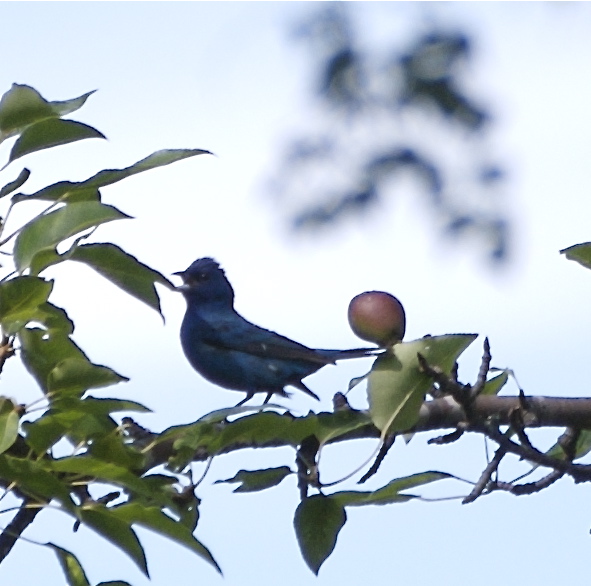
There is another drama going on in the south field with the Indigo Bunting family. The papa is calling out in what appears to be a stressful and concerning way.
Though clearly disconcerted, he does take a second to smell the sickle pear.
Looking about . . . I find he is not alone.
Closer to the ground his beloved female Indigo Bunting is quite perplexed and distraught as well.
She is frantically calling out towards the edge of the field, where I hear a good deal of scurrying and sounds of snapping twigs. I cannot see what is going on, for the thick green cover of wildflowers masks the scene. It would seem they have lost their fledgling and perhaps there is some creature in pursuit of the little one.
I was happy later on to see that at least one of the Indigo Bunting fledglings has survived.
Our gardens can be likened to a theatre with many seasonal dramatizations going on simultaneously. We create the sets then the players come!
For now the stage is deserted . . . the gardens white and chilling to the bone. It appears much deserted and barren . . . but life is only hidden. True most birds have deserted us for more fruitful grounds, but who can blame them! I wish I could follow their lead. Instead I await their return with springs refreshing shroud of greens.
I shall continue on with my bird reviews snatching images from my archives to create an avian parade . . . displaying the many colorful species of birds that share my rambling and wild paradise.
Today is Blooming Friday. Visit Katarina in Sweden to see more gardeners pondering the word deserted.