Sunday, August 12, 2012

Black Swallowtail Metamorphosis Misty August Garden


Black Swallowtail Papilio polyxenes 

I will be sharing more of the magical Monarch Butterfly Metamorphosis . . .
 but first I want to go back to earlier this spring and share the striking 
Black Swallowtail Butterfly and its metamorphosis with you. 
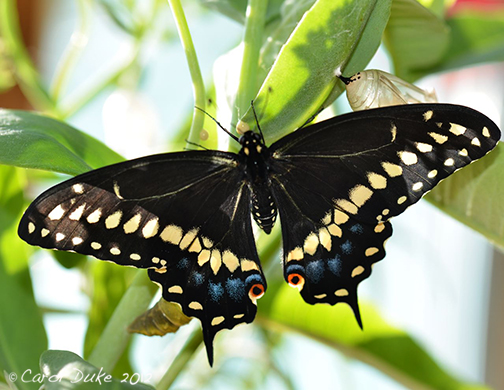

 A male Black Swallowtail from last year . . . the first one I had the joy to raise.


I was delighted to eyed this female ovipositing this May. 
She may have overwinter here in her pupa. 


Once she flies away,
 I discover an egg attached to Bishop's weed growing along the path. 
Aegopodium podagraria is of the Apiaceae or carrot family. 
I wish for millions of Black Swallowtail butterflies, for perhaps they can help me 
manage the pernicious Bishop's weed.  


The dark head of the tiny caterpillar can be seen in this photograph. 
A new beginning about to emerge . . . 


Having its first meal. 


Second or third instar. 


The Black Swallowtail caterpillar chooses the underside of an orchid leaf to unveil her chrysalis.


A perfect female Black Swallowtail


Releasing a healthy female into the late May gardens . . . perhaps she will become acquainted 
with the lively male (below) already enjoying the garden milkweed. 


Male Black Swallowtail

There are many more Black Swallowtails flying about the gardens 
but I have not eyed another egg to bring inside. 
This was the first 'inside' complete metamorphosis for the 2012 season . . . 
a couple of months before I found my first Monarch egg in the garden path. 

I have shared more information on the Black Swallowtail Butterfly's life cycle
 in another post over at Native Plants and Wildlife Gardens. 


Now nearly half way into August . . . 
days go by bringing many scattered thunderstorms 
sometimes dropping heavy downpours . . . 
the gardens and trees so appreciate the rain.
Mornings are often misty, cool and soft.
Butterflies enjoy the sunny afternoons. 
I continue to see many Monarchs, Black Swallowtails 
and several other varieties of butterflies flitting about the native plants.
There is a small Monarch caterpillar community in my barn studio.
This morning I was working hard trying to capture a teeny caterpillar 
emerging from its egg, while a female Monarch was flying about just
outside the window laying eggs on milkweed plants. Other caterpillars were
molting, while one was about to spin its mat and node so that it can hang
and unveil its chrysalis. 
All this and more goes on within the small view of the garden above too . . . 
truly miraculous to observe natures never ending small wonders.

Wednesday, August 1, 2012

July's Ending Rainbow Rosy Light Magical Monarch Metamorphosis


So Long July. 
Thanks for the rain and rainbows at sunset . . . many hours of luminous light . . . Hemeracallis, hydrangea and hummingbirds aplenty . . . copious caterpillars becoming complete within their magical Monarch chrysalises . . . joyful viewings shared of their virgin flights into butterflies . . . first ever sighting of a Giant in the garden . . .  exceptional dusk encountering . . .  a family of flying squirrels soaring from house to Rock Maple trees . . . eighteen furry elusive mammals exiting the eaves one-by-one and two-by-two . . . using the furnace chimney as their runway . . . scurrying up then fast as a flash gliding over to the large tree . . . disappearing up into its full canopy . . . for our garden bats . . . fabulous human family news . . . high art experienced with a dear generous soul and heaps more.


Millions of dripping prisms painting spectrums arching across the sky . . . somewhere perhaps a pilot  flies through a complete circular rainbow.


July ends with Lilium 'Journey's End'


Daylight softly fading away makes for soft focus images.


Miraculous Monarch Butterfly Metamorphosis . . . a sneak peek. More to emerge . . . 


Flower Hill Farm raised and released . . . 


I am certain to have raised over a thousand Monarch Butterflies during the last twenty five or more years but each time the metamorphosis astounds and amazes me. I especially feel joy at seeing them lifting off and taking their first flight. 
It is an honor and privilege to witness the miracle of this courageous creatures fleeting life.
It is also an honor to share it with you. 
Thank you.
Hello August.

Sunday, July 22, 2012

Mid July Garden Walkabout Warm To Cool Temperature in Color


Here in Western Massachusetts the horrid heat wave has finally fizzled out. 
Kinder weather patterns bring lighter, more clement days and crisp nights, but we truly need rain. 


I do so prefer intensity in colors rather than extreme temperatures on a thermometer. 
Here there are vivid, hot colors, from varying flower forms of sizzling Hemerocallis, 
found floriferous and in fine fettle within the July 'middle meadow garden.' 


A quick look back and in the opposite direction both in time and landscape . . . just for fun . . . to the cool colors of late May and early June in the 'middle meadow garden'.


Once again in Mid July surrounded by hot oranges and reds.


The tall sleek stems of this warm daylily stretch upwards towards six feet in height.
A bluebird house stands empty and quiet in the background and sadly, the gardener must report . . .
 she missed the virgin flight of the fledglings yet again.


Certainly a chorus of joy to our earth . . . if only we could hear the songs.


A parade of beauty lasting only one day.
Each sunrise swells open fresh . . . pure in intense colors . . . corollas designed and destined to collapse by sunset.


Stepping down towards our oldest apple tree and the lower garden . . . serene greens, softer yellows and washed-out-whites await. 


Looking up through the apple tree archway from the blueberry field. 


I am carrying water over to the 'lower garden' for this stressed Hydrangea and find it amazing how quickly the leaves perk up from the drink.


Walking into the north garden the scent of basil drifts amongst pure white panicles of Hydrangea paniculata, 'The Swan'.


Cimicifuga racemosa stands along side delicate clusters of another nameless Hydrangea. When standing next to 'no name', it sounds as if an entire beehive is visiting. Speaking of sound . . . I love the hisses which are formed when pronouncing Cimicifuga. Sometimes I just wish genera could stay the same . . . now black bugbane, black cohosh or black snakeroot . . . take your pick for a common name . . .  is scientifically labeled Actaea racemosa.


The ever faithful smooth Hydrangea arborescens 'Annabelle' or 'Grandiflora' sumptuously falling over . . . 


mingling among berried boughs of Viburnum.
Numerous birds are mingling within the red berries too.
Now that the blueberries are nearly finished . . . these Viburnum berries are a real hot item in the garden.

My heart goes out to all those who are suffering terribly from severe drought . . . it is bad here but nothing like other parts of our country and the world at large.
May rain soon fall . . .  for us all . . . steady and softly . . .  for several days with sunny day breaks . . .  throughout the season.


Lastly, I leave you with some fresh and faded oranges that float about the gardens these days.
Monarchs offer another warm color to the landscape and teeny intricately crafted eggs to our milkweed plants.
The second butterfly image is proof that the toxic cardenolides within milkweed do not always protect Monarchs from preying birds.
I have nearly thirty jewel-like chrysalises hanging about my studio and look forward to sharing this years magical metamorphosis with you.

The earth sighs as Greenland falls into the ocean . . . our world's soul dreams for our awakening and action for change . . . in our daily lives and beyond.
Do our legislators know our names . . . our ideas and demands?
Why not let them hear our voices on a weekly basis.
Let's unite our voices as a chorus for our earth.

Related Posts with Thumbnails