Showing posts with label Baltimore Oriole. Show all posts

Sunday, May 26, 2013

Blooming Apple and Crabapple Orchard in North Gardens


Days of rain and cooler temperatures are allowing me to catch up with the virtual gardens. In real time we are beginning the last week of May . . . the month seems to have bolted by with little rain and cool temperatures that held a multitude of blossoms longer.


Stepping back into earlier spring again and walking away from the south gardens and the Apple Gateway out towards the north field, beneath the serpentine Black Cherry 'Michael's Tree' (holding the meticulously woven Baltimore Oriole nest) and White Birch, we approach the north garden's edge and our sixth older Apple wearing a white canopy of soft blooms.


The Apple stands, holding up blossoming arm-like limbs, beside quince along the fringe of the Crabapple Orchard. Seeing the giant Rock Maples from the north gives a different perspective of these majestic trees. Deciduous Dawn Redwood's graceful branches reach into the photograph (on left) from the north field trying to touch the Apple that seems to be stretching towards it too. In truth the Metasequoia is much farther away and the Apple needs more serious pruning. I am standing in the north field looking over to the gardens and house.


Now, looking further to the right, I stand near a younger Rock Maple and have my camera pointed more into the orchard that fills the space on the north side of the barn.


One path leads up into the garden offering a view of the fleecy textures of quince, apple, pine and crabapple just beginning to unfurl their sepals and petals. The rosy petals in the taller crabapple will turn pure white as seen below. The sweetness of the fragrance is heavenly.


Layers of quince, apple and crabapple flowers fully unfurl. All are members of the Rose (Rosaceae) family that dates back millions of years. Apples and Crabapples are of the genus Malus.


Various crabapple varieties blooming at different times. I wish I had better records and could name the varieties I planted nearly twenty years ago.
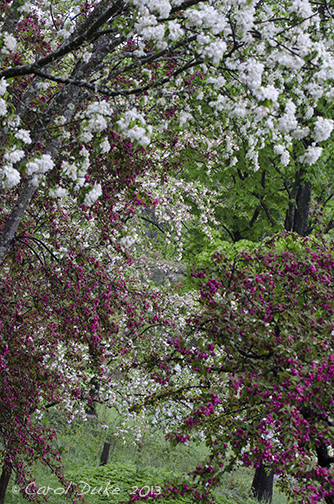

Looking through the Crabapple Orchard from the barn studio, the colors fill the windows and doors.


A Tufted Titmouse bathed in light and blooms sings for his mate. Who could resist?


Walking up towards the old farmhouse and looking back,viburnums and lilacs add another texture to the landscape.


Now, moving away from the Crabapple Orchard into other parts of the north garden and looking back.


The edge of the Crabapple Orchard and the north garden ablaze of blooms, seen while walking up yet another path from the north field . . . this one leading into the middle gardens, which I will share later this week.


Crabapple flowers are favored by foraging birds . . . especially the female Baltimore Oriole, who is taking a break from weaving her beautiful nest.


Woe be it for any little caterpillar, but the apples appreciate this steward. Crabapples are valued for their beauty and also they are an important food source during the spring and winter months for birds and butterflies. The small fruit is particularly preferred by Cedar and Bohemian Waxwings, Robins, Pine Grosbeaks, Wild Turkeys and some small mammals.


Just behind the farmhouse and the little studio looking down towards the Crabapple Orchard. The Weeping Crabapple (in the foreground) behind the studio is all budded out and will soon turn pure white. In real time they are fading and falling with the rain.


Looking out the barn studio door towards the north field and White Birch. The bright light on the white bark reflects the whiteness of some of the crabapple blooms. The late blooming lilac just before the quince is now fully blossomed with droopy blooms from the weight of rain and more rain.


The dozen crabapples that make up our Crabapple Orchard create a wildlife habitat in and of itself. Countless birds are often seen within the blooming branches gleaning for insects. Robins, warblers and even hummingbirds build their nests in the crabapple canopies and during the winter, Cedar Waxwings have a special technique of tossing and catching the tiny round fruit, which helps sustain them throughout the winter months. The branches also hold the weight of Wild Turkeys, especially when the ground is covered with snow, and help them survive the long winters here. All of this action, as well as, the fragrance and beauty of the crabapples offer us mere humans great joy.


Wednesday, May 22, 2013

Blooming Apples In The South Lower Gardens


Spring 2013 is a winner for Apples . . . unlike last year . . .  and this year, luckily, we did not get a killing frost to the fragile flowers. Hopefully last nights hail did not damage the forming fruit. These blooms have all but faded now but were like fragrant clouds within the gardens for a couple of weeks. Featured here are the Apple trees in our lower, east-facing, south garden that runs down into the blueberry fields. I was lucky to have inherited these trees when moving here and have cared for them for over thirty years now.


Our Apple Gateway is mightily floriferous and we look forward to the bounty of fruit.


A Yellow-rumped Warbler enjoys a dead branch for a perch.


Baltimore Orioles open the apple blossoms to find treats within.


Yellow-bellied Sapsuckers drill for sweet sap that flows within the old Apple trunks.


Looking up from the blueberry field there is a multitude of new spring hue and texture in leaves and blooms.


Standing beneath the Apple Gateway looking up towards the 1790 farmhouse, Magnolia soulangeana, and majestic two-hundred-year-old Rock Maples. 


Male Baltimore Oriole (above) and female (below) favor the Apple blossoms for gleaning tasty insects.


A 'bonsai' Apple appears to be growing from of an outcropping of granite.


Our most majestic Apple offers an interesting form and delicious fruit.
 The 'bonsai' apple is over to the left . . . a Shagbark Hickory in the background of the upper garden.


I have not taken the fruit to an expert to identify, but they are heirloom varieties 
akin to McIntosh, Cortland and Roxbury Russet with one of the Gateway apples reminding me of a Golden Delicious.


Light, wind and mist embrace trees wearing white blossoms or leafy greens and there is such a diversity of life flitting in and out of the bountifulness of branches.  Crusty, languid limbs of Apple stately stand about our surroundings throughout the seasons . . .  like charcoal drawn sentinel beings slicing the air while their supportive fleshy roots reach deeply down into the dark, moist, restorative, loamy womb of our earth. They are our connection to that which dwells within a soulful, regenerative realm beneath the lively, light-filled, surface layer we stride upon. 'Trees of knowledge' nourishing body and spirit and like a good friend, offering a solid something to lean into. I love these dear old friends . . . that never stop giving . . . inspiring in their beauty and deliciously beneficial in their sustenance for all life.


Sunday, June 17, 2012

Orange Unfurling Oriental Poppies and Baltimore Oriole


An ongoing cycle of life . . . contracting and expanding . . . continues to unfold in the gardens, fields and forest here at Flower Hill Farm. 
Flower buds swell . . . casting off their protective outer calyxes, just as nestlings grow . . . filling fledgling forms and seeing an exciting and dangerous world beyond the carefully woven nests of their parents.


Precious and fleeting life . . . not so unlike these tiny droplets . . . clinging to what they are attached to.


Outer casings give . . .  along finely, engraved cracks . . . yielding to a swollen force of will. A poppy plants burgeoning blossom no longer can exist within the confines of contraction . . . expanding from within . . . out towards light and fulfillment of life.


Paper-like petals neatly folded opening to first shafts of sunlight. 
Warm sunrays will iron wrinkled flower leaves smooth. 


Luscious reddish-yellows glow . . .  a corolla afire opens to reveal contractions deeper within. 
Spider-like landing pads lure needed pollinators. 


Spreading wings . . .  free to fly into compliments of green. 

The only other orange in the gardens right now are the beloved Baltimore Orioles. A protective father perches just over his nestlings.


Partnership in parenting is helpful to the female and nestlings alike. The male stands guard while the female forages for food. 


One little caterpillar, who will never expand into mosaic wings, is about to become part Baltimore Oriole. 


I believe the former nestlings have become fledglings . . . here the mother is searching for her young. 


Papa looks on as his progeny expand into their own. 

Now the remarkably woven nest is empty . . . the male Baltimore Oriole has more time for preening.  
I can see the nest, from where I sit writing, and do miss the comings and goings of the parents, as well as the chirping sounds of the young. I still see the father . . . somehow, he seems lost as he flies about the branches and calls out for his mate, when he is not preening that is. Yesterday I watched and photographed him fluffing his feathers for over fifteen minutes. I do hope he is not bothered by lice.  

The lovely tonal trills the male sings out are not as numerous now. I have not seen or heard the calls of the female this morning and do hope all is well with her and the little fledglings. 

Flowers bloom and fade and I do regret the absence of their fragrance and ephemeral beauty. I find I feel a larger loss with the flight of fledglings, while, of course, I am elated that new life comes into being and flourishes within the gardens and land I steward. 

This year I am given the rare joy of seeing a bluebird fledgling grow day by day. While her mother sits on new eggs within the nest box I cleaned, the fledgling waits patiently nearby. I can see her foraging on her own too. It is amazing how quickly birds become self-sufficient. The father bluebird spends time with his immature offspring and is attentive to his mate . . . bringing her bits of food to sustain her during the gestation of their new brood. They are a devoted family.

I think I just saw a flash of female Baltimore Oriole. I shall go out and explore and give you an update soon. The father's presence near the nest gives me reason to think the female and fledglings are nearby. 

Wishing a Happy Father's Day to all Papas . . . especially to L & J. 


Related Posts with Thumbnails