Showing posts with label Phoebe. Show all posts

Wednesday, June 27, 2012

First Days of Summer Walkabout


Summer greets Western Massachusetts with a hot soup of humid heat. The rising sun casts a net of sweltering, swelling, sanguine rays piercing skin and leaf alike. 


Spreading landscape's spring green evaporates into a darker coating . . .  void of its former verdant glow. It is a great time for butterflies, except for all the many round eyes and beaks hunting and tearing at their lovely gowns. Catbirds and Phoebes especially are relentless in their pursuit of the many Tiger Swallowtails nectaring on the Tree Lilac and numerous other plants and shrubs in the North and Middle Meadow Gardens. 

Bluebirds are looking forward to a second brood and the female seems somewhat less concerned with my presence in the Middle Meadow Garden. Her gaze is a bit curious of my cutting, pulling and photographing. During the heat wave, she is busy building her new nest. 


Her fledglings are never far away. The first days of summer finally settle into more temperate tones and we enjoy cooler days and nights. The female bluebird is in the nest box sitting with her new eggs, while her fledglings perch patiently on the nestbox. They are a sweet family. It is quite impressive how quickly the fledgelings grow up and become self sufficient.


The parent bluebirds become even busier when the new brood hatch and are constantly bringing the nestlings bits of food harvested in the gardens. 


A new addition to the gardens. A simple metal arbor . . . something to grow on. I love how it nearly disappears into the garden green. Our 'New Dawn' rose took right to it, as did all the birds. They enjoy another perch to eye the gardens for flying, crawling or tunneling food. 


Those first summer hot days pushed flowers to their limits quickly. Japanese iris folds are simply elegant. Walking down into the Lower Garden seeing the apple trees and grasses rebounding there are many birds coming and going from the blueberry fields. Just today I saw a near head-on collision . . . there is so much excitement over the bumper crop of berries. Looking up towards the Rock Maples . . .  a hydrangea holds the light within the lace-like form of blossoms.

Entering the South Field I enjoy the sight and flights of the Tree Swallows. They are a favored and revered bird here for their constant sweeping the sky of biting bugs and their gurgling calls. I shall miss them, as they will be flying off with their fledgelings any day. 


This year the Tree Swallows in both the south and north fields were so tolerant of me and allowed me very close to their nest box . . . yet I did not get any photos of the young ones being fed. This fledgeling is trying to follow her parent back into the nest box. A sibling or two are still inside. Stepping back up towards the Upper Garden . . . wild roses stand just outside the downstairs apartment entrance. 


Phoebe nestlings are about to flee the nest too. It seems a bit crowded. Standing in the downstairs doorway I get a pretty good view. 

It is a privilege to see the gardens grow and these precious birds rear their young, even with all their antics that cause a bit of angst. I so wish they did not dine on butterflies! The birds are all so busy with their fledgelings and I cannot keep up with all that is growing in the gardens and in my other work. I finally found my first Monarch butterfly eggs on the milkweed within the paths. Life is full and it is good to feel strong. I wish as a citizenry we were stronger in our opposition to the outrageous injustices unfolding everyday. We are but stewards for the future and what will we be leaving them. 


Saturday, April 30, 2011

Birds in Review Part XXXVI 'A Bird Parade' Spring Returns


It's A Bird . . . No A Bud. . . A Corolla . . . A Blossom . . . A Spring Bird and Bud Parade!

Chionodoxa forbesii

Nesting Eastern Bluebirds Sialia sialis

American Robins Turdus migratorius 

Chaenomeles 'Flowering Quince' 


Serenading Northern Cardinal Cardinalis cardinalis

Alluring Viburnum carlesii

A Winter Keeper . . . Spring Creeping Brown Creeper Certhia americana 

Fairytale Lilac Cluster Emerging

Eastern Phoebe Sayornis phoebe Wings Its Way From Tight Buds To . . . 

 Sprouting Lilac Limbs


Flitting Palm Warbler Dendroica palmarum


Earlier Arriver 


Tree Swallows Tachycineta bicolor

The 'Star' of The Garden Now Magnolia stellata

Tree Swallows Fill the Sky With Song and Fanciful Flight of Pure Delight!


Dreaded Brown-headed Cowbirds Molothrus ater


Tiny Ruby-crowned Kinglet Regulus calendula is so thrilled, he can hardly sit still.


Hiding a Ruby Crown

Yellow-rumped Warbler Dendroica coronata

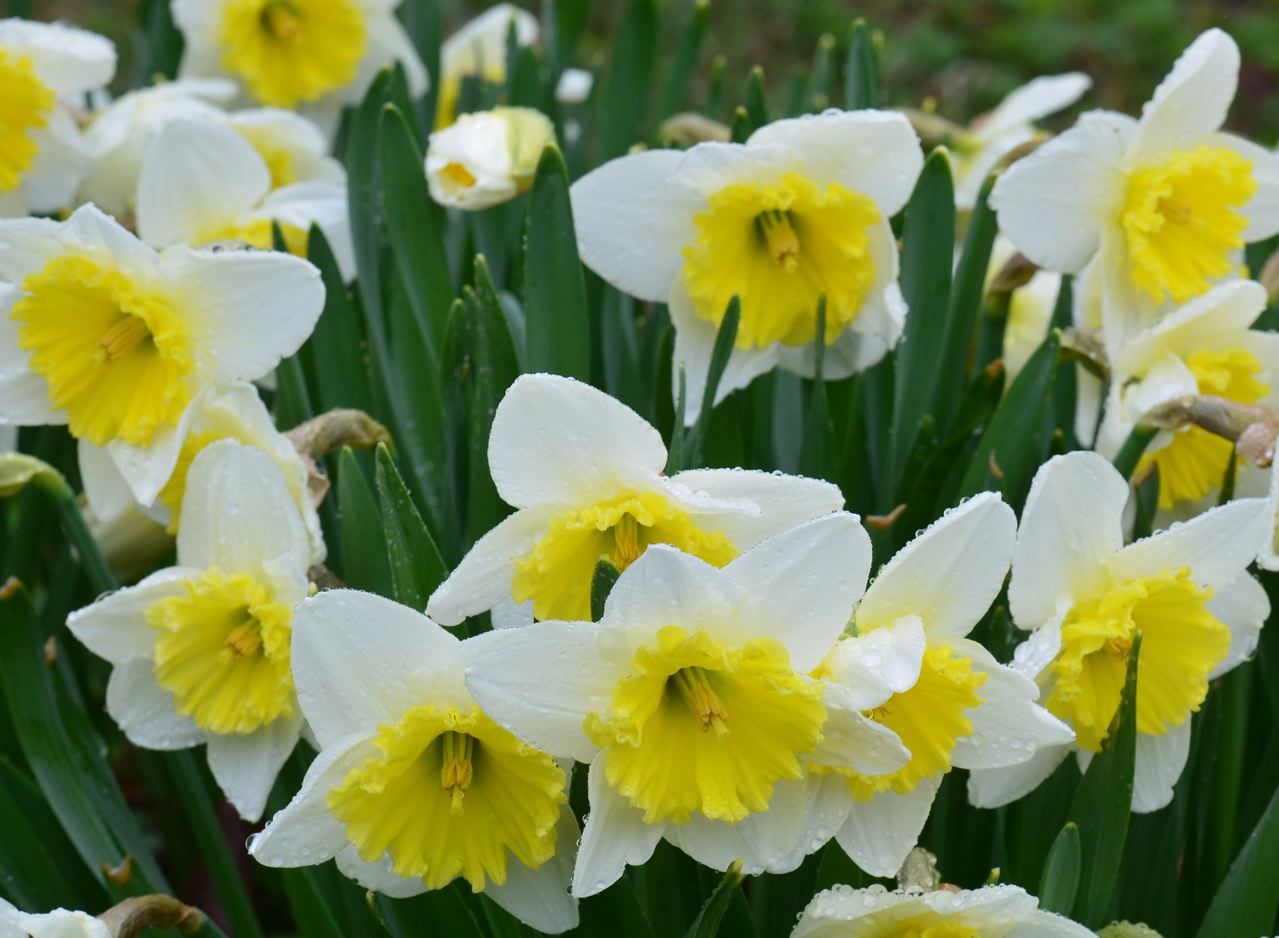
A Chorus of Daffodils 

White-throated Sparrow Zonotrichia albicollis

Praying Japanese Tree Peony 


American Goldfinch Spinus tristis reclaims its color


Daffodil Trumpets Announcing Spring 


Warmer moist days are bringing more migrating birds back to Flower Hill Farm and refreshing the colors of those birds that overwinter here. Spring's true arrival is casting off sepals revealing an array of colorful buds and blooms. The air is filled with the energies of excitement . . .  everywhere . . .  within the waking landscape and gardens. 


Sunday, March 20, 2011

Birds in Review Part XXIX 'A Bird Parade' Eastern Phoebe Perigee Moon


The Vernal Equinox arrives for the Northern Hemisphere, bringing a perigee full moon and the Eastern Phoebes return to our gardens and wildlife habitat. Back in 1804 the Eastern Phoebe was the very first North American bird to have ever been banded and the threads were wrapped by the great naturalist and artist John James Audubon himself. 


The Eastern Phoebe is a delightful flycatcher who can be seen often bobbing his tail and darting about harvesting insects on the fly. Just now there are not many insects flying about so the Phoebe may supplement his diet with a few smaller fruits.


Eastern Phoebes are widely known for singing persistent "phee-bee, phee-bee" phrases. These small songbirds will build their mud and moss nests right over a door or window indicating their tolerance for the comings and goings of people. This behavior gives people a great opportunity to observe them close-up.


Eastern Phoebes prefer woodlands and forest edges with some water nearby. Their breeding range extends throughout the northeast and midwestern United States into Canada. They then choose to overwinter in Florida, along the Gulf Coast into Texas and Central America. Some Phoebes will become year round residents in parts of the southern United States. 


They are very solitary birds and even within a coupled pair the individuals are not very sociable. Perhaps Phoebes spend time alone nurturing their poetic perspectives. Females seem to have little tolerance for the males company.


There are no eye rings or discernible wingbars on the Eastern Phoebes brownish gray coat. The underbody is mostly all buff with some pale yellowish tints earlier in the season. The male and female are very hard for me to ascertain.


I will include my one photograph of an Eastern Kingbird with the Phoebe contingent, for often at first glance one might be fooled into thinking this medium-sized songbird is an Eastern Phoebe. Besides being larger and darker in color, the Eastern Kingbird is a flycatcher that has evident white tips to his tail. His manner and voice are quite different as well. The Kingbird is very defensive and will attack nest predators such as Blue Jays, Crows and Hawks with great determination. Their song is a titillating treble of trills "Ti-t-t-t-ti-zeer"  that the songbird will repeat up to seven times. The Eastern Kingbirds breeding range reaches farther than their name implies, covering much of the United States and Canada. They migrate to South America for the colder winter months. 
Thanks to All About Birds 


 Looking out from my barn studio door two days ago, I enjoyed an early spring sunset casting a lovely lavender veil over Mount Tom and the Pioneer Valley. 


A segment of the Mount Holyoke Range wears a purple hue.


Perigee Moon rising while the sun sails away. This is actually the night before the full moon. Our moon is closer to us than it has been in eighteen years and did seem brighter to me. You can learn more about this special moon here .  


Yesterday was the actual day that would usher in the full moon.


Lovely light was scattered across the cloud filled sky. I was afraid it would be too cloudy to see the moon. 


Long after sunset it rose like a fiery globe from the clutches of hemlock along Carey Hill into the dark black night. Soon the mirroring moon lit up the garden floor and tossed charcoal shadows across the remaining snowy carpet.


Wishing all a Happy Spring! The snow is melting ice crystal by ice crystal . . . day by day. 
May the worlds suffering melt with it. 
Oh, that it could. 


Friday, January 21, 2011

Birds in Review Part IX Parenting Birds Throughout the Garden


Here at Flower Hill Farm outside of boxes and woven pouches there are many birds building their own unique nests and rearing their young. In this post I present some other parenting birds from all about the gardens. 
This Gray Catbird was nearby at the exact time I was photographing the little Baltimore Oriole fledgling (from my last post) up in this same Viburnum shrub. Another Catbird was further away and making a fuss, while this bird was not able to cry out at me since its mouth was filled with currants! I quickly looked about, to discover why they were alarmed at my presence, when I noticed a nest hidden within a Hydrangea bush right in front of me.


This might be a second brood, for look how small the Catbird nestlings are compared to the Baltimore Oriole fledgling. I did not linger long, though I did try to imagine which of the babies would get the currants. They are so peaceful in this photograph, but in a moment all will be animated with mouths thrown wide open. There will also be tiny cries coming from the lush green Hydrangea bush.


Grey Catbirds particularly love berries and butterflies! The gardens offer plenty of currants and blueberries for birds to harvest and fill their bellies, as well as, provide for their young. Many Swallowtails fall prey as well, when lost in luscious nectar sipping frenzies from the many flowering shrubs and plants about the gardens. These berries, a diversity of insects along with the protective shrubberies are a real attraction for many birds who nest here.


Our American Robin favors the Crabapple Orchard for its juicy red apples . . . which might enrich its rufous hue . . . 


A color so beautiful and one that I find hard to achieve with oils. Robins do stay around all winter and perhaps decide then . . . on where they will build their nests. 
In winter the fruits provide important nourishment.


Spring brings blooms and greens to provide cover for their sweet nestlings. The babies grow along with the ripening Crabapples. 


Robins live in flocks during the winter . . . going their couplet ways come spring. I often have at least two families brooding not far from one another within the gardens, however. Robins are often seen stealthy stalking along the ground in search of insects and worms. This parent is a bit concerned, as I am near its nest in the old Apple tree. 


This nest is quite different from the Robin's nest in the Crabapple Orchard, which is supported by many branches. This one seems to be mostly siting on its own atop the old Apple limb. At first glance it seems deserted too!


Then surprise those Robin eyes arise! Note the almost full white circle around the orb. I cannot imagine there could be more than one within the nest, which appears so small in comparison to the size of the near fledgling.


Later on and back in the Crabapple Orchard there is a tragedy playing out. The photos do not convey the size as well as they might. The fledgling appears to be much larger than the 'adopted' parent. I am not one hundred percent positive, but I believe this to be a Cowbird fledgling being feed by a Phoebe. 


Brown-headed Cowbirds do not make their own nests or raise their young . . . in this case the female lays an egg in the Phoebe's nest. The Cowbird nestling hatches quicker and becomes much larger and stronger than the other Phoebe nestlings. In time the Cowbird will smother the Phoebes true offspring or nudge them out of the nest. Some birds will reject the eggs. They will puncture the Cowbird egg then toss it from their nests. Phoebes and many Warblers do most often accept the eggs to the detriment of their own young. It is so amazing to me that many birds do not realize the difference between their own eggs and that of a Cowbird. One of natures mysteries. Cowbird females are known to use over two hundred species of birds to raise their young. 


Once a nomadic bird, the Brown-headed Cowbird traveled along with herds of bison out on the Great Plains. They are now found all over most of North America. Their parasitic habits can create havoc and demise for populations of birds struggling to survive. Some believe they have contributed to the near extinction of some songbirds. From my research . . . I am sure the parents of this Cowbird are nearby, though I have not seen them. They will eventually claim their offspring by calling to it . . . then the Phoebe will have some rest! I keep wondering . . .  if it ever occurs to the Phoebe . . . that this bird it so devotedly cares for . . . cannot be its own. Cowbirds have benefited and multiplied due to the great efforts of other birds, their unconditional love (if this can be attributed to birds. . . from my experience it would seem so) and I suppose to the fact that most simply never stop to think. Is everything in our wild world only innate . . .  instinctual and predetermined? Why would instinct not help birds in knowing their own eggs from another? Maybe they do recognize the difference but are not able to do anything about it. Then, of course, there is the need of the Cowbird, who never learned the art of nest building or how to care for their own. 


Cedar Waxwings do not think of departing come fall. They also remain through the winter months and feast on the Crabapples. They congregate in flocks and when I hear a high pitched whistle, I look for their flight towards the small orchard.


In the summer months they feast on blueberries and feed them to their young.


I espied this parent and fledgling in an old White Pine north of the barn. They are too far away for my camera, but I was thrilled to see a Cedar Waxwing fledgling with its parent.


There was a sweet tenderness about their exchange. The parent is protective and seems somewhat aware of my spying upon them.


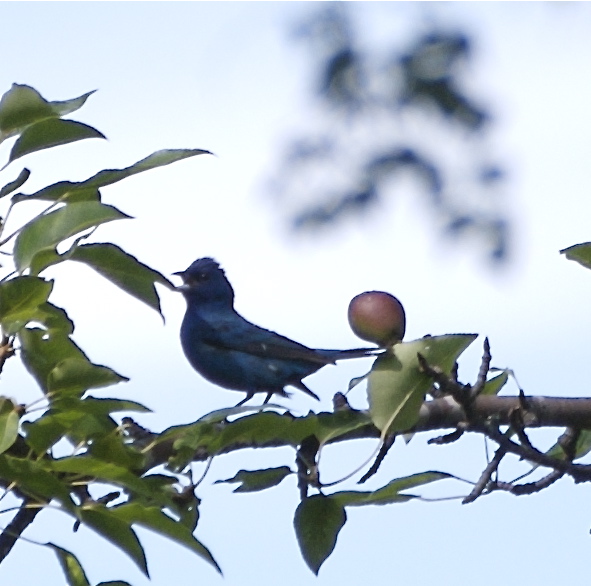
There is another drama going on in the south field with the Indigo Bunting family. The papa is calling out in what appears to be a stressful and concerning way.


Though clearly disconcerted, he does take a second to smell the sickle pear. 


Looking about . . . I find he is not alone.


Closer to the ground his beloved female Indigo Bunting is quite perplexed and distraught as well. 


She is frantically calling out towards the edge of the field, where I hear a good deal of scurrying and sounds of snapping twigs. I cannot see what is going on, for the thick green cover of wildflowers masks the scene. It would seem they have lost their fledgling and perhaps there is some creature in pursuit of the little one. 


I was happy later on to see that at least one of the Indigo Bunting fledglings has survived. 
Our gardens can be likened to a theatre with many seasonal dramatizations going on simultaneously. We create the sets then the players come! 
For now the stage is deserted . . . the gardens white and chilling to the bone. It appears much deserted and barren . . . but life is only hidden. True most birds have deserted us for more fruitful grounds, but who can blame them! I wish I could follow their lead. Instead I await their return with springs refreshing shroud of greens. 
I shall continue on with my bird reviews snatching images from my archives to create an avian parade . . . displaying the many colorful species of birds that share my rambling and wild paradise. 
Today is Blooming Friday. Visit Katarina in Sweden to see more gardeners pondering the word deserted.


Related Posts with Thumbnails