Showing posts with label Luna Moth. Show all posts

Sunday, July 27, 2014

Ephemeral Visitations from Ethereal Nighttime Beauties


We humans are creatures of habitual repetition and it is a reliable assumption that by nightfall most people are indoors with lights on and doors closed to the outside world. When we accidentally or purposefully leave our outside lights on, it is somewhat like fly fishing with the bright light being the lure. Many night beauties will be drawn to the light and will fall into a deep sleep making them vulnerable in the morning.


You can read the entire story here. After you read the story and see more photos I hope your connection to  nighttime beauties will happen often. 

Monday, March 26, 2012

Flower Hill Farm BUTTERFLIES OF 2011 - OTHER LEPIDOPTERA FAVORITES


Hummingbird clearwing Hemaris thysbe, also known as Hummingbird moth, is out in the gardens and fields sipping nectar during the day and often at dusk. 


People sometimes confuse Hummingbird clearwings with a real hummingbird due to its habit of hovering while feeding with its long proboscis. Host plants include honeysuckle, hawthorns, plums, cherries and snowberries.


Note the difference in the two species above and below. 


Snowberry clearwing Hemaris diffinis is more black but its coloration can vary. 
As its name implies . . .  this clearwing relies on snowberry. Other host plants are honeysuckle and dogbane.  Snowberry clearwings also fly about in the daytime and are more often seen in the summer months. 


All of the clearwings or Hummingbird moths are spritely flyers and like many butterflies they depend on our not being too fastidious with our clearing of debris, for they need leaves to spin within their cocoons and detritus along the ground offers protective covering through the cold winter months, while the pupa wait for spring. 


The lovely pale green Luna moth Actias luna, is one of the largest moth species in North America and is only active in the dark hours of night. Females can lay up to two hundred eggs. Here at Flower Hill Farm our Shagbark Hickory, White birch, Walnuts and even Sumac act as host plants. The caterpillars munch on leaves and shed their skin five times, as their relative butterflies and then overwinter in their silky cocoons beneath the chosen host plant. 
The adults have no mouth parts . . . imagine a simple life of sleep, flying and mating for one week only and you have an idea of the life of an adult Luna moth.
I forget to turn off a light the night this Luna moth comes to visit. Early next morning I carefully carry the sleeping moth inside, so that the birds will not have an unfair advantage. He sleeps all day and when the curtain of night falls, I hold him out to the dark air and watch as the beautiful creature takes his ghostly flight into a night of pursuing pleasure.  
They have amazingly strong wings but sometimes fall prey to our beloved bats.


A member of the Saturniidae family, Luna moths only have one brood here in the northeast. I usually see them in May but the one above was found in June. It looks like it might be already a few days old.


Another member of the Saturniidae family, the Rosy maple moth Dryocampa rubicunda also has no need of a mouth for they too do not eat as adults. Much smaller than their Luna cousins, the Rosy maple moths will also be attracted to a light and then will sleep through the night and next day. If a light is accidentally left on, I try to get them to fly into nearby plants in order to hide from birds. Females lay eggs on leaves of oak, sugar maple and other maples. The caterpillars spin a cocoon and sleep through the winter months. 


A mystery moth in the clutch of a flower crab spider. 
Moths can be very beautiful and their caterpillars can be very striking too. 


White Spotted Sable Moth Anania funebris, can be found in our fields and gardens in the daylight. 
The host plant is Goldenrod.


Intricately patterned mystery moth found on tree peony leaf.


Lovely white mystery moth with a yellow line through both wings found on iris. 

I missed Katarina's Floral Friday because I was enjoying a break with a dear friend by the sea . . .  and studying color with a fabulous expressionist painter and teacher through Provincetown Art Association and Museum.
Though there is not a wildflower within any of these photos the moths are pretty wild and hopefully considered wild enough for Gail's Wildflower shadings. 


The light and colors in Wellfleet, North Truro and Provincetown were magical! 
Wildlife was wondrous. 
I came home to spring but tonight is dipping down into the teens. Ouch! 


I think it fitting that upon arriving home . . . my first wildlife encounter in the gardens would be this magnificent Turkey vulture. (An amazing encounter I will share later.)
My teacher has encouraged me to use black paint in my work. 
Black can surely evoke power.
Turkey vultures are certainly more 'photogenic' than I had imagined. Attractive might be a stretch but truly . . . what a magnificent creature. 
Happy Spring to All! 


Friday, November 5, 2010

Wild Visitors for Blooming Friday


Actias luna
One morning in July I found this lovely pale male Luna Moth sleeping on the clapboards next to the front door of my house. I carefully lift and carry this beauty into the studio, for he would surely have become lunch for a Chickadee had I not eyed the moth myself. He can continue dreaming of a mate more safely indoors on this plant. (If you have time here is a great video of the Luna Moth life cycle.) He continues dozing until dusk, then I hold him out into the night and watch as he awakes, quakes and using my hand as a flight pad . . .  takes off . . . his ghostly wings uniquely flapping side to side rather than up and down like most other moths and butterflies. I have only ever encounter them in May never seen one this late in the summer. I felt like I was given a gift. 


What a life . . . having no mouth . . . no need for food . . . a Luna Moth simply sleeps all day and  flies about all night, with one goal . . .  finding a mate. They have one full week of life in this manner. In my garden, the female may lay her eggs in groups on leaves in the Shagbark Hickory tree.

Male Luna Moth . . . the wide full antennae are the giveaway. 

Luna Moths are so incredibly beautiful. Someday I will post about a spring, when nearly thirty come to visit over a period of a couple weeks. I imagine my human visitors may have left their outside light on during the night, which attracted this moth. Birds appreciate the mistake and feast on sleeping Saturniidaes. I have seen the hunt and try to wake the moths, but mostly they just fall to the ground . . . this is why I began bringing them inside to have a safe place to sleep. I try to remind guests to turn off their outside lights. I will not deny that in this case I am not upset about the remiss. 

White-tailed Deer  Odocoileus virginianus

Oh, I see you little one! I have often called my farm 'Flower Hill Fawn Care'  for sometimes a doe will leave her babies to sleep in the flower borders or hidden within the shrubberies, while they roam further to forage. I was lucky once to see one doe at pick-up time. Remarkably the Deer do very little damage to my gardens. We have an understanding most of the time.

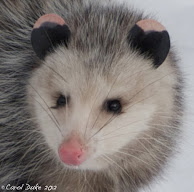
This Virginia Opossum Didelphis virginiana

This creature cannot seem to make up its mind . . . going up . . . or going down?


Bobcat Lynx rufus


One of my most amazing visitors . . . you can see my earlier post on this Bobcat along the side bar. He takes my breath away!


Coyote Canis latrans


I am happy to finally see this fellow in the light of day. We have known each other in the garden at night . . . he or she growling at me, when suddenly realizing I was nearby. The frightful sound pierces my solitude and I do not feel quite welcome, as I jump out of the hammock . . .  from my quiet moon watching meditation . . .  shouting towards him while clapping my hands. I can see a form running away, but that night I did not have my flashlight. 


I would like to think that my presence just makes her uneasy, as I am so quiet and the wind may be blowing in the wrong direction for my scent to be detected. We have another encounter the next night in a different part of the garden. Perhaps she is just caught off guard and her growl is more from fear. Equipped with my light this time . . . I can see her form more clearly . . .  with those eyes lit up staring back at me. Wild creatures such as Coyotes and Bear run away when frightened then stop and turn around . . . looking back at what it was that scared them off. Finding this rather disconcerting I always walk with a quick step . . . not running. . . back towards the safety of my house. Alas, I have given over the night garden to the wildlife. Most likely this Coyote would not harm me, but it is a wild creature and I respect its right to be here too. Often there is a pack howling and carrying on in the garden. Their chilling calls are thrilling. This one seems to be a loner. This gardener/farmer greatly appreciates their skills at hunting rabbits and voles. I worry for the little fawns and yearlings, while knowing there is a balance at work here. Coyotes are native and have been wandering the land for millions of years.

 Least Weasel

I am very grateful for this little critter too. I only wish he or she would not raid bird nests. Weasels do enjoy dining on rabbits and voles as well. There is the danger with all these predators . . . for the larger ones to kill the smaller predators. I think Weasels and Ferrets might be better at controlling Rabbits. I hope they are more clever than the Coyotes. 


Catbirds are rather brazen at times . . . here they challenge the Least Weasel. 
I love that my gardens and land are home to so many different wild creatures. I do sometimes wonder just who is the visitor here. It is Blooming Friday over at Katarina's  Roses and Stuff  be sure to visit to see other garden visitors from around the world. 
Related Posts with Thumbnails