The terrace garden outside my little studio is a contained and rather hidden place that seems safe from deer or other creatures that might devour my little plant prisoners.
A varied collection of plants are potted into simple clay and painted Moroccan pots each season, creating original bright tapestries flourishing year after year until hard frosts take them down.
Offering the gardener and visiting guests delight in blooms, colors and fragrance, the terrace garden is also a great feeding garden for Butterflies and Hummingbirds.
Oh, I must collect the slugs to keep the container garden thriving, but with vigilance I can keep them in check.
Do not make the mistake of believing the slimy, yucky mollusk responsible for this destruction.
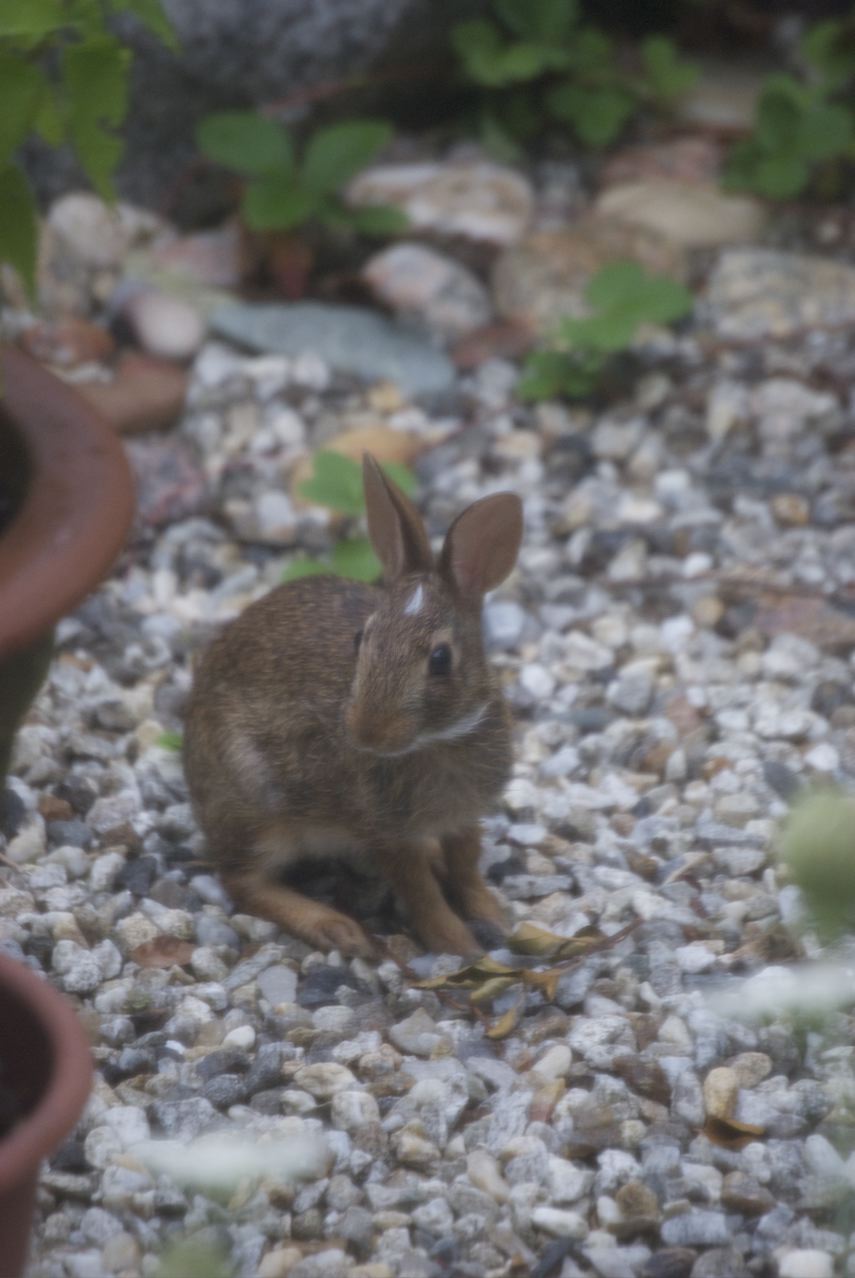
Here is the young culprit! An Eastern Cottontail Sylvilagus floridanus, considers my terrace garden a five star herbivore restaurant. Now this has not happened in the past . . . bad enough that the little critters . . . shall we call this one Peter . . . are eating my veggie garden, as quick as I can plant it, and most any new native perennials I plant . . . but this is the final insult.
I am not growing Cottontails in my pots! Peter has gone potty and is harvesting all that had lived happily within every single jardiniere. Wiping out my lovely terrace garden . . . turning it into rabbit tissue and excrement. I believe now the rabbits consider this the nursery garden . . . where baby Cottontails dine before venturing out further into the garden. How sweet . . . not! Or perhaps as the rebel hero Peter was forbidden Mr. McGregor's garden, this one too is overwhelmingly tempting! In any case, it is heartbreaking to the gardener.
Luckily I have some plants in larger pots they cannot reach. I suppose going big is one solution.
Morning Glories are allowed to reach higher still. Peter continues to grow too, and along with his siblings, not unlike Flopsy, Mopsy and Cottontail, carry on in their feasting of the gardens and fields of wildflowers.
Many a morning I walk into the gardens and count at least that many Cottontails chomping down . . . often on my newly planted treasures. As I approach, they all bounce hippity, hoppity away . . . every day . . . not just for a holiday.
I admit that when young babies, the Eastern Cottontail is very cute, nurtured by my lovely flowering plants and organic veggies. I do not find the adults so adorable, however, and watch with angst, as perhaps the uncle of the younger one eats Milkweed! I cannot tell if there are Monarch Butterfly eggs or even a small caterpillar on the leaves. I move closer, and when the fellow hops away, I am able to check the Milkweed leaves he did not get a chance to eat. Indeed there is a tiny caterpillar on one leaf. So now I even have to worry for the Monarchs here being eaten by the rabbits. A Lagomorph preventing a Monarch metamorphosis!
Of course Peter loves wild carrot or Queen Anne's Lace. I suppose the tiny Swallowtail eggs might be delectable to him, as caviar is to some humans.
I would not mind at all sharing the invasive Bishops Weed, but oh no, they will have none of that. I am wishing for a gout epidemic on all of the Eastern Cottontails here at Flower Hill Farm, in hopes that they will gorge on Bishop's Weed - also known as Goutweed. Please do not think me cruel . . . Bishop's Weed is said to aid in the cure of gout. I do confess to having far more harmful wishes towards these varmints, that were at one time classified in the same order as rodents.
I imagine them carried off in the claws of my friend the Red-Tailed Hawk, or eaten by a Coyote or Bobcat.
Timber! to the lovely wild Asters. Oh, why could he or she not eat the Bedstraw growing aplenty right in back of it and all over the garden?
You may think that I should calm down and be more accepting of this native wild thing. You would be right that I should be more accepting of what is, but wrong if you think this Eastern Cottontail a native. It was introduced in the 1800's and now outnumbers our native New England Cottontail. I am sure the native Cottontail would have far better manners and be more generous to the gardener. I have heard tell it is about to be placed on the endangered list. I guess good manners and generosity do not necessarily keep one alive. The New England Cottontails have shorter ears and do not have the white mark on the top of their head. It is believed that they are not able to hear as well and fall prey to their enemies more often than the Eastern Cottontails seen here.
Seeing the Eastern Cottontail out in the fields, feels more natural and with all the grasses, wildflowers and clover, it would seem there would be more than enough to satisfy their appetites.
I do know they will not eat Salvias. So next year I will find as many varieties and colors that I can, to accommodate this jewel of a visitor.
Marigolds too seem safe from the sharp, angular bite of rabbits.
Digitalis grows abundantly . . . freely sowing in the terrace garden as well. I will have to soften when I see the Cottontails, and stop being angry with the remarkable Beatrix Potter, for making the world see them as darling. She anthropomorphised rabbits so that we all attribute human emotions and identify with the naughty Peter, when he stands like a little boy Cottontail crying in fear of the 'monster' Mr. McGregor, who is only trying to protect his food. Oh well, I will have to choose my battles here or go mad. I must get a good fence around the veggie garden and grow only those plants in the terrace garden that Cottontails will not eat.
I will continue to hope that the fox, coyote, raptors, weasels, minks and bobcat will enjoy dining on my free range organically raised rabbits! When we create a wildlife habitat, it is not possible to pick and choose who gets to join the club. It is best to just go with the flow realizing that change is always a part of life and gardening/farming. I have so much to be thankful for and as long as the leaping Lagomorphs do not completely destroy my shrubberies and perennial plantings, I will not allow my blood pressure to rise with each encounter. Dare I say, I may even grow to find them endearing. Well, as of today that is a bit of a stretch.