Showing posts with label Early Spring Landscape. Show all posts

Friday, April 12, 2013

Flower Hill Farm Butterflies of 2012 ~ Eastern Tailed-Blue and Summer Azure


Flower Hill Farm Butterflies of 2012 continues with two little Blues of the Gossamer-wings family. Last year in July, I had an exciting first capture of an Eastern Tailed-Blue Everes comyntas, which I spotted along the edge of the south field. A bit smaller than the Summer Azure, these small beauties are also considered common throughout most of the eastern half of North America. 


The Eastern Tailed-Blue has three flights beginning around the middle of May through the first part of June, then the middle of July till the end of July and mid August through to late September. To make identification confusing each brood may look somewhat different. A tell tale sign of the Eastern Tailed-Blue is the orange eyespot like markings on the bottom hindwings and the tiny thread like tails, though as with the one captured here those may disappear with time. They are such beautiful little butterflies. I so wish the wings were fully open to illustrate the gorgeous blue but a peek shows a bit of the color that seems to vary between broods and sexes.

In between these flight stages would be the time to search out the single eggs and dark green caterpillars on buds and stalks of clovers (if the rabbits leave me any) and various legumes. Here at Flower Hill Farm the little blues might enjoy the vetches growing in the airy north and south fields and perhaps I might find caterpillars along the forest edge.


Eastern Tailed-Blues overwinter in their caterpillar stage.


Summer Spring Azure Celastrina ladon, is perhaps the most confusing butterfly I have ever tried to identify. Thanks to Joe from the Massachusetts Butterfly Group on Facebook, I think I have it right. The sighting of this tiny 3/4 - 1 1/4 blue was just outside our little studio last August. This makes it a summer form of the Spring Azure, if I understand correctly. The Azure is considered common and flies from early spring up to early September throughout much of the United States.

A great diversity of plants and shrubs serve as hosts for the larva that resembles a slug, including cherry, blueberries, maple, dogwood, viburnum, oak, lupine and more and more. It is a wonder since Flower Hill Farm has all of these and many more of the other listed host plants and trees that I have never seen this butterfly here before. I can only assume the birds are incredibly fastidious in searching out the caterpillars and then the butterflies, or I have just not been in the right place at the right time.

The butterflies also choose from a variety of flowers. Males congregate along streams and puddles and will sample excrement and carrion. Azures prefer fields with shrubs to an open airy field, so I now know to look more in the blueberry fields when they begin to flower, for the caterpillars prefer flowers to leaves. Right now the chrysalis forms is in hiding perhaps below the blueberry bushes in the photographs below. Azure butterflies only live for a few days, beginning courtship and then laying eggs very soon after emerging from their yellow-brown chrysalis.


Within  the blueberry field above and below, Azure chrysalises may be safely awaiting the unfurling of buds.


The little caterpillars of the Eastern Tailed-Blue will have to remain hidden from the sharp eyes of the Bluebirds. 


It is truly overwhelming to imagine all the hidden life within these fields . . . section of north field above and south field below . . . both will be filled with wildflowers in a months time.


The returning Tree Swallows fill the sky with fluid dance, songs and champagne like gurgles. 
Their presence in the gardens and sky above is pure delight and they eat hundreds of biting insects each day.


I hope there will be plenty of food for the birds and that many of these precious blues will survive to fly about the wildflower and blueberry fields later this spring.

Our temps have dipped back down into the 30's with some sleet and snow showers promised in a day. Though I love the warmth, I would rather have these colder spring days than suddenly having summer upon us. We had a couple of days in the 70's this past week and the heat makes all the new emerging life move too quickly. I so love a slow spring after a long winter, one that allows us to pause and celebrate renewal . . . and now I have a bit more time to catch up with last years butterflies!


Monday, April 8, 2013

Flower Hill Farm Butterflies of 2012 ~ Little Wood Satyr, Common Ringlet and Common Wood Nymph


The more I learn about butterflies, the more I understand just how enchanted our gardens and nature, in general, truly is. With satyrs and wood nymphs all about the grassy meadows and fields who could ever dream of using poisons? We share our gardens and land with a complex and varied living community and we can attract these magical creatures into our lives by learning about their needs and pleasures. 

By planting the necessary host plants or being sure not to yank them out of our gardens in the first place and not being such fastidious gardeners or farmers, we encourage a more balanced and diverse wildlife habitat. We need to allow our gardens to be somewhat disorderly by leaving some detritus lying about, for what might appear to a gardener as messy may be life saving to a hibernating caterpillar or butterfly. Some even go the extra mile for butterflies by creating butterfly houses or hotels. 

When I look out into the gardens and fields, I am overwhelmed at times when realizing that there is so much life hidden from me. Over the years . . .  spending time just 'being' in nature and the gardens . . . quietly listening . . .  I began to see and feel that I am entering into another realm . . .  one that is evolving from my constant control to that of a richer and more natural environment . . . a wondrous world that speaks to me. I continue to receive such joy in knowing my little hillside this way. 

These butterfly portraits are but a part of that joy . . . an incredibly inspiring exchange when gardening with and for wildlife. All three of these featured Brushfooted butterflies are in the subfamily of Satyrs and these were all first sightings, by me at least, here at Flower Hill Farm in the spring and summer of 2012.


Little Wood Satyr Megisto cymela, is abundant here in Massachusetts and might be seen by the hundreds if the habitat is right for the butterfly to become prolific. This Little Wood Satyr might have been laying eggs when I capture this portrait . . . you can see the tiny round globular eggs in the photograph above and then circled below . . . it is hard to determine the color which is a pale green. 


Little Wood Satyrs choose a habitat along the edges of woods where fields and meadows lay nearby. Flying from May till the beginning of August, these tiny, dark-brown, one inch and three quarters wingspan butterflies do not seem so drunken as their namesake. Perhaps they do become a bit intoxicated from sipping aphid honeydew or sampling a variety of tree sap within a wood. I cannot say, for this was our first meeting and the butterfly did not dawdle.

Nectar from flowers is rarely favored by this butterfly or so it seems from the lack of documentation. My only sighting is of the Little Wood Satyr near the ground and the other images I have seen are similar. 

Orchard grasses and some sedges may be considered hosts for the caterpillar. The females fasten their eggs towards the tips of a blade of grass or even on the ground nearby its preferred grass. Leaf litter is essential for their survival, for they overwinter as last stage instars beneath debris along the ground. 

As I write this piece, I see beyond my French doors hundreds of robins scurrying about the ground lifting all sorts of dried leaves. Sometimes it is hard to love both bird and butterfly. 

The Little Wood Satyr was a first sighting for me here at Flower Hill Farm in July of 2012. 


Common Ringlet Coenonympha tullia, has a wingspan of 1 - 1 7/8 inches and is noted for the rusty orange coloring on its upper wings. There will always be one small eyespot looking back at any observer too.
These little satyrs might be sighted all over New England, Canada and even in Japan and Italy, and  may also be seen in groupings of hundreds in the right habitat.


This sighting of the Common Ringlet was in May of 2012 out in our south field and also a first for me here at Flower Hill Farm. They might be flying, with their unique bouncy flight, about open fields and meadows, with some shrubberies, or along wooded, country roads from late May through the beginning of July and then from the end of July to the end of August.

Again, various grasses seem to be the necessary host plant. The butterfly appears not to be too picky and will sample a number of flowers for nectar. They too overwinter in various larva stages.


The free spirited Common Ringlet decided to immigrate from Canada to New England as recently as the late nineteen sixties and are now plentiful across the state of Massachusetts.


Common Wood Nymph Cercyonis pegala, is the larger of the three satyrs featured here, with a wingspan of about 2 - 2 7/8 inches. The eyespots painted on an yellow-orange background are dramatic within the dark brown wings and make these butterflies easy to identify, though there are variations on this design that might be confusing.


Common Wood Nymphs may be seen flying about from July through the early part of September in open meadows, bogs and along sunny forest corridors. As the name implies these little beauties are pretty common here in Massachusetts. The caterpillars eat various grasses and later as butterflies sip from a diverse array of flowers along with rotting fruit and even fungi.


Common Wood Nymphs overwinter here in New England too. Right about the time our first icy frost clings to leaves and carpets the ground, and when just out of its egg, the first instar caterpillar will crawl or drop down into the center of its host plant and hibernate throughout the winter.


Little Wood Satyr, Common Ringlet and Common Wood Nymph all members of the Subfamily: Satyrs


Again in present time . . . hopefully our last snowfall has come and gone and now we truly long for spring to stay.


Soon there will be a myriad of sprouts stirring and breaking through the crust of earth or armored calyx and surviving caterpillars will begin munching their way to becoming butterflies.


Robins were with us all winter. Hundreds of the rusty-red breasted birds are now running along the newly exposed ground, about the fields and gardens, like sentinels. I am afraid the caterpillars will have to be very clever in their camouflage with so many beaks lifting leaves and other debris.


 Our resident Yellow-bellied Sapsucker has returned.


The Bluebirds are more actively guarding their chosen nest box. 


Bulbs are dotting the garden floor. 


Spring brings more light while stimulating life and imagination. A new growing season begins along with all the excitement of returning birds and song filling the fresh, soon to be, verdant landscape. I feel blessed and honored to be steward to this land and wildlife habitat.

It is at this time of year, when there seems so much promise, that I feel most enraged and saddened about all the injustice and cruelty to our planet and all life on it. I so truly wish it could be different, that all peoples could peacefully mark their days by what bird or butterfly returns to their small paradise. I am lucky to have, for awhile, this plot of earth that is ever giving while allowing me to express my love for nature. It is my hope that in some small way my sharing it brings joy and inspiration to others. 


Friday, January 18, 2013

Recalling Landscape Tapestries of Spring Twenty-Twelve


Looking out on a white and cold landscape, 
I dream of spring, though do not wish to hurry it. 
Since we are in January, I look ahead 
while also following Janus's glances back in time 
towards my favorite Flower Hill Farm landscape tapestries 
of spring twenty-twelve.


It truly is remarkable . . . experiencing the seasons . . . 
imagining this lush, joyous and verdant breath of life . . . 
now resting and dormant within the deepest protected layers 
of crusty, cellular trunks and fleshy roots . . . 
beneath the surface of frozen earth.

Monday, May 14, 2012

Quietly Walking About the Mid May Garden


Joyous song and fragrance fills the air about our hillside habitat and gardens.

Male Indigo Bunting

Delicious Viburnum and French Lilac

Lilac and Viburnum Looking Towards Mount Holyoke Range

French Lilac and Lilac Topiary Looking Over Toward Walnut Hill

French Lilacs and Lilac Topiary Looking Over Towards Carey Hill and High Ridge

Lilac Topiary Looking Into Lower Garden

Dwarf Fothergilla  and Lilacs Looking Down Towards Apple Gateway and Blueberry Field

Same As Above Only More to the Left

Tiger Swallowtail on Lilac

Viburnums Looking Down Toward Oak in Lower North Field From Inside Upper Garden

Between Viburnums Looking Down Towards Middle Meadow Garden Edge Japanese Maple

Japanese Maple and Three Graces ~ Crabapples and North Garden

Father Hugo Rose in Middle Meadow Garden

Male Baltimore Oriole 

Female Baltimore Oriole 

French Lilac and Weeping Crabapple Looking Up From North Garden Towards Rock Maples

French Lilacs and Fairytale Lilac Looking Out Barn Studio Towards North Field Birches

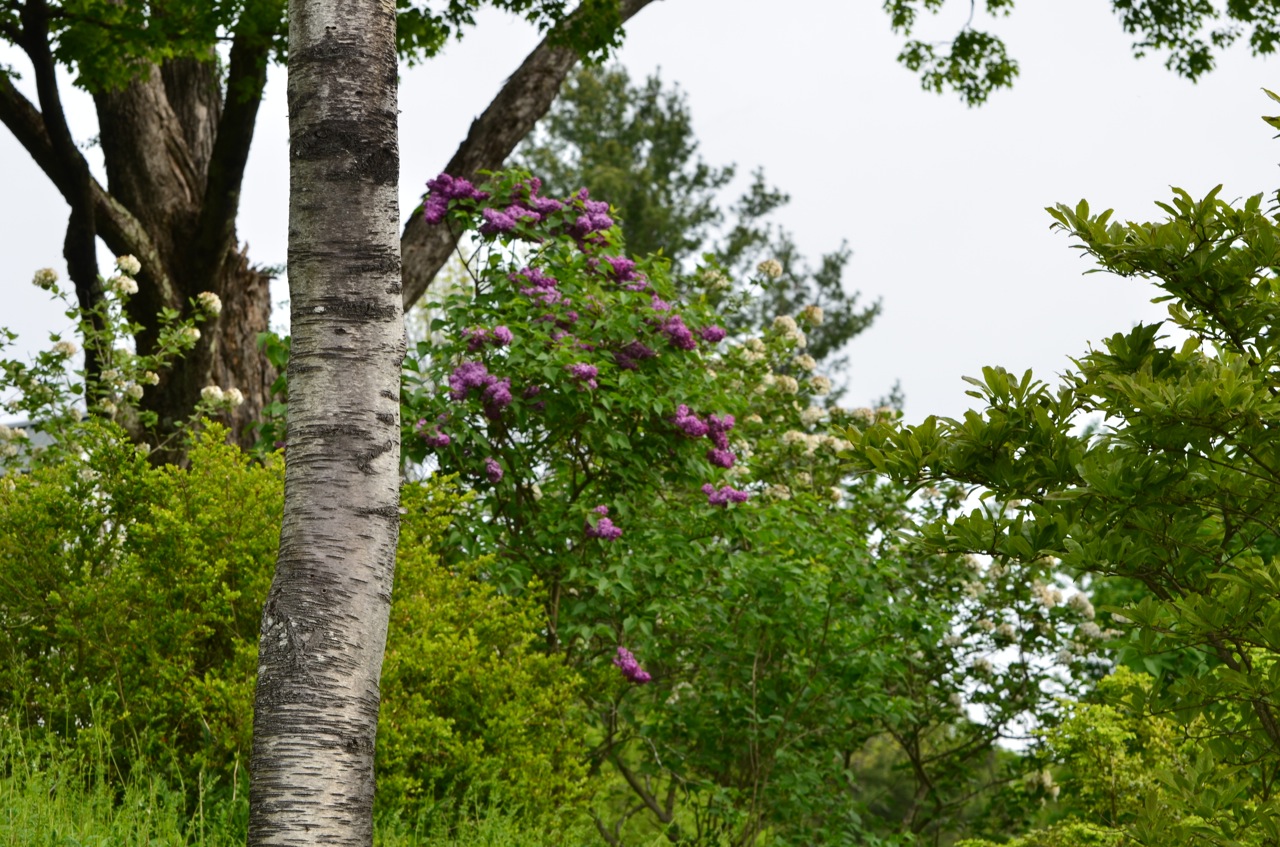
Looking Up From South Rock Garden ~ Gray Birch, Lilacs and Viburnum  Before  Rock Maple

Same As Above Further Along the Path


Looking Back Towards Gray Birch

Red Admiral on Lilac

Wisteria Before Lilac 

Magnolia Before Viburnum and Lilac Topiary


Red Admiral on Lilac Topiary

Joy spreads throughout the sweet petals of lilacs and viburnums and in vibrant wings of returning butterflies and birds . . .  cycles of life unfold. Unfurling wildflowers reaching up towards the light fill fields with dappled beauty . . .  bearing nurturing nectar for a bounty of pollinators. Colorful unsettled male birds are jousting with beaks and unarmored wings, while other bonded pairs are building nests and feeding young.
Spring is a riot of procreation. 


Related Posts with Thumbnails