Showing posts with label Misty Landscapes. Show all posts

Tuesday, January 21, 2014

Winter Blues ~ Eastern-tailed Blue, Summer Azure and Silvery Blue


Dreaming of Blues fluttering around the garden can shake off the mantle-of-melancholy winter sometimes weaves about our spirits. Today, I gather some delightful, inspiring and tender butterfly encounters, from this past sizzling summer, and toss them on this page of white, that they may bring a ray of light, to warm the inner gardeners folded inside our longing souls. 

Eastern Tailed-Blue Butterflies of 2013

The progeny of these gossamer-wings are now chrysalises, or caterpillars in the Eastern Tailed-Blue's case, tucked away in crevices within mossy mounds, pods of vetches and clover, or along the frozen winter ground. Little fragile beings within their sleepy pupa or larva state, without realizing their fate, without questioning, without knowing, without hoping to survive the onslaught of freeze and thaw, human flaws and sharp bird beaks, simply, sweetly sleep, waiting for transformation. 

Summer Azure Butterflies of 2013

Holding on throughout the bleak winter months, many new Blues will emerge, along with our gladdened hearts, into the warm breath of spring. I hope and imagine hundreds of butterflies surviving the numerous perils that come between them and their completed metamorphosis. Such gossamery treasures tickle emotions and call the caring mind to action in thoughtful ways towards their wellbeing. An added appreciation for subtleties in shades of blues and grays awakens this slothful painter, when gazing upon the pastel Blues.

Silvery Blue Butterflies of 2013


Without snow cover, butterfly chrysalises and caterpillars are more vulnerable. Just beneath the old apple tree, gray birch and blueberry bushes, precious life is quietly in hiding.


I love birds too and they enjoy all the stages of butterflies equally, especially at this lean time of year.  No snow coverage is good news for this little Carolina Wren, who has decided to move in and live year round.


Wren and other bird beaks are perfect for lifting up the leaves and digging for larva nuggets below. Too bad for the butterflies being of the lower food chain, but then, butterflies fasten hundreds and hundreds of eggs to various host plants assuring there will always be trembling gossamer-wings to pollinate and touch our hearts. I say, always, but heedless humans do have a hand in the decline of butterflies of all kinds.


Foggy, frosty, winter morning sunrises are wondrous to behold just outside the windows and doors. I feel blessed to start the day in this inspiring way. A branch of the Mill River runs between the hill where Flower Hill Farm is situated and Carey Hill just due east, making for a great show of mist most every dawn. I am less excited about the sheet of wood smoke that is always more gray.


Millions of unique snowflakes fall, thickening a fleecy snow-blanket, sheltering tiny life. It is heart-warming to know of all the diverse, quiescent wildlife sleeping beneath the surface of snow in layers of detritus deeper below. In the dance of life, all is in limbo, uncertainties abound upon a blanketed earth.


Winter can be beautiful in its frozen snow-blossom way. Creating an ever changing wonderland with a great deal to explore, to ponder and exclaim about. It can soften the mind and loosen binding thoughts of gloom. If its beauty fails to lift our spirits, it may help to remember that the little Blues are placidly waiting too. 


Sunday, March 3, 2013

Flower Hill Farm Butterflies of 2012 ~ American Copper


The teeny tiny American Copper (Lycaena phlaeas) packs a sizable palette for one so small.   I was happy to find this little butterfly sunning in the south field back in May of 2012. Its wingspan is only 7/8 x 1 1/8 . . . a delicate, miniature, ephemeral painting belonging to the Gossamer-wings family . . . offering distinctive marks and textures that one can identify but never own. However, photos and happy memories are filed, of a late may day, walking in the south field along side a fragile, yet plentiful living jewel. 


We might pause before pulling out all of the invasive Sheep Sorrels or Curly Dock of the Rumex family growing in our gardens and meadows. I am sure to examine plants carefully before composting them in hopes of finding eggs or caterpillars of this lively and vibrant butterfly. Stands of sorrel are left to grow along the south field paths . . .  in honor of American Coppers.


The American Copper butterflies are on the wing or in varying stages of metamorphosis from mid May through the middle of September. They overwinter here in their chrysalis stage or as the Massachusetts Butterfly Club's great website mentions ~ in half grown Larva state.


It stimulates the imagination, to consider life waiting beneath heavy blankets of snow now filling our Western Massachusetts gardens, fields and forest . . . and as far as the eye can see, lightly coating every twig and tree. Hemerocallis sleep within a deep frost . . . waiting to feel alive again.
Color will run riot in just a couple of months, but for now, just outside our windows and doors the dawning sun paints the sky, clouds and mist ethereal hues of lavender and pink.


March continues to hold fast to winter's quiet and cold beauty. 
Bluebirds are patiently guarding their house, while the Mount Holyoke Range sits shrouded in pink mist. 


Spring seems content to stay away for now . . . I shall have to visit 'early spring' at the Lyman Conservatory on the Smith College campus just fifteen minutes away down in the neighboring town of Northampton, where visitors can inhale an elixir of hyacinths and other flowering bulbs of their Spring Bulb Show.


Friday, April 13, 2012

Nature's Black Knight ~ Raptor of the Dead


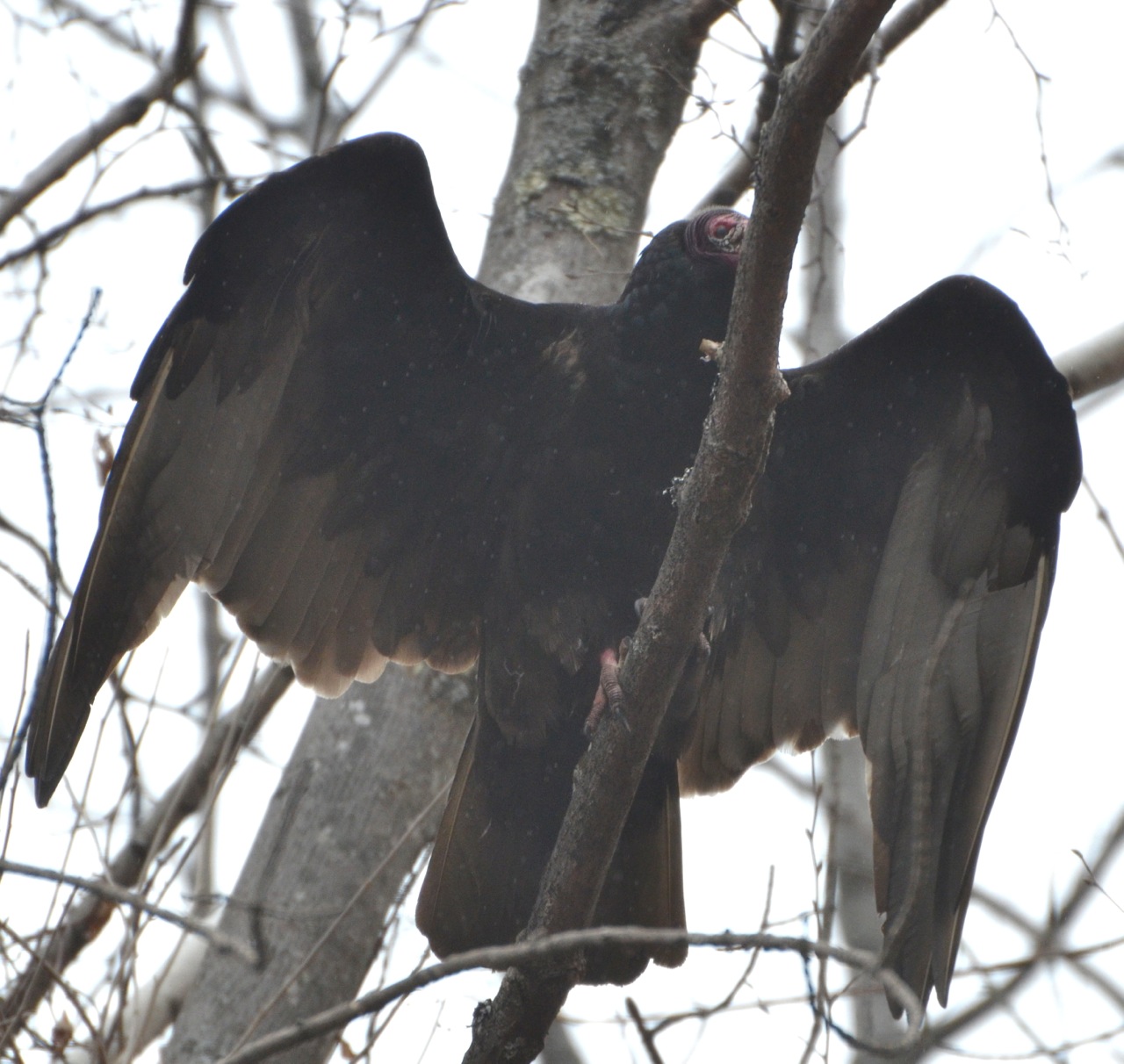
Dark as a moonless night, this new world vulture . . .  nature's silent black knight Cathartes aura, emanates mystery, while evoking macabre images from the minds of many that view him. 
Turkey Vultures are truly remarkable diurnal creatures, preferring carrion to fresh meat and purifying our world as they dine. If you were to change the 'C' in its scientific name for a 'K' you would have the Greek derivative Kathartes meaning cleansing or purifier. Carthartes aura means purifying breeze. 
It is hard to imagine our world without Turkey Vultures or vultures of any kind.


I feel the intent, glaring stare upon me here, but do not fear for I know that these dark lords of the sky do not attack the living. Perhaps it is only a curious stare after all. 


Spring is a time of song but not for this magnificent being, who makes only sibilant sounds . . . a sibilance of hisses . . . air streams emerging from deep within. 
This Turkey Vulture is letting me know he or she is annoyed with my approaching too closely in the south field. The sinister sound is meant to frighten me away and the Turkey Vulture seems piqued by my persistence. 
They are known to grunt, cough, rattle and if really upset, vomit might spill down upon me. 
Singing is out, for they are not endowed with adequate vocal organs. 
Smelling is keen however, for unlike other raptors, vultures have super sophisticated olfactory organs. Note the rather large nostrils. 


A rapacious raptor . . . perhaps when feeding, but otherwise they get on quite well with one another and can migrate in flocks of up to a thousand individuals. Turkey Vulture roosts are sometimes as large as one hundred. 
What a sight that must be and to hear that many hisses at once . . . creepy yet thrilling.


Vulture comes from the latin vellere, to tear, and this princely bird of prey comes equipped with a sharp hooked ivory beak. 
I find it very impressive especially as it is not built to kill.


Misunderstood and even mistreated vultures are revered in some cultures where 'sky burials' are favored and vultures play a key role in their beliefs for releasing the spirit or soul of the dead. 


If hisses do not frighten you away . . . here is another way to let you know that I am big and fierce. 
This is a WOW experience. 
It must be a challenge to keeps ones balance with wings spread up to six feet. 
A first fauna encounter after being off the farm for a week and it being suggested that I do not use enough black and gray in my paintings. 
I have read that the TurkeyVulture is really more black-brown but being this close up it appears black enough to me. 
Never having encountered a perched Turkey vulture before, I feel very lucky to have eyed its large form in a young oak along the south field. 
Luckier still that the vulture allows me to approach so closely and take over three hundred photographs. 


Are you not frightened yet??


Oh Well. 


I will be off then . . . to heights you cannot but dream to reach!
Even though I speak kindly and with great admiration for the majestic grace of this Turkey Vulture, he finally spreads his wings for flight . . .  instead of fright . . . and soon was soaring out of sight. 


Vultures die when they eat the remains of poisoned critters. Yet another good reason to never . . .  ever use poisons. 
All vultures are actually aseptic animals and do not spread disease. 
I should love to have an immune system such as theirs . . . these cleaners of our dead keep our world safer and sweeter. 

Hellebores are poisonous but used to cure madness. 

Spring is a sweet time of year and buds are beginning to burst here at Flower Hill Farm. 

Dark apple trunks dancing in the mist . . . contrasting gray birch.

There is ever mystery in the process. 


The Turkey Vulture would not have been moved by flattery from a fox as was a fabled crow, but perhaps you might enjoy my latest installment to my bestiary over at Native Plants and Wildlife Gardens. 

Update: April 15, 2012
Another very valuable black/brown creature has returned to Flower Hill Farm . . . I sighted my first bat last night!! Finally the fungus that is killing our bats has been marked as the real killer and hopefully now a cure can be found . . . before it is too late. You can call congress and the white house and demand funding for this important research. I have called and I hope you will too. We do not want to have a world without bats.


Friday, August 19, 2011

Gray Mantles of Foggy Mist Covering Twilight Sky Over Hemlock and White Pine Forest


 foggy mist billows
emanates through countless leaves
vast cool covering

mysterious veil
floating dreams mingling within
twilight curtain falls

ever morphing sky
filled with wondrous light and form
gazing southeastward


Related Posts with Thumbnails