Showing posts with label Viceroy Butterfly. Show all posts

Friday, April 5, 2013

Flower Hill Farm Butterflies of 2012 ~ Viceroy and Common Buckeye


The striking Viceroy Limenitis archippus, can be sighted in flight, here in Massachusetts, from around the end of May till the beginning of October.
Birds are now searching out the overwintering, hibernating, bird droppings-like caterpillars in their neatly constructed leafy 'tents' of apples, cherry or willow leaves. Like the Red-spotted Admiral they cleverly create a hibernaculum by drawing out silk from their bodies and securing leaves to twigs or branches so that they cannot fall. The third instar caterpillars then neatly fold the leaves creating a silky tunnel around their tiny bodies and proceed to sleep through most of fall, winter and well into spring.


Viceroys are consider common and abundant in Massachusetts. It would seem that the birds are fooled by the Viceroy's fastidious overwintering tents, as many caterpillars are able to emerge from their dry leafy homes and munch along the fresh green leaves that open in spring. Many successfully then hide out in their again bird poop-like chrysalis forms and after about ten days become butterflies.
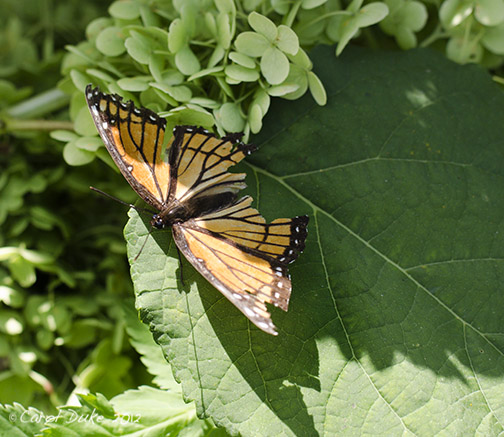

Viceroys are designed to confuse birds and other predators by mimicking the toxic Monarch butterfly. I guess some birds do not attend the 'Butterflies Not To Eat' seminars or perhaps they learn to spit out the toxic body parts. The photograph above illustrates that to mimic is not always a guarantee to sail through life peacefully. I often see the Viceroy's cousin the Red-spotted purple (scroll down to last post) with tattered wings too, even though that butterfly form of the Red-spotted Admiral is suppose to be a mimic of the Pipevine Swallowtail.

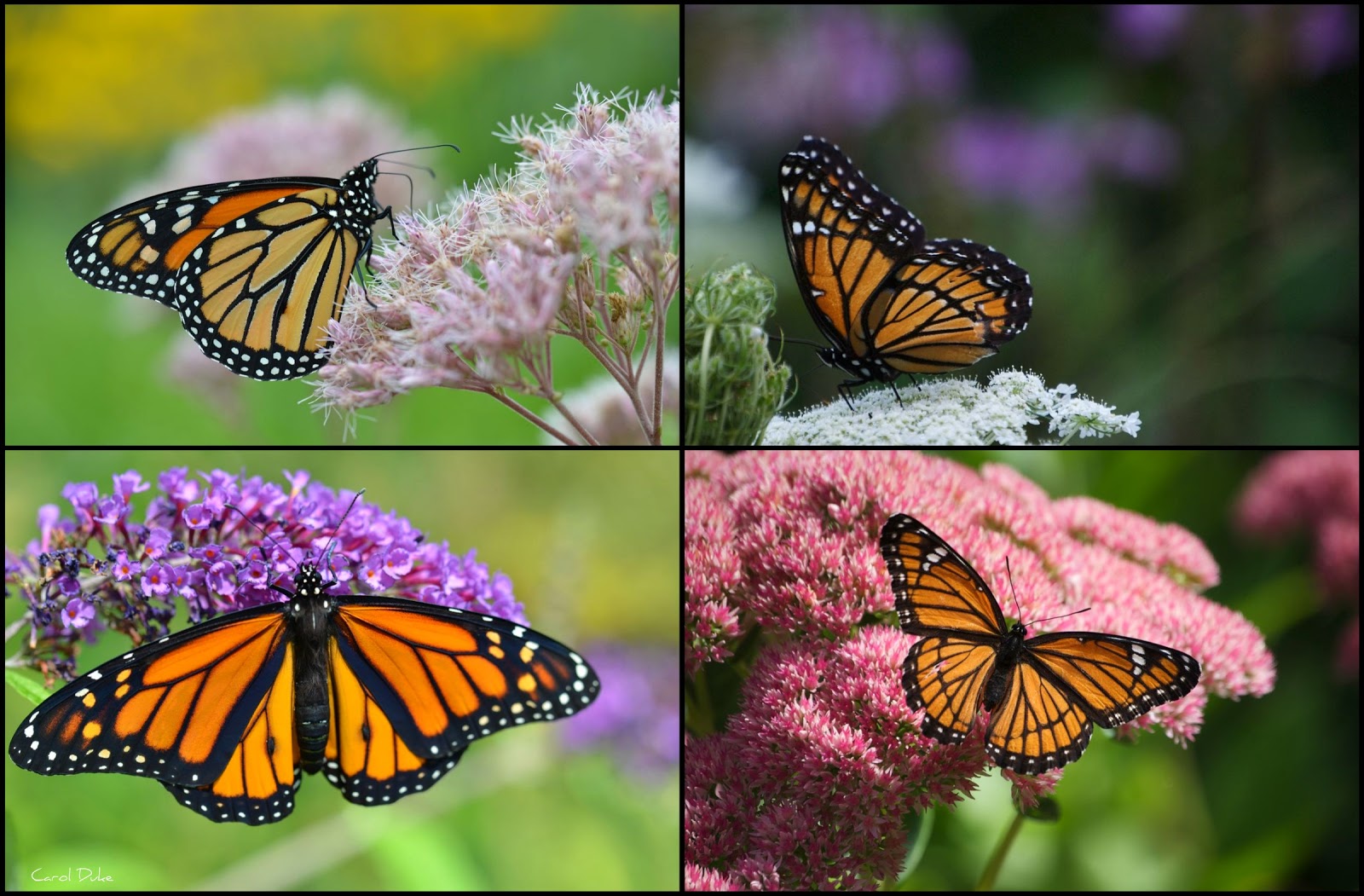
Monarch butterfly on Left . . . Viceroy on Right

Though a viceroy is not as high in rank as a monarch, the butterflies do end up confusing people too. There are many differences but besides being smaller, the easiest identification mark is the 'smile line' through the Viceroy's hindwing vertical lines. If the butterflies are too far away to see these details, you can always discern the spectacular soaring flight of a monarch from any other butterfly.


I was not able to get any close ups of the Viceroy in 2012. The two images above from previous years clearly show the horizontal line going through the vertical lines on the hindwings. The Viceroy may mimic the Monarch but does carry its own potently unpleasing taste to deter predators. 
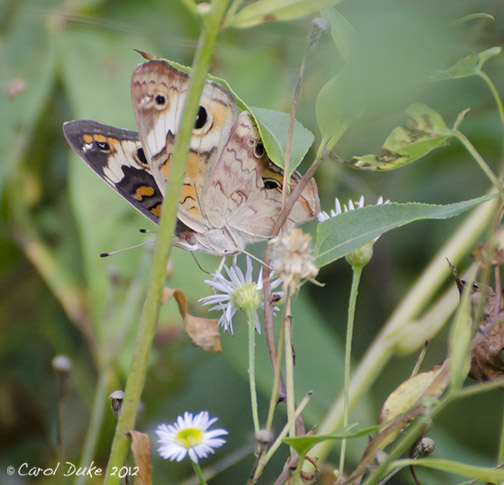

The Common Buckeye Junonia coenia, is not a mimic of any other butterfly but has it defense in its large eyes that might frighten any bird away. These migratory butterflies are not really so common here in New England. Some years they may be rare and others more abundant in numbers. I did not see but the one above in July of 2012 and could not get close to it. Butterfly hunting with a camera is hardly ever easy but the photographs below reveal a Common Buckeye from 2011 that was very close and allowed me to take over a dozen images.


The images above were from some of the photos that were my very first sighting here at Flower Hill Farm in July of 2011.  I was so thrilled the entire time I was clicking away. 

The Common Buckeye can be sighted in flight from July through September and then in large numbers in their fall migration. If you grow snapdragons or any of their family members please allow some of these butterflies larva to feed on the leaves. Caterpillars also eat Blue Toadflax, False Foxglove and other plantain family members. There may be other plants that please the Common Buckeye too so be sure to identify any caterpillars before you remove them. Who needs perfect plants anyway? The butterflies tend to favor the composite family. 


Gardening for butterflies can be so rewarding! 


These are all the butterflies (with open and folded wings) I have reviewed so far from my sightings at Flower Hill Farm in 2012. I have more to share. 

The temperatures in Western Massachusetts dipped down into the teens on Wednesday. I hope the emerging Mourning Cloaks were able to stay warm enough through the bitter cold night. 


Friday, March 2, 2012

Flower Hill Farm BUTTERFLIES OF 2011 ~ Favorite Viceroy


The Viceroy Limenitis archippus, is a bright orange butterfly with black veins, cleverly mimicking the bad tasting and tummy aching (for the birds) milkweed butterflies. It is classified as a Mullerian mimic of the Monarch butterfly.


Therefore upon first sighting the Viceroy, an observer may believe it to be a Monarch butterfly. There are many differences, however . . .  such as size and hue intensity . . .  but the easiest way to identify the Viceroy, is to note the thick black vein drawn horizontally through the hind wings. The monarch, as illustrated above, does not have this trait. Also, notice the drops of white. . . the color of milkweed sap . . .  are quite different in numbers and shapes.


The Viceroy may not be very tasty either but that does not keep the birds from trying to find out the hard way.


When spotting these beautiful butterflies further out in the gardens and fields, it is harder to determine the differences. One sure way to know a monarch from a viceroy . . . even faraway . . .  is in the unique and graceful soaring flight of the monarch. 


Viceroy butterfly on wild carrot Flower Hill Farm 2009


Viceroy on sedum Flower Hill Farm 2010

Viceroy butterflies may have up to three broods during May through September. Females lay beautifully intricate pale green eggs . . . that mimic plant galls . . . on the leaves of willows, poplars and even apple and cherry trees. The third instar caterpillar of the last brood will fastidiously fashion a leaf, of its preferred host plant, into a safely fastened silk-lined shelter and wait out the fall, winter and early spring months here in the northeast. Mother nature has protected these little critters by adorning them in the most unappealing garments . . . resembling bird poop. Come spring, when sap begins to stir and rise up through veins of crusty trees . . .  reaching for extremities . . . tiny leaves begin unfurling, awaking sleeping caterpillars, who stretch and begin anew on their journey towards becoming rather dull, dark-brown and white chrysalises. The first boldly painted butterflies may emerge before many plants are flowering and find nourishment where they can . . .  in pools of water, decaying flesh, excrement and even by shrewdly sipping aphid honeydew. 


The sun sails a bit further north each longer winter day.


Robins fill the crabapples and reap the benefits of dried fruit.


 Marching towards spring is always unpredictable here in the northeast. Soft snow began falling on the hard frozen ground Wednesday afternoon continuing throughout Thursday . . .  the first day of March.


 The soft bluish landscapes above were taken just at dusk on Thursday. 
It is still very much winter here and all the overwintering caterpillars and chrysalises continue to dream while the farmers and gardeners long for spring. 
Luckily we have thousands of butterfly photos to edit and other gardens to visit. 
Friday is for flying away to Sweden to visit Katarina's Roses and Stuff.
Clicking into Katarina's and other wondrous gardens does help soften the hard cold fact of winter's continued chill.

Thursday, September 16, 2010

September Bloom Day Garden Walkabout


Before we go out into the garden, take an eastern peek with me out my French doors. The early morning light is casting a magical spell over the north garden. A Crabapple tree and Tree Hydrangea are wearing the golden rays of sun like a brilliant mantle. 


Then suddenly the sun is hidden in a blanket of clouds . . . note how cool it all becomes and how it changes the mood of the photograph.


The clouds are playing with the sun . . . tossing it about . . . one minute it is hidden the next it is out. Looking east from the doors I see what appears to be a Monarch butterfly on the Sedums. Something looks a bit odd about it though . . . let's go out and see!


Just one minute more from the inside, I want to share this young Ruby-throated Hummingbird with you. In my last post of Late Bloomers . . . I featured this Miss Canada Lilac throwing out a repeat bloom. Does this youngster not look overjoyed.  


We are gazing out a east facing window now . . . I have not installed a screen so as to open and capture moments like this. Many hummers are passing through on their way south. I took these photos while finishing my last post. 


Yummy sweet!


Now outside walking through my funky Crabapple orchard towards the Tree Hydrangea. This photo was taken a couple of weeks ago . . . all the other photographs in this post  . . . except the hummer . . . were taken yesterday, as the sun rose over Walnut hill. Light and shadows enjoy dancing in this little grove.


Before we walk over to the Sedum, to check out the butterfly . . . take a look at this great feeder. The light is bright and fills the foliage . . . painting it yellow green.


Then the clouds hurl the sun back beneath their downy fluff and all is cooler and darker green. The Pokeweed or Inkberry is a volunteer, as are many of the wild native plants about this jungle of a garden. Birds love the berries, which are poisonous to mammals. The seeds simply pass right through our feathered friends. 


Now let's try to find the butterfly. 


It is never hard to find a butterfly or bee when they are feeding on the Sedum . . . the world seems lost to them. As it turns out, this is not a Monarch at all, but a Viceroy mimicry. There are many differences but one that is easy to quickly identify is the black line going through the two hind wings.


Sedums and Hydrangeas are still making a show in the garden.  Looking back towards the Crabapple orchard we see the Hydrangea paniculata (Pee Gee Hydrangea) then by turning around . . . 


a large mass of Hydrangea macrophylla Snowball are piling up on top of themselves in front of a Viburnum.


A fresh white cloud (mophead) is just forming.


We walk past this Rugosa just as she is joining others in a repeat performance of bloom. 


Then straight ahead and around the corner of a Viburnum a sweet Fairy rose spreads her shinny green leaves and tiny spray clusters like a lovely gown about the ground. Many Sedums are scattered throughout the gardens, for they are easy, stand up to Bishops Weed and maybe most importantly . . . they are great feeders for butterflies and bees. This little Viceroy seems to like the roses too.


Wild Asters create a natural tasty filler in this arrangement of pinks.


Sedum 'Autumn Joy' might be consider common to many but not to these butterflies. You can keep it from flopping over by giving it support or cutting it back early in the season. 


Bumblebees seem to prefer flowers that offer doors that open and shut, such as this Impatiens Royalei.


Lobelia siphilitica  blooming between Sedums is a native member of the Bellflower family.


Looking south from where we stand Nikko . . .  another 'mophead' Hydrangea . . .  is gracing the gardens with late repeat blooms. This image is cooled by the cloudy sky.


When the sun comes out again, it sure warms everything up. The blue is striking next to the wine colored hue of Lilac leaves.


Now we are walking over towards the veggie garden. I should say what was the veggie garden, for the rabbits simply refuse to let me have it! A delicate Hydrangea paniculata is unfurling fresh blooms too. 


Walking out into the middle meadow garden and looking back there is another Hydrangea paniculata before a Japanese Tree Lilac wearing faded blooms. Yes! that is yet more Sedum growing near the Joe-pyee Weed.


Purples join the palette of blooms in the form of Asters now beginning their open house for wild honeybees and butterflies. Faint in color but not in stature, are the Smoke bush and Joe-pye Weed mirroring each other in less saturated pinks. Oh, and there is another cluster of Sedums. This 'meadow' was filled with Iris, Daylilies, Roses and other perennials earlier this spring and summer.


A splash of yellow skirts the meadow in panicles of Goldenrod and composites of Rudbeckia Herbstonne. In the background a Linden topiary stands next to the Smoke bush.


What a joy to find this bloom! 


An orange brushstroke or is it an American Painted Lady . . . 


How good of the rabbits to let me have a few shoots of Verbena bonariensis, or I could never have shared this dazzling creature with you today. It's the day after bloom day . . . I am so slow these days.  Be sure to visit Carol's May Dreams Garden to see more blooms around the world.  
Related Posts with Thumbnails