Showing posts with label Summer Landscape. Show all posts

Wednesday, August 14, 2013

Hot Colors of Cool August Butterflies and a Bestiary of Birds


What is normal or average anymore? It seems that days are spread out more like a delicately hand-stitched quilt laying loosely across a large bed . . . not in triangles or squares but in free-form patterns that hardly relate to one another except in hues. Vivid colors, with a play of values, fills the eyes and dreams of those that slip beneath basted layers of wrinkled cloth . . .  pieces torn and recombined.

Such are our New England August days, once felt to be the warmest of the summer. Somehow the year has been taken apart and reset with September's cooler temperatures now placed where August's heat used to be. Memories of summer ways, warm fronts, cold fronts and days get reshuffled into another sort of design.

Climate change is not simply hot and cold, wet and dry . . . sadly we must visualize another sort of quilt made of ancient dead organisms, fossil fuels, dirty values and sooty tints pieced in carbon footprints across an unimaginative covering that is choking, liquefying and slowly reshaping shorelines and beloved landscapes over the huge berth of our earth.

The little glass globe, that we all love to handle and shake, in order to see clean snow falling over a quaint home, has cracked in large proportions never to be repaired. A nightmare creeps in between the fragments of fabric presenting a globe where pesticide and other unimaginable poisons fall as deadly flakes into a world where all life is sickened. As we place the fragile memory of a child's more beautiful dream back in a protected case and slide back under what we believe to be a safe and cozy blanket, we fail to see how it too is becoming unraveled while we kick away the cover of truth too often and go about our usual "Oh Well, What Can I Do?" ways.

It is in the little things we do everyday, in our pennies we fail to count, where we might see a change. Collectively, in our right minds, with our voices and dollars demanding a greener world; where families are not displaced, wooly, white bears may safely stand and butterflies continue to fly, we may yet save the fine flora and fauna that we are so intricately a part of.


This morning when I woke, I thought to just write whatever came out of me for an hour and so the paragraphs above appeared. You may skip them and simply join me in this landscape I call home, where our native Joe-Pye Weed stretches towards Walnut Hill and the sky above.


Where Red-spotted Admirals extract vital life-enhancing nectar.


Tiny colorful American Coppers pollinate marjoram.


A more muted beauty with great eyes . . . Common Wood Nymph sipping marjoram. 


A garden falls over into itself.


Yesterday, for a split moment at least, I was excited to think I eyed a Monarch butterfly. Alas, the Monarch was but a Viceroy. Though a beauty in its own right, this butterfly is not one I can raise and observe its metamorphosis. It is a joy I have had for thirty years and the absence of Monarch butterflies in our gardens this year and across parts of the country is greatly felt. Pesticides from GMO's is greatly to blame.


Daylilies are fading but there are still some to delight certain butterflies. Hydrangeas in the middle garden are still offering beauty and nectar too.


A Spicebush Swallowtail wearing pollen dust enjoys a dip and sip from deep within the well of this flower and soon flies on to another. I am exhibiting two separate blooms visited by two different butterflies captured weeks apart. I do not know of spicebush growing here . . . perhaps a neighbor grows it or there is another plant, growing on our land or nearby, that this butterfly has decided to use as a host plant.


Even a teeny Delaware Skipper is attracted to the flavor of daylily and casts its proboscis towards the Hemerocallis reservoir of sweetness.


I should love to see from the compound eyes of a butterfly, for a day or five, when the birds are otherwhere and otherwise occupied.


Surely, seeing the world of colors, as this Greater Spangled Fritillary does, could inspire.


The daughter of Zeus may well exchange a glance from within a human eye and morph back into herself within this Aphrodite Fritillary butterfly. Perhaps by seeing our worlds from within other's eyes we may all grow more wise.


For a bird's-eye-view I have taken to writing about warblers and if you might enjoy seeing and learning more about these marvelous feathered friends of our gardens, forest and fields, why not take a click over to Native Plants and Wildlife Gardens to view various installments of my 'A Bestiary: Tales from a Wildlife Garden.'

May your days be filled with butterflies and birds . . . I would love to hear of your Monarch butterfly sightings, if you are of time and mind to share.


Sunday, July 21, 2013

Back To Cooler Garden Days of June ~ Roses, Mauves, Reds and Bluebird Broods


July has been a sultry mix so far with last night's "humiture" becoming more bearable or wearable I might say. I find it amusing that a former weatherman and gardener of the name George Winterling developed what we know as the 'heat index'  . . .  where the temperature of the air and that of the relative humidity are combined to come up with 'how hot it feels.' Well, we have all been feeling the heat wave and riding it as best we can. 

Back awhile ago, I promised to share the mauves and pinks that were filling the cooler June gardens. As promised . . .  a stroll through mostly the middle and north gardens dressed mainly in greens . . .  with pinks, mauves, reds and splashes of white. I hope to catch up with the July gardens before the month is out.


Looking southeast towards the Mount Holyoke Range and middle garden where the Bluebirds are now raising their second brood. Rosa Rugosa, Miss Canada Lilac and Beauty bush frame a tunnel-like space, that birds and butterflies flit through, leading into the middle gardens.


Eastern Tiger Swallowtails emerge in greater numbers just as the pink 'Miss Canada' Lilac blooms.


Rosa Rugosa 'Purple Pavement' never disappoints.  The delicious fragrance floats throughout the gardens. Later plump rose-hips become important food for the birds overwintering here.


Weigela florida 'Carlton' is also called 'Ghost' for the way the leaves turn a lighter color in the summer. 


I thought it would be a great plant for the hummingbirds, but I have yet to see one visiting the small shrub. Native bees do enjoy the nectar and will go to the trouble of opening the buds themselves to venture inside. The deer walk right by it and never take a bite.


You can see the Bluebird house is open in the photo above. The first brood fledges in mid June and so I remove the front panel of the nestbox, clean and then allow the simple, rustic birdhouse to air out. When the Weigela is in full bloom the bluebirds have fledglings. By mid-July they are busy caring for their second brood in the same nestbox. My cleaning and airing methods met with approval.


 Papa Bluebird is an intense or perfervid harvester of caterpillars . . . perfervid is a perfect word in reflecting these steamy hot days. "From modern Latin perfervidus, from Latin per - 'utterly' & fervidus 'glowing hot, fiery'" found in my mac British Dictionary. Can anyone identify the hapless caterpillar?


Little Bluebird nestling peering out at me as I check on the birds June 2nd . . . this is a nestling of the first brood. There had been no activity for days it seemed and concern had me opening the house for the first time ever while there were babies inside. Removing the front panel and portal of the nestbox, I did find a large black spider, with a couple of white spots, looming in the top/back left corner . . . not a pleasant greeting for the entering parents. After encouraging the creepy spider to leave, I close the box again. Activity picks up once more as per usual.


Looking up towards the middle garden and old Apple from the lower garden. 


From the middle garden looking towards the Apple and Joe Pye Weed.


The cherry-red blooms of Weigela florida, become cool in the shade while the Gray Birch clump glows in the sunlight creating an interesting contrast.


Walking over towards the north garden under the 'Three Graces' crabapples. The Japanese Tree Lilacs are just beginning.  


Japanese Tree Lilac with clouds of blooms over Mock Orange and Rosa Rugosa in the north garden. 


Just a bit earlier the roses were more of a show. 
The Mock Orange was only in bud behind the Rosa Rubrifloia 'Glauca'

At present . . . late July, the gardens are quite different, though the Rugosas are offering a few second blooms along with the Bluebirds second brood. 

I enjoy spending hours in the gardens and fields butterflying and have discovered and documented forty-six species living or visiting here over the years. I am allowing the gardens to just be on their own for now . . . with exception to cutting vines that would otherwise choke out milkweed and other beloved plants. 

The next garden walkabout will feature dramatic whites. 


Saturday, February 9, 2013

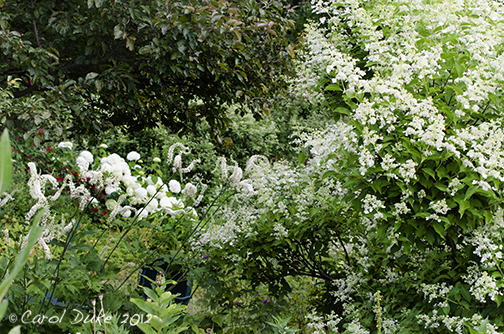
Recalling Landscape Tapestries of Summer Twenty-Twelve


While many are shoveling out from deep blankets of snow-drifts, I would like to escape our white wintry hillside by recalling landscape tapestries of summer twenty-twelve. Storms of blossoms unfurl throughout the spring and summer here at Flower Hill Farm attracting pollinators, birds and other beasts to our gardens, fields and forest. It is this living tapestry of color, texture, fragrance and sounds that inspired me to create this blog four years ago . . . February 6, 2009.


Over the last four years I feel I have grown as a photographer, writer and gardener from sharing the virtual world of gardens and nature with all of you. Lovely and brilliant fellow blogger Sarah of Sarah Laurence.com expressed it so perfectly in her sixth anniversary post when she wrote . . .  "What I see, I want to share with you. I do not walk alone in the snowy fields thanks to your company."

It is a joy to see the snowy fields of Maine through Sarah's eyes, as it is to see the opulent world of fellow bloggers and now dearest of friends Jane and Lance of the acclaimed Hattatt Budapest and Brighton blog. Blogging builds bridges to worlds we might never have known. It connects kindred spirits and activists for wildlife and I am so honored to know and be a co-author with so many talented gardeners and photographers on Carole Sevilla Brown's Native Plants and Wildlife Gardens blog and Ken Billington's  Focusing on Wildlife blog. I have just published the fifteenth installment of 'A Bestiary' which is a compilation of many tales regarding the wildlife that share Flower Hill Farm.

I want especially to thank all those of you who continue to visit and grace this blog with your thoughtful words even though I am not able to reciprocate as I once did. To gracious Eva, who has been with me since the beginning, who has no blog or link to share, please know that I am so deeply appreciative of your words of wisdom and endless support that always touches me to the core and inspire so much more.

The riot of life in these image memories is in such contrast to the cold and raw world that actually barricades me inside right now. I do have one door that opens inside but would have to trek through hip high drifts to get to other doors to shovel . . . and shoveling is not something I can do anymore either. Someone will arrive today or tomorrow to clear doorways and pathways, as well as, uncovering my little car. Having this medium to reach out to the world is fabulous anytime, but now, being literally 'snowed in', I appreciate it all the more. I am so grateful for not losing power and feel so for those who have. May it be restored quickly.

MANY THANKS TO YOU ALL! 


Sunday, August 12, 2012

Black Swallowtail Metamorphosis Misty August Garden


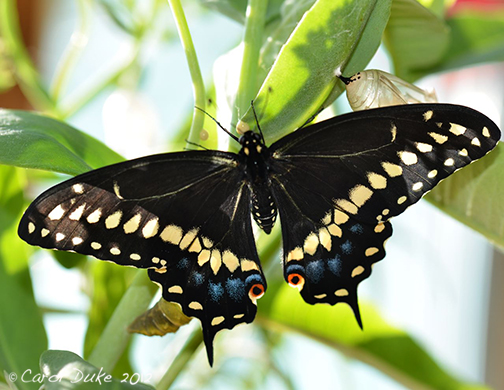
Black Swallowtail Papilio polyxenes 

I will be sharing more of the magical Monarch Butterfly Metamorphosis . . .
 but first I want to go back to earlier this spring and share the striking 
Black Swallowtail Butterfly and its metamorphosis with you. 


 A male Black Swallowtail from last year . . . the first one I had the joy to raise.


I was delighted to eyed this female ovipositing this May. 
She may have overwinter here in her pupa. 


Once she flies away,
 I discover an egg attached to Bishop's weed growing along the path. 
Aegopodium podagraria is of the Apiaceae or carrot family. 
I wish for millions of Black Swallowtail butterflies, for perhaps they can help me 
manage the pernicious Bishop's weed.  


The dark head of the tiny caterpillar can be seen in this photograph. 
A new beginning about to emerge . . . 


Having its first meal. 


Second or third instar. 


The Black Swallowtail caterpillar chooses the underside of an orchid leaf to unveil her chrysalis.


A perfect female Black Swallowtail


Releasing a healthy female into the late May gardens . . . perhaps she will become acquainted 
with the lively male (below) already enjoying the garden milkweed. 


Male Black Swallowtail

There are many more Black Swallowtails flying about the gardens 
but I have not eyed another egg to bring inside. 
This was the first 'inside' complete metamorphosis for the 2012 season . . . 
a couple of months before I found my first Monarch egg in the garden path. 

I have shared more information on the Black Swallowtail Butterfly's life cycle
 in another post over at Native Plants and Wildlife Gardens. 


Now nearly half way into August . . . 
days go by bringing many scattered thunderstorms 
sometimes dropping heavy downpours . . . 
the gardens and trees so appreciate the rain.
Mornings are often misty, cool and soft.
Butterflies enjoy the sunny afternoons. 
I continue to see many Monarchs, Black Swallowtails 
and several other varieties of butterflies flitting about the native plants.
There is a small Monarch caterpillar community in my barn studio.
This morning I was working hard trying to capture a teeny caterpillar 
emerging from its egg, while a female Monarch was flying about just
outside the window laying eggs on milkweed plants. Other caterpillars were
molting, while one was about to spin its mat and node so that it can hang
and unveil its chrysalis. 
All this and more goes on within the small view of the garden above too . . . 
truly miraculous to observe natures never ending small wonders.

Related Posts with Thumbnails