Showing posts with label lilacs. Show all posts

Wednesday, June 5, 2013

Bygone Lilac Time of May 2013


There are only about a dozen French lilac bushes here . . .  some being quite large and of various cultivars. We also grow several Syringa vulgaris or common lilac shrubs, (which most other cultivars came from originally), as well as, the more delicate Persian lilacs and a few Korean lilacs. There are three late blooming 'Miss Canada' or Preston lilacs Syringa x prestoniae in bloom just outside from where I am writing now . . .  luring many Eastern Tiger Swallowtails with their profuse pink blooms and filling my studio with their subtle, sweet perfume. 

Every early lilac shrub, Crabapple and Apple tree bursts into bloom all at about the same time beginning around the second week of May. My photography focuses on specific shrubs and trees as seen from different perspectives. The lilacs are the last to be featured within our May gardens and panoramic landscapes. 

Now, the lilac blossoms are turning brown and beginning to form seeds. The deciduous shrubs are being carefully pruned so that the plant does not waste energy forming seeds, and so as not to interfere with the newly forming buds for next spring.

A tour of the Bygone Lilacs  . . . 


In the upper garden just south of the farmhouse, we call our south gardens, standing near French lilacs . . . looking east over the top of our oldest Apple,  towards Walnut Hill, Carey Hill and High Ridge. 


From our second-level terraced garden of white French lilacs looking up towards the upper garden and purple French lilacs. I can only guess at the exact names of these cultivars for my records are shamefully lacking.


Still on the second-level terraced garden with the French lilacs, 'Bonsai' Apple (right) and Magnolia stellata (left) still holding a few blossoms . . . looking down towards the 'Gateway' Apples. The Apples are full blown, while the lilacs are just beginning.


Back in the upper garden looking east again towards Walnut Hill. You can see a bit of the purple Persian lilacs that also grow on the second-level terrace in our south gardens.


Looking northeast through lilacs, our oldest Apple . . .  out towards a stately Oak and the forest edge.
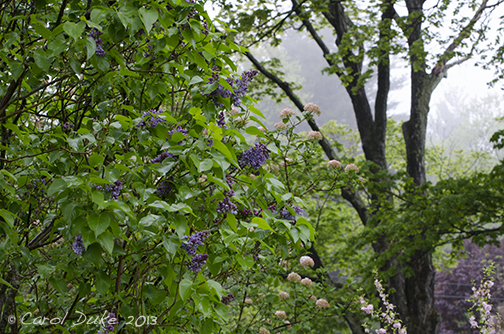

French lilacs and viburnum before giant Rock Maple, as seen looking west towards the road.


Standing on the second-level terrace looking up and north towards the old farmhouse framed by two giant Rock Maples on a bright sunny day my camera offers another view of our French lilacs and viburnums.


Inside the upper garden again looking out in the direction of the old Rock Maples on a misty day the fully blown lilac blooms are a bit wet and heavy.


An Eastern Pine Elfin enjoys the lilacs too. The tiny butterfly is nectaring on Syringa vulgaris 'Alba'.


The same lilacs and viburnum as seen above looking up from the rock garden beneath the 'Bonsai' Apple.


Outside the upper garden a hedgerow of viburnums, lilac and the most willful wisteria stand before a Shagbark Hickory with a climbing hydrangea.


Fully opened blossoms.


Magnolia soulangeana before French lilacs standing more to the left of the hedgerow above.


The last image from the south gardens on the second-level terrace garden, which features Persian lilac topiaries.


Looking towards the north garden and wildflower field . . . from behind the farmhouse.


Moving out behind the barn studio.


The view from inside the barn studio looking east towards Walnut Hill.


Along the edge of the Crabapple Orchard a smaller Korean lilac 'Fairy-tale' just beginning above and fully open blooms below.


Though I feel my gardens are too big for me to manage even with help . . . especially with all the invasives I have to battle, I must confess that May is a most intoxicating and joyous month for the most part. This year we did not even have the bothersome black flies . . . mostly thanks to the early drought and the Tree Swallows.

It was glorious walking about the May gardens with all these delicious shrubberies in bloom. The Hawthorns Crataegus made their show after all the lilacs were spent. Now walking into June with countless wildflowers, roses, iris, poppies, peonies and more unfurling and promising . . .  the garden is a constant theatre of form and color attracting this writer/gardener, as well as, a diversity of wildlife that adds so much more happiness . . . with exception to the rabbits and ticks.

HAPPY JUNE!


Wednesday, March 27, 2013

Flower Hill Farm Butterflies of 2012 ~ Red Admiral


When I wrote about the Red Admiral, Vanessa atalanta, in my first Flower Hill Farm Butterflies of 2011, I was bemoaning the fact that I had never seen this 'admirable' butterfly in my gardens. Well, from year to year, we never know how things might be. 

This past spring of 2012 I delighted in oodles of the brightly, patterned butterflies floating about like living ornaments, lit up by the sun, lighting and feeding all over the weeping crabapple just outside our little painting studio. Red Admirals were nectaring on the lilacs too. Proof that these members of the Brushfooted family do enjoy a sweet sip of flower nectar along with tree sap, when they are not focused on the more fermented yucky taste of rotten fruit or excrement, including that of birds . . . who eat butterflies . . . hmmm. 


Like their cousins, Painted Ladies, the Red Admirals live worldwide. 

In Massachusetts one might see admirals 'on the wing' from May through early September. They will choose a habitat near a wettish wooded area and must enjoy the several seasonal springs in our forest. 

Stinging nettles, false nettle and wood nettle along with hops will suffice for the caterpillars, who secure themselves within various leaves and munch through instars . . . finally folding a leaf over themselves to become a chrysalis. These butterflies will fly south for the winter months. Massachusetts sightings noting hundreds of Red Admirals moving west have been recorded along with other United States and European enthusiast reporting seeing "enormous numbers" . . . records go back for over a hundred years.


The migrating admirals admire the May gardens and do their best to flee when a bird's beak slashes their lovely kaftans. May is a time for parenting birds to forage for nestlings and they become discerning hunters making Flower Hill Farm a dangerous place for butterflies in any stage of growth.


The Red Admiral above appears to be enjoying a deep sip for his antennae is dipping down. Yummy.


We can all help out research by reporting migrating Red Admiral and Painted Lady butterflies to the Iowa State University research site. It would be great to learn more about their migrations.


I was overjoyed to sight this Red Admiral in Venice during my 2012 November visit. The dot just beyond my shadowy head is the little guy. You might think . . . what a terrible photo . . . why share that? I agree but must say before one passes judgement . . . this is a 'Venetian' Red Admiral. It was a thrill and still is when I see these images.


Near full golden moon rising above the ridge of Walnut Hill. 


It seems like this March full moon should be a Full Snow Moon continued but in fact it is the Worm Moon according to some Native Americans. Beneath the snowy fields the ground may be thawing and the earthworms are stirring which is great news to the woodcocks. Some call this March full moon Full Sap Moon and it is certain that our neighbors are burning sap in their sugar shacks, so that tells us that tree sap is running. Whatever one calls this moon it can always be call beautiful as it spins around our planet. Birds are singing at sunrise . . . they must know that spring is nearly here, though when I look out the window it seems faraway.


I cope by continuing to play with bright cheery colors from last years wildlife. 

More butterflies were sighted in the gardens in 2012 and I look forward to sharing them with you in upcoming installments of Flower Hill Farm Butterflies of 2012. 


Friday, January 18, 2013

Recalling Landscape Tapestries of Spring Twenty-Twelve


Looking out on a white and cold landscape, 
I dream of spring, though do not wish to hurry it. 
Since we are in January, I look ahead 
while also following Janus's glances back in time 
towards my favorite Flower Hill Farm landscape tapestries 
of spring twenty-twelve.


It truly is remarkable . . . experiencing the seasons . . . 
imagining this lush, joyous and verdant breath of life . . . 
now resting and dormant within the deepest protected layers 
of crusty, cellular trunks and fleshy roots . . . 
beneath the surface of frozen earth.

Monday, May 14, 2012

Quietly Walking About the Mid May Garden


Joyous song and fragrance fills the air about our hillside habitat and gardens.

Male Indigo Bunting

Delicious Viburnum and French Lilac

Lilac and Viburnum Looking Towards Mount Holyoke Range

French Lilac and Lilac Topiary Looking Over Toward Walnut Hill

French Lilacs and Lilac Topiary Looking Over Towards Carey Hill and High Ridge

Lilac Topiary Looking Into Lower Garden

Dwarf Fothergilla  and Lilacs Looking Down Towards Apple Gateway and Blueberry Field

Same As Above Only More to the Left

Tiger Swallowtail on Lilac

Viburnums Looking Down Toward Oak in Lower North Field From Inside Upper Garden

Between Viburnums Looking Down Towards Middle Meadow Garden Edge Japanese Maple

Japanese Maple and Three Graces ~ Crabapples and North Garden

Father Hugo Rose in Middle Meadow Garden

Male Baltimore Oriole 

Female Baltimore Oriole 

French Lilac and Weeping Crabapple Looking Up From North Garden Towards Rock Maples

French Lilacs and Fairytale Lilac Looking Out Barn Studio Towards North Field Birches

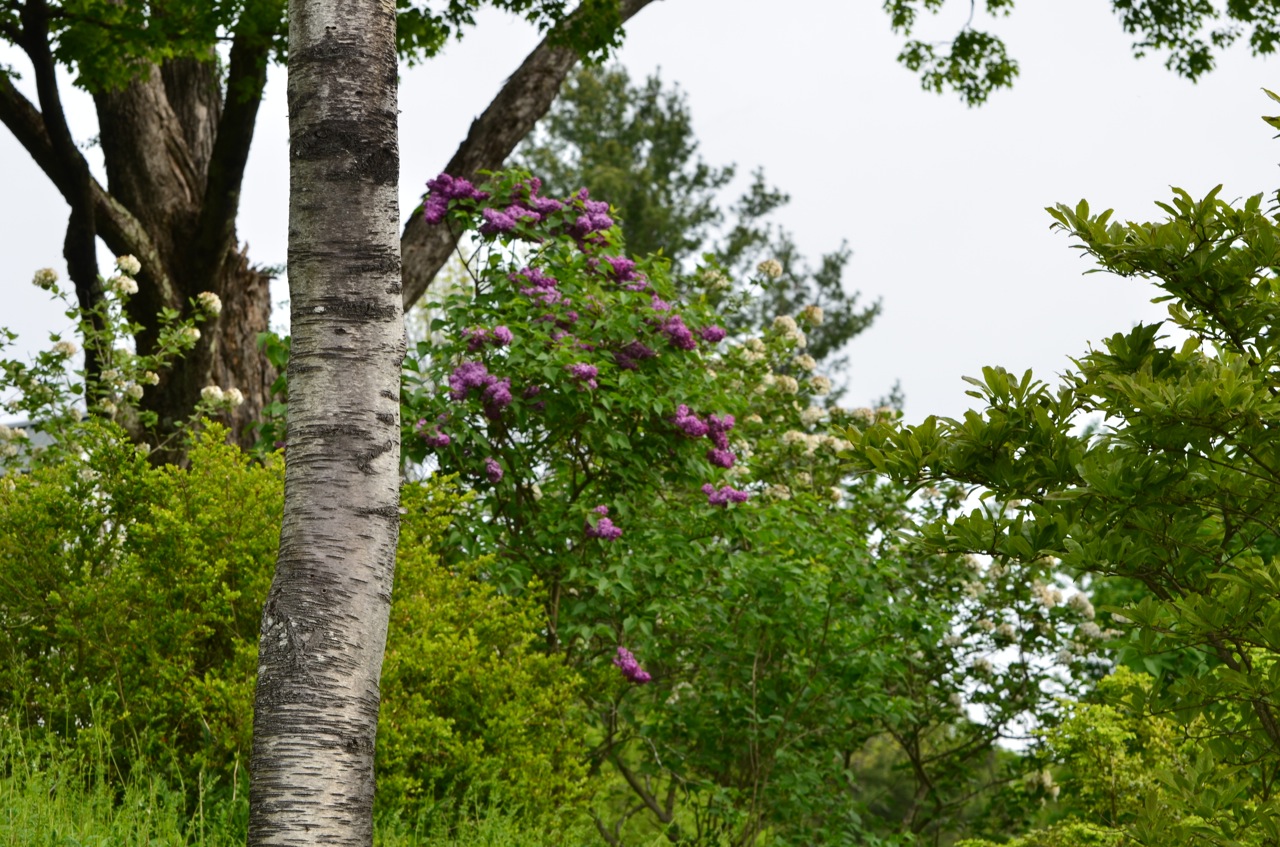
Looking Up From South Rock Garden ~ Gray Birch, Lilacs and Viburnum  Before  Rock Maple

Same As Above Further Along the Path


Looking Back Towards Gray Birch

Red Admiral on Lilac

Wisteria Before Lilac 

Magnolia Before Viburnum and Lilac Topiary


Red Admiral on Lilac Topiary

Joy spreads throughout the sweet petals of lilacs and viburnums and in vibrant wings of returning butterflies and birds . . .  cycles of life unfold. Unfurling wildflowers reaching up towards the light fill fields with dappled beauty . . .  bearing nurturing nectar for a bounty of pollinators. Colorful unsettled male birds are jousting with beaks and unarmored wings, while other bonded pairs are building nests and feeding young.
Spring is a riot of procreation. 


Related Posts with Thumbnails