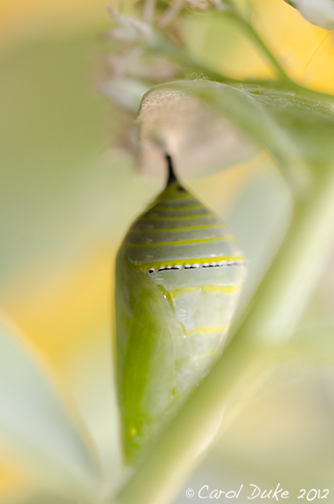
Showing posts with label Monarch Butterfly Caterpillar. Show all posts

Saturday, April 27, 2013

Flower Hill Farm Butterflies of 2012 ~ Monarchs


The Monarch Butterfly Danaus plexippus, is perhaps one of the most widely known and beloved butterflies. We know that climate change, threats to the fragile overwintering sites, pesticides and loss of essential host plants, Milkweed, is causing concern for the survival of these amazing navigators. Yet Monarch butterflies have survived for millions of years and somehow I must believe they will adapt to our environmental disasters and continue to do so. It is too heartbreaking to imagine otherwise.


Female Monarch butterflies have now flown from their over wintering sites in Mexico towards Texas fastening their eggs to Milkweed plants and then dying . . . passing the torch, as it were, to their offspring to continue further north and east until the fourth or fifth generation of the Monarchs, who took flight from Flower Hill Farm last fall, will arrive here to begin the Monarch butterfly metamorphosis anew. 

I have been so blessed for over thirty years by being able to share parts of the summer months with these remarkable butterflies. I cannot imagine life without this renewal . . . observing a unique transformation close up. Inspirational and joyous moments abound through the discovery of a small creature's struggle to grow, change and then take off on a momentous journey.


It is remarkable to consider that the intelligence, consciousness or genetic code is already set within this tiny form that will one day transform into another form supporting wings and then take flight to faraway lands. 

The cream colored Monarch caterpillar chomps through its clear, finely-etched egg casing and gobbles it up for its first nutritious meal. It will continue to munch milkweed leaves, flowers and stems growing and shedding its tight skin four times, not to waste a good meal the Monarch caterpillar will eat each pile of molted skin then pick up munching milkweed again . . . growing more until the fifth time when it unveils the chrysalis it has been creating inside the later clear black striped caterpillar skin. The yellow and white colors are the caterpillar body inside the skin.


A part of the butterfly that it will become is already tucked inside the little Monarch caterpillar and it will nurture that part of itself during the two weeks it munches milkweed, sheds its skin and becomes bigger and bigger till suddenly it feels the urge to weave a silk node and let go of its caterpillar self. 


Note the small silk ball or node the Monarch caterpillar carefully weaves and forms from the thin silk threads it pulls out of its spinneret. This is an important creation for the caterpillar, for its very life depends on its strength to hold the caterpillar, while it pulls up its skin to reveal its jade green chrysalis hidden inside of the black, yellow and white striped caterpillar. 

The Monarch caterpillar has also been building a 'cremaster' or pole just about where its hind feet are now. The 'cremaster' has hundreds of tiny hooks to hold fast to the silk button it is creating. This important part of the chrysalis will pull out from under the pile of skin to find the essential silk node and latch onto it, then thrashes around to be sure its hold is secure. 


One day a Monarch caterpillar whispered to me . . . 

"Please raise me with dignity . . . give me space and fresh air as I find out in the garden and fields . . . do not toss me into a box or jar or fish tank with dozens of others of my kind. You will never really get to know me that way. I may get sick and die from overcrowding. I play a very vital role in the making of what I become . . .  thank you for honoring that and my journey as a caterpillar." 


And now the curtain is about to rise! What do we see? A caterpillar or chrysalis? 


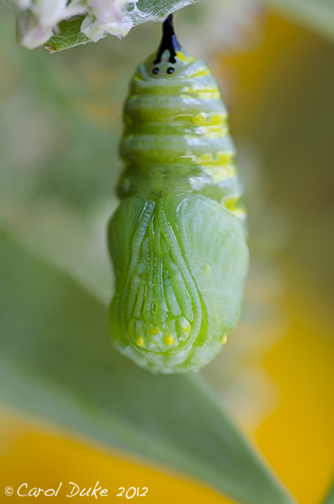
The caterpillar trachea is no longer needed so it lifts off with the old skin. The shape of the caterpillar is not quite gone yet. The chrysalis will shrink and a clear casing will harden enclosing and protecting the reshaping life.


A Monarch butterfly template is revealed within the forming chrysalis.


Tiny jewels hang for about two weeks while the Monarch metamorphosis takes place.


When it is time, a fresh new butterfly flips out of its protective chrysalis casing. The butterfly abdomen is bloated being filled with the fluids that will blow up the wings. Once they are fully blown out the butterfly hangs to dry like a fine dress on a clothesline . . . this can be a dangerous time for a butterfly. It must hold on tight and not fall or it will surely die.


When the Monarch butterfly's wings are dry and the butterfly is familiar with its new body and has discovered how all the parts work, it will begin pumping its wings preparing to fly.


Releasing Monarch butterflies is especially thrilling. 
Whispering 'Best of Luck!' We watch in amazement and joy as each butterfly takes its first flight.


For weeks during late summer enchantment fills our days.


The native plants and others in the fall gardens are more alive with Monarch butterflies readying for their long voyage to Mexico. Native Ironweed and Rudbeckia are particular favorites. Buddleia (below) or butterfly bush can become invasive in warmer climates. Here in my climate of today I can barely keep one alive. A Painted Lady sips nearby a newly released Monarch butterfly.
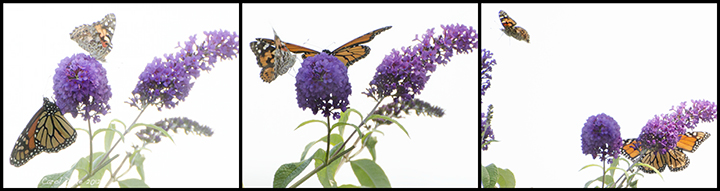


Sedum 'Autumn Joy' is a magnet for the Monarchs. 


The wild asters in 2011 were covered with Monarchs where Autumn Joy was the main attraction in September 2012. 


Whenever I share my favorite images of Monarchs of previous years, it seems like a celebration of incredible joy . . . of life and infinite possibilities for change.

We can all help these beautiful butterflies and others by never using poisons and by calling congress and the EPA demanding an end to the use of harmful chemicals that kill insects good and 'bad' and cause cancer and other diseases within human organs. We can also plant milkweed that is native to our areas to guarantee the monarchs will always have host plants.

Many are already seeing Monarch butterflies returning to their gardens and fields. I did have my first sighting in May of last year but did not find caterpillars until July.

I have one more butterfly post featuring butterflies from 2012 . . . it's a grand finale . . .  just in time, for the gardens are beginning to pop, birds are returning and I am excited to give a spring walkabout.


Tuesday, September 18, 2012

Monarch Butterfly Life Cycle: A Metamorphosis ~ Part Two ~ Jeweled Chrysalis


Though I greatly enjoy and respect the antics and heroics of the Monarch Butterfly caterpillar, the chrysalis or pupa stage of the Monarch Butterfly Life Cycle offers delectable candy for the imagination. 
The beautiful jewel like ornaments studded with what appears to be gold hang beneath leaf or twig completely vulnerable to the goings on around them. 
While breezes blow and rain and sun soak the landscape, hundreds of Monarch and other butterfly chrysalises hang hidden from view . . . so we must tread carefully in wild places and let our own land be allowed to grow somewhat wild too. 
We would not want to interrupt dreams . . . dreams of becoming free to fly to heights never before explored. 
Within fourteen days the ongoing metamorphosis is seen inside the clear casing of a Monarch butterfly chrysalis. 
Colors begin to appear filling out the forms of wings. 
The metamorphosis is truly one of natures marvels yielding hope and inspiration, as well as, beneficial and beautiful butterflies. 


It seems so miraculous to look upon a Monarch caterpillar imagining what is hidden beneath the black-stripped skin. 
The color of the chrysalis can be seen between the black stripes close to the caterpillar head. 


In the photographs above and below the yellow stripes of the caterpillar still remain distinguishable in the one hour or so neatly formed chrysalises. 
Soon they will vanish into a hue of pale jade green. 
The yellow, white and black necklaces that link back to the colors of the caterpillar and milkweed are clearly visible. 
Note the tidy black lines that only underline the white pearls beneath the solid line of yellow. 
Pure ornamentation? 
A tiny metaphor or token for a caterpillar who played its important part in the process?


Caterpillars like to hang close together and allow us to clearly see the differences between a one and two day old chrysalis. 
Yellow and white turn to gold, an alchemical elixir to reflect the sun and blind any predators from seeing the pupa. 
Perhaps just magic for the sake of beauty and joy. 


All signs of a caterpillar vanish into a green cellular soup within a hardened clear casing.
Life forms within the shadows too.


In about twelve days the colorful patterned wings begin to show through the clear casing.
A window into the miracle of an intricate matrix molding life.


Can you see the proboscis, legs and antennae? 


Just as the teeny caterpillar was trapped in a clear casing . . . now the butterfly must exit its tight fitted casing into the larger world, only now it has no mandibles equipped for chewing but strong legs and abdomen will push and wiggle causing the chrysalis sheath to yield . . .  opening on the template lines of its finely etched design. 
Part Three of Monarch Butterfly Life Cycle: A Metamorphosis will reveal emerging butterflies. 


Sunday, September 9, 2012

Monarch Butterfly Life Cycle: A Metamorphosis ~ Part One ~ The Capable Caterpillar


The mammoth Monarch Butterfly migration is underway.
Sightings are reported along rivers and hillsides, fields and meadows, 
gardens and parks by lucky viewers seeing hundreds of these skilled navigators flying south. 

Here at Flower Hill Farm there are numerous fresh Monarchs floating about the gardens each day. 
I have counted up to thirty on one Buddleia, 
while several are scattered feeding on Ironweed, Phlox and Liatris. 
Yesterday I noted the pink florets of Sedum 'Autumn Joy' 
dotted with both Monarch and Painted Lady butterflies along with hundreds of honey bees.

Many perfect days have passed where I might be found walking out into the gardens 
with newly emerged Monarch butterflies
 . . . happily observing as each gingerly takes their impressive first flight. 
Each departure unique, joyous and somewhat staggering
 as I had known these tiny magnificent creatures since they were 
but even more minuscule eggs. 

Which came first . . .  the butterfly or the egg? 
The Monarch Butterfly Metamorphosis begins with an egg and then the capable caterpillar and its miraculous feat of nurturing a chrysalis within. 


First there is an egg
but how did it appear?
A female butterfly 
fastened it to its host Milkweed leaf . . .   
not needing to tend her young she flies away
with many more eggs to oviposit.


A day or two goes by and a teeny black head stirs within
independently chewing its way out into its hairy leafy world.


Reading caterpillar body intelligence . . . this one seems to say "Boy, this feels good."
The egg capsule was a very tight fit. 


A newborns first yummy meal . . . munching its own nutritious clear egg casing.


 Chomping many milkweed leaves . . . first instar to fourth instar. 


Second instar compared in size to Milkweed or Oleander aphids. 


Molting along the way and turning to eat their old clear black-striped skin in each new stage. 
The ocelli or compound eye can be seen on the fourth instar above. 
Too tiny to be seen an antenna is near each eye
 . . . not to be confused by the two longer tentacles on the thorax and abdomen. 
Its now clear head capsule will have black stripes soon too 
forming a protective covering for the yellow head. 


Fifth instars pausing between chomps as growth inside 
forms transitional templates. 
It is nearly time to unveil its hidden self.


First the caterpillar can be seen securing a silk mat and knob
with the help of its singular spinneret . . .  
looking closely you can see it. 
Expressive tentative tentacles take part in the drama of the act. 


Meticulously extending out from the silk knob 
the fifth instar pulls silk threads creating an anchor mat, 
while true legs hold on to form the silk button its life will later depend on. 


Courageous caterpillar free fall . . .  holding fast to its handiwork. 


Stretching and splitting skin behind the head giving birth to itself.


The caterpillar tracheae is a lovely lavender purple pulling up with the clear black-striped skin. 
The chrysalis has its own spiracles or air holes and tracheae allowing it to breathe. 
I find this palette inspiring for a painting. 


Amazing to see what was already within the caterpillar. 


Twitching and twisting, the forming chrysalis works the old skin up 
and performs the amazing act of pulling out its shinny black cremaster,
   feeling its way over the pile of skin . . .  then
 the ebony barbed appendage hooks into the carefully formed silk knob. 


The old skin falls away looking like a dried up fly. 


More twisting 
 . . .  for the certainty of hundreds of hooks
 being securely fastened within the silk. 


Now . . . the shrinking act begins and all that resembles a caterpillar disappears. 


Viridescent fluid butterfly template 
wings, antennae, legs and proboscis 
all to be seen then disappearing into jade green.
A chrysalis is born.


A pearl necklace appears reminding all of the pure white toxic milky juice of milkweed. 


The capable caterpillar is not forgotten but painted here in a design
of white, yellow and black. What are the colors found in the caterpillar? 
A token of appreciation for all the many changes it had to go through? 


Later the necklace appears golden . . . still the colors of the caterpillar shine. 
Within a few hours a clear casing will harden to protect the chrysalis. 

As I write this first installment to my
 'Monarch Butterfly Life Cycle: A Metamorphosis' today,
 two . . . now three Monarch butterflies are emerging 
within a bouquet atop a table near the open French doors. 
Oh, I just noticed the one that became like a tassel on a silk pillow in a chair next to the table too. 
I see a fifth on a walking Iris plant near a cheery bouquet of sunflowers both on the same table. 
So, five monarch butterflies emerge while I write about their beginning. 
A caterpillar just completed spinning its silk knob and finally let go to dangle in a J
 as all the butterflies hang like wet laundry drying their stained glass like wings. 

Later, I will walk out into the gardens to release all these magical butterflies 
before heading off to the Berkshires and the 'Temple of Music' 
to hear chamber music at the South Mountain Concerts. 
Life can be enchanting here in Western Massachusetts. 

Next installment will be more on the captivating Chrysalis. 

Related Posts with Thumbnails