Showing posts with label Butterflies of 2012. Show all posts

Saturday, April 27, 2013

Flower Hill Farm Butterflies of 2012 ~ Monarchs


The Monarch Butterfly Danaus plexippus, is perhaps one of the most widely known and beloved butterflies. We know that climate change, threats to the fragile overwintering sites, pesticides and loss of essential host plants, Milkweed, is causing concern for the survival of these amazing navigators. Yet Monarch butterflies have survived for millions of years and somehow I must believe they will adapt to our environmental disasters and continue to do so. It is too heartbreaking to imagine otherwise.


Female Monarch butterflies have now flown from their over wintering sites in Mexico towards Texas fastening their eggs to Milkweed plants and then dying . . . passing the torch, as it were, to their offspring to continue further north and east until the fourth or fifth generation of the Monarchs, who took flight from Flower Hill Farm last fall, will arrive here to begin the Monarch butterfly metamorphosis anew. 

I have been so blessed for over thirty years by being able to share parts of the summer months with these remarkable butterflies. I cannot imagine life without this renewal . . . observing a unique transformation close up. Inspirational and joyous moments abound through the discovery of a small creature's struggle to grow, change and then take off on a momentous journey.


It is remarkable to consider that the intelligence, consciousness or genetic code is already set within this tiny form that will one day transform into another form supporting wings and then take flight to faraway lands. 

The cream colored Monarch caterpillar chomps through its clear, finely-etched egg casing and gobbles it up for its first nutritious meal. It will continue to munch milkweed leaves, flowers and stems growing and shedding its tight skin four times, not to waste a good meal the Monarch caterpillar will eat each pile of molted skin then pick up munching milkweed again . . . growing more until the fifth time when it unveils the chrysalis it has been creating inside the later clear black striped caterpillar skin. The yellow and white colors are the caterpillar body inside the skin.


A part of the butterfly that it will become is already tucked inside the little Monarch caterpillar and it will nurture that part of itself during the two weeks it munches milkweed, sheds its skin and becomes bigger and bigger till suddenly it feels the urge to weave a silk node and let go of its caterpillar self. 


Note the small silk ball or node the Monarch caterpillar carefully weaves and forms from the thin silk threads it pulls out of its spinneret. This is an important creation for the caterpillar, for its very life depends on its strength to hold the caterpillar, while it pulls up its skin to reveal its jade green chrysalis hidden inside of the black, yellow and white striped caterpillar. 

The Monarch caterpillar has also been building a 'cremaster' or pole just about where its hind feet are now. The 'cremaster' has hundreds of tiny hooks to hold fast to the silk button it is creating. This important part of the chrysalis will pull out from under the pile of skin to find the essential silk node and latch onto it, then thrashes around to be sure its hold is secure. 


One day a Monarch caterpillar whispered to me . . . 

"Please raise me with dignity . . . give me space and fresh air as I find out in the garden and fields . . . do not toss me into a box or jar or fish tank with dozens of others of my kind. You will never really get to know me that way. I may get sick and die from overcrowding. I play a very vital role in the making of what I become . . .  thank you for honoring that and my journey as a caterpillar." 


And now the curtain is about to rise! What do we see? A caterpillar or chrysalis? 


The caterpillar trachea is no longer needed so it lifts off with the old skin. The shape of the caterpillar is not quite gone yet. The chrysalis will shrink and a clear casing will harden enclosing and protecting the reshaping life.


A Monarch butterfly template is revealed within the forming chrysalis.


Tiny jewels hang for about two weeks while the Monarch metamorphosis takes place.


When it is time, a fresh new butterfly flips out of its protective chrysalis casing. The butterfly abdomen is bloated being filled with the fluids that will blow up the wings. Once they are fully blown out the butterfly hangs to dry like a fine dress on a clothesline . . . this can be a dangerous time for a butterfly. It must hold on tight and not fall or it will surely die.


When the Monarch butterfly's wings are dry and the butterfly is familiar with its new body and has discovered how all the parts work, it will begin pumping its wings preparing to fly.


Releasing Monarch butterflies is especially thrilling. 
Whispering 'Best of Luck!' We watch in amazement and joy as each butterfly takes its first flight.


For weeks during late summer enchantment fills our days.


The native plants and others in the fall gardens are more alive with Monarch butterflies readying for their long voyage to Mexico. Native Ironweed and Rudbeckia are particular favorites. Buddleia (below) or butterfly bush can become invasive in warmer climates. Here in my climate of today I can barely keep one alive. A Painted Lady sips nearby a newly released Monarch butterfly.
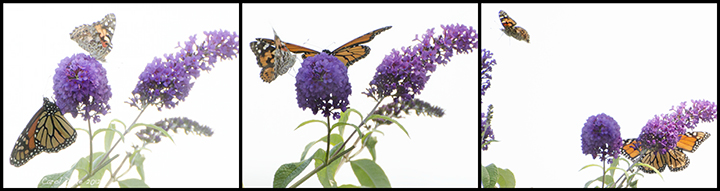


Sedum 'Autumn Joy' is a magnet for the Monarchs. 


The wild asters in 2011 were covered with Monarchs where Autumn Joy was the main attraction in September 2012. 


Whenever I share my favorite images of Monarchs of previous years, it seems like a celebration of incredible joy . . . of life and infinite possibilities for change.

We can all help these beautiful butterflies and others by never using poisons and by calling congress and the EPA demanding an end to the use of harmful chemicals that kill insects good and 'bad' and cause cancer and other diseases within human organs. We can also plant milkweed that is native to our areas to guarantee the monarchs will always have host plants.

Many are already seeing Monarch butterflies returning to their gardens and fields. I did have my first sighting in May of last year but did not find caterpillars until July.

I have one more butterfly post featuring butterflies from 2012 . . . it's a grand finale . . .  just in time, for the gardens are beginning to pop, birds are returning and I am excited to give a spring walkabout.


Monday, April 22, 2013

Flower Hill Farm Butterflies of 2012 ~ Skippers


Flower Hill Farm Butterflies of 2012 continues on this Earth Day, celebrating the butterflies that were sighted on our farm mostly over the past year. This installment features the teeny and erratic Skippers of the Hesperiidae family.

Skippers may not be the showiest of butterflies and this makes them all the more challenging to identify. Here is a terrific video site which reveals live in the field skippers that is great for learning how to identify these little butterflies.

I have tried with the help of others to identify the Skippers below but there may still be some mistakes. With many Skippers a guess is about as good as it gets, especially when the photographs do not show enough detail.


A Crossline Skipper Polites origenes, contently sipping from an Echinacea in the middle meadow garden last July. These tiny skippers fly for only one flight period beginning the end of June through early August. Females lay eggs on a variety of grasses found mostly in dry fields or other open habitats where the caterpillars will weave together two blades of grass for privacy while feeding.


The Crossline Skipper overwinters as third or fourth instars. 
I am not certain about the little butterfly sipping on milkweed florets in the photograph above. 
The Skipper above might be a Crossline Skipper or may well be a Dun Skipper.


A Dun Skipper Euphyes vestris, feeding last July in the middle meadow garden. These skippers are fairly common and might be seen in numbers of one hundred or more from late June through to the middle of September, though more often seen from the beginning of July till the end of August. The larva feed mostly on sedges. The delicate eggs are fastened one at a time to the leaves of the host plant where the young caterpillar will roll the leaves to feed. Dun Skippers overwinter as a third instar larva.


A Silver-spotted Skipper Epargyreus clarus, beneath the graceful curve of a not so gracefully behaved gooseneck loosestrife in our middle meadow garden last July. This skipper is commonly sighted in large numbers throughout the state of Massachusetts and has the coolest caterpillar form of a bright yellow with a red collar below its dark brownish head. Very striking and I wonder what the birds make of it. The caterpillars will fold over a leaf corner to feed and when older they fasten together two leaves with their silk threads creating a nest to hide within during pupation.


The Silver-spotted Skipper is larger than most other skippers and flies about gardens and meadows from May through October but more often the beginning of June to the middle of August. In Massachusetts they may only have one flight period. The females seek out various leaves of legumes such as Honey or Black Locust, False Indigo and some clovers to fasten a single egg to. I will carefully search the locust saplings I cut from the fields this year to see if I can find some Silver-spotted Skipper eggs of this butterfly. They overwinter as a pupa.


 I wish this was a native bloom! Yet another thug growing here at Flower Hill Farm. Lysimachia clethroides is native to China and Japan. We have it growing here between two mowed paths. I find it easy to keep in check but know that it can become very invasive. 


A mystery Skipper in the south field last July.


In an earlier post of Butterflies of 2011 I had not been able to identify the Skipper above. Hopefully I have it right this time. I would not be able to name any of these little Skippers without the help of the great website and generous folks in the Massachusetts Butterfly Club. Many thanks go out to Joe for letting me know Indian Skipper Hesperia sassacus, is the right name for this butterfly who was sunning on a milkweed leaf near a swarm of honey bees back in late May of 2009.

These butterflies fly about only from the end of May through the end of June when females deposit varying shades of green to white eggs on various grasses.

The fabulous Butterflies of Massachusetts site lists a number of grasses used by the larva. I will have to be sure to cultivate these in an undisturbed area near the forest edge here in future for these butterflies may be on the decline. I do not understand why it does not continue to fly and mate throughout the summer months. The Indian Skipper overwinters here in either larva or pupa forms.

I am so deeply thankful to our mother Earth for all of the diverse creatures that enrich my life daily. Butterflies are especially magical to me and through their amazing metamorphosis inspire a deeper appreciation for all life and the countless changes that abound within it.

Monarchs are up next on Flower Hill Farm Butterflies of 2012!


Wednesday, April 17, 2013

Flower Hill Farm Butterflies of 2012 ~ Fritillaries


Todays segment of 'Flower Hill Farm Butterflies of 2012' features the boldly flecked Fritillaries. It seems the only Fritillary that flies about our gardens these days is the Greater Spangled Fritillary Speyeria cybele. Early on, I mistakenly identified these butterflies as Aphrodite Fritillary, but the eminent Lepidopterist Randy Emmitt pointed out that the large beige band near the edge of the outer hindwing indicates that these are in fact Greater Spangled Fritillaries

I do so enjoy these butterflies whatever we humans tend to call them. There is but one single flight period for the fritillaries beginning in June and stretching into early September.


Giant Ironweed Vernonia gigantea is a native butterfly magnet with nourishing nectar for many butterflies and bees. I would never call it a weed, for it is very showy and stands beautifully with other late summer plants. The flowers are lovely especially when wearing strikingly, speckled wings.


Monarch butterflies frequent this valued native too. 


Fritillaries also love our non native butterfly bush. We only have the one plant which dies back each year. I have never seen a seedling. If you live in a more temperate climate, Buddleia can and does become invasive through seeding, I believe . . . so you might be sure to deadhead or consider alternatives. I confess to loving my sole bush, as long as it behaves, that offers long plump, purple, panicles of blooms for all sorts of butterflies and bees to land upon. A little Skipper sips near the Greater Spangled Fritillary. Hummingbirds also love this native of China. Climate change may well make this species an unwelcome visitor, but for now it is a showy and giving member of our garden just outside the farmhouse and studio.


A Painted Lady nectars along side two Fritillary butterflies.


Joe Pye weed Eutrochium purpureum, is another great native that Fritillaries, along with other butterflies, moths and bees are attracted to for its bounty of nectar. This tall member of the Asteraceae family is a comely, compatible companion to the impressive Giant Ironweed.

The wide beige band between the two rows of white markings is clearly illustrated in the image above. Again, this is a telltale sign that the butterfly is a Greater Spangled Fritillary and not an Aphrodite. I imagine the name greater spangled is for the glint of the white, silvery-spotted wings.

The first instar Fritillary caterpillar overwinters here beneath or near a violet plant its mother Fritillary would have fastened its egg to towards the end of August or early September. Once out of the egg the tiny caterpillar eats only the egg casing before dropping or crawling down to find a leaf or other detritus to serve as protective cover throughout the winter. Remember not to be such a fastidious gardener and instead leave safe houses for lots of overwintering caterpillars, chrysalises and butterflies.

The Fritillary caterpillars, that survive the birds and rabbits, will awake in May when the violets begin to leaf out and munch their way into June, until they feel an urge for change and seek a safe rock or log where they can privately morph into a brown chrysalis. With the passing of two weeks or so a butterfly will emerge . . . the males usually emerge first flitting about seeking a suitable female who pushes her way out of the chrysalis a bit later than the males.


Speaking of males, I was drawn away from my writing this morning by these toms way down by the forest edge.  I could not lift the lens that would make these more vivid images. Wild Turkeys are busy stepping around lifting up leaves and debris in search of some of those overwintering delectables I have been writing about in this series of butterfly posts.


Shooting into the sun does not make for very vivid photos either but I love the way the tom's wattles are lit up by the bright early morning light. I am afraid the Wild Turkeys notice my presence, when I step out to get a better look, and quickly take off to the lower lands and into the cover of the forest.


I usually hear Wild Turkeys before I see them . . .  for there is some impressive courtship and alpha male vocalizing going on right now. I note a few hens in a lower field, while the toms are still stepping out together. There will be a split up soon and a group of toms will go off on their own leaving the dominant gobbler to care for the hens. I hope they have not found too many of the overwintering caterpillars and chrysalises and yet I want these beasts to be healthy and happy too.


My first 2013 sighting, just this morning, of a Palm Warbler  Dendroica palmarum. I notice at once that this little guy is busy scurrying along the ground looking for those tiny morsels of caterpillar and chrysalis like the robins, turkeys and bluebirds. I am so amazed any butterflies ever make it to fly in our gardens and fields.


This sweet songbird may have made it back here from Florida or as far as the Caribbean.  


Next up on the Butterflies of 2012 I will share some of our resident Skippers and then a post on the Monarchs before the grand finale. 


Friday, April 12, 2013

Flower Hill Farm Butterflies of 2012 ~ Eastern Tailed-Blue and Summer Azure


Flower Hill Farm Butterflies of 2012 continues with two little Blues of the Gossamer-wings family. Last year in July, I had an exciting first capture of an Eastern Tailed-Blue Everes comyntas, which I spotted along the edge of the south field. A bit smaller than the Summer Azure, these small beauties are also considered common throughout most of the eastern half of North America. 


The Eastern Tailed-Blue has three flights beginning around the middle of May through the first part of June, then the middle of July till the end of July and mid August through to late September. To make identification confusing each brood may look somewhat different. A tell tale sign of the Eastern Tailed-Blue is the orange eyespot like markings on the bottom hindwings and the tiny thread like tails, though as with the one captured here those may disappear with time. They are such beautiful little butterflies. I so wish the wings were fully open to illustrate the gorgeous blue but a peek shows a bit of the color that seems to vary between broods and sexes.

In between these flight stages would be the time to search out the single eggs and dark green caterpillars on buds and stalks of clovers (if the rabbits leave me any) and various legumes. Here at Flower Hill Farm the little blues might enjoy the vetches growing in the airy north and south fields and perhaps I might find caterpillars along the forest edge.


Eastern Tailed-Blues overwinter in their caterpillar stage.


Summer Spring Azure Celastrina ladon, is perhaps the most confusing butterfly I have ever tried to identify. Thanks to Joe from the Massachusetts Butterfly Group on Facebook, I think I have it right. The sighting of this tiny 3/4 - 1 1/4 blue was just outside our little studio last August. This makes it a summer form of the Spring Azure, if I understand correctly. The Azure is considered common and flies from early spring up to early September throughout much of the United States.

A great diversity of plants and shrubs serve as hosts for the larva that resembles a slug, including cherry, blueberries, maple, dogwood, viburnum, oak, lupine and more and more. It is a wonder since Flower Hill Farm has all of these and many more of the other listed host plants and trees that I have never seen this butterfly here before. I can only assume the birds are incredibly fastidious in searching out the caterpillars and then the butterflies, or I have just not been in the right place at the right time.

The butterflies also choose from a variety of flowers. Males congregate along streams and puddles and will sample excrement and carrion. Azures prefer fields with shrubs to an open airy field, so I now know to look more in the blueberry fields when they begin to flower, for the caterpillars prefer flowers to leaves. Right now the chrysalis forms is in hiding perhaps below the blueberry bushes in the photographs below. Azure butterflies only live for a few days, beginning courtship and then laying eggs very soon after emerging from their yellow-brown chrysalis.


Within  the blueberry field above and below, Azure chrysalises may be safely awaiting the unfurling of buds.


The little caterpillars of the Eastern Tailed-Blue will have to remain hidden from the sharp eyes of the Bluebirds. 


It is truly overwhelming to imagine all the hidden life within these fields . . . section of north field above and south field below . . . both will be filled with wildflowers in a months time.


The returning Tree Swallows fill the sky with fluid dance, songs and champagne like gurgles. 
Their presence in the gardens and sky above is pure delight and they eat hundreds of biting insects each day.


I hope there will be plenty of food for the birds and that many of these precious blues will survive to fly about the wildflower and blueberry fields later this spring.

Our temps have dipped back down into the 30's with some sleet and snow showers promised in a day. Though I love the warmth, I would rather have these colder spring days than suddenly having summer upon us. We had a couple of days in the 70's this past week and the heat makes all the new emerging life move too quickly. I so love a slow spring after a long winter, one that allows us to pause and celebrate renewal . . . and now I have a bit more time to catch up with last years butterflies!


Related Posts with Thumbnails