Showing posts with label Cedar Waxwing. Show all posts

Monday, March 24, 2014

Waiting with Wildlife for Spring's Return


We are all patiently waiting for spring to arrive here in Western Massachusetts.  Flower Hill Farm has no buds a bloom in the trees or scattered about the snow covered grounds, and though I may be a bit weary of this winter, I can see signs of spring in the arrival and behavior of some of our wildlife.  I have seen turkey vultures soaring high over the hills and do note more song filling the rawness of early morning.  Also, sap is flowing within the sugar maples, while stacks from sugar shacks are ushering plumes of sweet steam into the chilly air.


A Red-shouldered Hawk woos me with his strikingly patterned wing span and full tail fan, as he flies from Michael's Black Cherry tree towards the forest below.  More ephemeral than a spring flower but what a warm rush of awe I feel in witnessing this flight.


The bluebirds are ready for spring to finally spread our way too.  I cannot help but think he is trying to tell me something coming in out of the bright sunshine, to perch in the cooler shade closer to my door.


 I am curious why the bluebirds never eat the crabapples, when so many other birds find them tasty.


Cedar Waxwings are seemingly content harvesting American Cranberry bush Viburnum and crabapple fruit.  I am seeing them through a studio sliding door and screen which gives a more pastel feel to the image.  The bright yellow tips of their tails remind me of daffodils that must be stirring a bit beneath the snow.


Waxwings filled the naked trees like large buds.  They will perch for awhile and then suddenly all will dive like a small cloud into the crabapple orchard and feast on the apples.  There is a flock of waxwings out in the crabapple orchard as I write this, but they are mostly still, taking in the warmth of the sun, on this 18 degrees Fahrenheit frigid morn.


On the ground there are hundreds of animal tracks crisscrossing around the snowy gardens and fields.  Here a white-tailed doe gracefully displays her namesake as she walks through the middle garden mirroring the white landscape.


 In the crabapple orchard, could they be munching on the tiny fallen fruit.  It has been a very long winter and all the wildlife must be longing for a heartier meal.


I startle the deer, when I open the door to have a closer look and they quickly flee into the north field.


I have always wanted horses and find them beautiful to see out in fields.  Seeing deer bounding through the snow covered scenery adds cheer to the still clinging winter day.


White-tailed Deer do very little damage here but this critter is an entirely different matter.  She chomps off-shoots of shrubberies as if they were celery sticks.  Clearly some beasts are more compatible for waiting out spring's return.  To be fair to the Eastern Cottontail, I could add that most shrubs do recover from this pruning.


Wild turkeys, however, bring such fun into the gardens.  When they fill the scene their liveliness is so comical and uplifting.  I sense they are very winter weary too, as they literally leap and lift themselves up into the trees.  This hen is not leaping for joy here but for the tiny crabapples that are abundant in the canopies of the small trees.


A hen harvests apples from up in the crabapple tree, while a few toms skid and slip about below picking up what she drops in the slippery snow. 


Sunlight is perfect lighting — illustrating the bronze-green iridescent wild turkey plumage.  This male displays his long beard or tuft of hair.  I have yet to find an explanation for this odd detail that only males don.


Such colors brighten spirits still longing for spring.  All these visits come within a day except for the Red-shouldered Hawk, who visited one day earlier.  These beautiful creatures simply take each day as it comes and in observing their grace and patience, this human can bear the wait for spring's return with gratitude and good faith too.  


Wednesday, January 8, 2014

A Frightfully Frigid Winter Interlude


Winter is becoming a bit freaky across the country creating whirlwinds of bone-chilling chaos and disasters in many states.

Here, icicles dangling like dangerous claws, can be likened to imaginary bars of winter's bitter prison blocking healing warmth. 


Pruning will fill up much of February and March if days warm enough to hold pole clippers and saws.


What was I thinking to plant a climbing hydrangea on the beautiful Shagbark Hickory . . . a good trim here and there will open to view some of the striking textured bark. Still, winter does reveal the beauty of this marriage. It is summer when the groovy Shagbark is lost to me. Lichen alters another tree's bark, as noted in the distance, on a sound and solid oak.


Bearing up to the cold, resident buteos choose cherry and oak, standing tall within the north and easterly fields, as their lookout perches. A juvenile Red-shouldered Hawk eyes the frozen solid ground, and the human not too far away within warm barn-studio walls.


The Red-shouldered Hawk feels uncomfortable with my presence and so takes flight towards the forest and river below.


Our more frequently viewed buteo, sighted just a few minutes after the Red-shouldered flew off, prefers the distance of an oak firmly holding along the eastwardly slope. Red-tailed Hawks are always welcome by this community member but not so appreciated by most birds of our habitat.


Red-tailed Hawk 


I am never surprised to see crows, blue jays and even hummers and tree swallows chasing buteos. New Year's Eve day showed me yet another bird or flock of birds in chase of a hawk. Cedar Waxwings are barely visible in the top tier of the oak the Red-tailed Hawk is also occupying.


A closer look above and their shapes become perceptible but not their mood for only moments after this shot, and too quick for my capture, about twenty or so waxwings were in hot pursuit of the Red-tailed Hawk.


Soon, after the chase, the Cedar Waxwings began doing what waxwings are most often seen in pursuit of . . .  harvesting and gulping down little crabapples. I did not know they had such pluck to chase a hawk away.


I am shooting through a glass pane and still cannot escape the watchful wary eye of at least one of the waxwings. 


The crabapples are delicious and nutritious treats . . . with or without snow cream. 


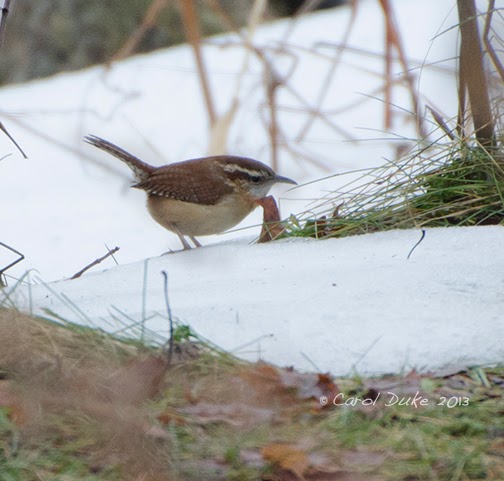
Another winter surprise is the sighting of a Carolina Wren . . . I had no idea they overwinter here and have been told, by a serious ornithologist, that if it gets too cold the wrens will just die, for they will not think to fly further south. This little fellow already made it through the minus 13 F night a bit ago. It is about 4 degrees Fahrenheit right now, as I write, and I do wonder how this Carolina Wren is keeping warm. I hope homeless folks too are able to find safe shelters in order to stay warm throughout this chilling winter spell. 


Friday, December 20, 2013

A Winter Focus ~ Cedar Waxwing Ornaments and Long Nights Moon


The nakedness of winter's landscape can sometimes seem cold and lonely, when suddenly, whoosh, all together in flight, a flash of fluttering life lifts the spirit high towards outermost tips of a beloved Black Cherry tree. Offering light and enchantment to the lucky viewer, a flock, an 'ear-full', a 'museum' of over sixty Cedar Waxwings alight, sprinkled along the top of the skeletal cherry canopy, resembling delicate ornaments bedecking leafless limbs. 


A closer focus reveals hints of waxwing antics, patterns and forms. A group that may rest and then be off together, a burst of beaks, trebles and feathers, winging through the crisp air down to our crabapple orchard.


Surrounded by colors of autumn and captured through glass, so as not to frighten the timorous Cedar Waxwing, I cannot quite focus the bright yellow tip of its tail or the yellow wash covering its downy belly. Tiny apples are hanging temptations, little-bitty baubles, winter apples waiting to be plucked. Only these are nourishing . . . vital winter food for the waxwings, robins and wild turkeys too.


Every inch of branch, twig and dried stalk, wearing icy snow-coats all across the fields, groan of winter's beauty. 


During a storm . . .


After a partly sunny day . . . snowy mantles melt away.


Into wonder of long black nights, native cherry, charcoal raven touching crumbling cerulean sky, tickling the 'Full Cold Moon'. A joyous interlude between dark and light.


Rising up from swirling surf of clouds, following the setting sun, the 'Long Nights Moon' sails across the painted pastel sky.


Night folds us into our dreams until daybreak, shattering the dark, while scattering light and soft puffs of rosy pink, awakens a new day. An old, softened mountain slumbers still beneath a mantle of lavender smog, as days, nights and solstices dissolve one into the other.


Dreamy underwater illusions, a world of sediments worn down over millenniums, torrents of lava flows from time and crust torn apart. A deep plentiful supply filling an ancient tectonic rift . . . pressure forced up molding forms Native American-like silhouette looking up longingly, for millions of year, towards the sky. A segment of the Metacomet Ridge, of the Mount Holyoke Range dreaming since days of dinosaurs, within my view.

Presently, with placid anticipation, life moves through a calendar of months making what it can of each. Filling the hours minute by minute, spilling seconds by the spoonfuls. It is all over in a wink.

Winter Solstice 2013 is marked on our calendars for tomorrow December 21st, for those of us in the northern hemisphere, the exact moment is never certain, when the shortest day will give birth to the longest night of the year. After a few days, we will note the lengthening of light, as a rebirth, a celebration of our sun, leads us deeper into winter. Peace and Goodwill and Good Day to All.


Tuesday, October 11, 2011

Berry Busy Fussy Birds


"Whoa!" said the Cedar Waxwing to the Northern Flicker. 


"Hey! Can you not see this branch is occupied???!! And don't you know you are a woodpecker!??" 


"Sorry."


"Do not loose your feathers over it . . . I just did not see you for all the ripe berries luring me in. Yes! Of course I know I am a woodpecker, and if you were paying attention you would have noticed that I often perch rather than hold onto branches and trunks like some of my cousins. By the way,  I saw Ms. Pileated Woodpecker on this Viburnum bush just last week! I am most often seen on the ground stirring up leaves and so forth using my somewhat curved bill to dig for ants and beetles, but I do so enjoy supplementing my diet with berries too!" 


 "Well, be that way . . . flying off in the middle of a conversation."


"All the more berries for me!"


"What are you looking at?? Do not tell me you too think I look odd perching this way?"

Admittedly I did think the Northern Flicker looked at bit out of its element, when coming in for a landing so near the outraged Cedar Waxwing. It was more humorous than anything except clearly NOT to the Cedar Waxwing. Both are beautiful birds even when they are fussy!
 It was really odd to see a Pileated Woodpecker flying into the Viburnum weeks past now and seeing its large beak picking these small black berries. 
The berries are long gone now and the lovely ridged leaves are a deep burgundy color adding to the brilliant fall colors on the hills and in the garden. I do not recall the name of this Viburnum but believe it to be a native species. 
I hope you might visit 'Native Plants and Wildlife Gardens' to see my new post on native asters. It is a great site and I am honored to be one of the team that shares the importance of native plants and gardening for wildlife. There are many great posts on the site so look around, if you can spare the time and check back often, for a new article is posted daily. 

A great OP-ED for Occupy Wallstreet


Sunday, February 20, 2011

Birds in Review Part XVIII 'A Bird Parade'


Bohemian Waxwings

The Great Backyard Bird Count continues through tomorrow. Yesterday we had horrific winds and every respectable bird was hidden somewhere safe. Today was bright and without
the howling Boreas or north winds, I  did count many Cedar
 Waxwings and Robins in the Crabapple Orchard.


Cedar Waxwings


Above is a portrait of a Robin singing in the Spring . . .  then another below seemingly of a surly disposition. 


Perhaps his scowling expression has more to do with defending his nesting area, for I was close to the Apple tree where later a nest was built. I do think the light paints both of these photographs with a drop of magic. 


I have not seen the Cardinals in many days, for last summer's drought prevented the Rosa rugosa from producing many rose hips. 


This will be interesting for the bird count, for they are usually here every day during the winter months. It will show from my last years list that they are missing.


I have seen two pairs of Chickadees however.


I love this spring shot showing a male singing his tiny heart out. 


I have counted two Titmice! These images from last year are to me very dear.


The image above and below were taken today. Those little black dotted eyes look towards me, as if to say . . . Well what do you have for me please? 


The Bluebirds checked in today, as well, and I can add five to my list so far. 


This is the first posting of my 'Bird Parade' . . .  a list in images of the birds photographed here in my wildlife habitat and gardens over the last two years. I am digging through my archives to line them all up in a colorful procession.


The processions of night and day . . . moon and sun . . .  continue across the sky above Flower Hill Farm. February full moon is seen here rising over Carey Hill. I long to paint a sky so beautiful. 


Next morning sunrise, painting a rose gouache wash above the Mount Holyoke Range.


A welcome spell of warmer days did eat the winter cake, not leaving a snow crumb behind. I cannot be certain another cake will not be created, before this winter is through with us. 
My bird parade will take me back into spring, summer and fall which will help brighten the coming chilling cold days. 
Related Posts with Thumbnails