This year, early spring was dry and perfect for butterflies here in the fields and gardens. Of late we have had rain, rain and more rain that must be a great challenge for the survival of our exquisitely painted pollinators. Though butterflies are not the most efficient pollinators, they do aid in pollinating many of our wildflowers. Along with all the luscious blossoms of spring, butterflies add such joy to our lives.

This has been an amazing spring for Mourning Cloak Nymphalis antiopa, butterflies. Last year I did not see one here at Flower Hill Farm but this spring I sighted over eight before I capture my first image. I have seen three more since these images and then yesterday found a very tattered and weak butterfly resting on a white iris. About fifteen sightings here in all . . . and that is only when I happen to be looking.
The Mourning Cloak is the only butterfly that has been recorded flying through every month within Massachusetts. Since it overwinters in butterfly form, it can wake-up for awhile during warmer days. HOST PLANT - birches, poplars, American Elm, willows, hackberry and others.


A first of life sighting here on the second of May was an Eastern Pine Elfin Callophrys niphon, flitting about in the blueberry field. I am sure it has flown about the fields and gardens for years . . . only I did not notice due to it being so tiny and my being more impressed by the larger and bolder patterned butterflies. What a world of wonder I had missed for years. The first photo was too blurred to share. I had seen the first sighting right before I went out to North Truro for a week getaway, where I saw many more Eastern Pine Elfins. Upon returning home I did see the butterflies in the images above among the Lilacs and in the blueberry field. HOST PLANT - Pines, White Pine, Pitch Pine, Red Pine


Another first sighting for me here in May is this Eastern Comma Polygonia comma. You can see clearly the little white comma on its wing that helps to identify this butterfly. It overwinters here as a butterfly along with the Mourning Cloak and both may come out of hibernation for awhile during warmer days. You can see the tattered wing in the photograph above. Birds are very busy butterflying too.

This was my first ever sighting of an Eastern Comma seen in North Truro May 8, 2013 just days before I was able to find one at Flower Hill Farm. This photograph helps to illustrate what the butterfly looks like with wings fully opened. Another tattered gown . . . hard to be a butterfly. HOST PLANT- American Elm, Stinging Nettle, False Nettle, Wood Nettle, Hops.

Little Pearl Crescent Phyciodes tharos, live and breed in this habitat in large numbers. On any given day, except of late with all the rain, I see more than twenty or so flitting about in the fields of wildflowers.

I have come to really admire these bright and lively butterflies. HOST PLANT- Asters

Around mid May these Sulphurs began to show up among the wildflowers . . . the birds took notice too.

It can be hard to determine a Orange Sulpher Colias eurytheme, (above) until the butterfly opens its wings revealing a bright yellow painting with bold orange spots . . . all darkly outlined.

Clouded Sulphur Colias philodice is finely outline in pink. HOST PLANT - Vetches, Alfalfa, White Clover, sweet clovers, and legumes.

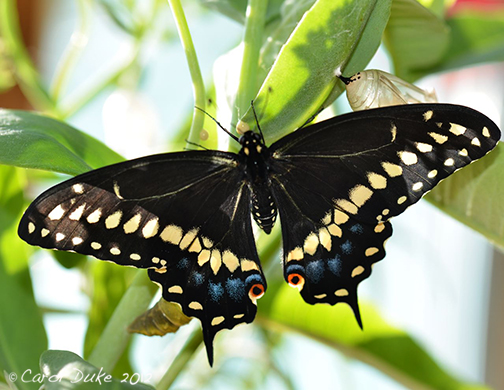
Black Swallowtails Papilio polyxenes and Eastern Tiger Swallowtail Papilio glaucus, butterflies enjoy both garden blooms and the wilder ones out in the fields. HOST PLANT - Black Swallowtails - Carrot family. Tiger Swallowtails - Black Cherry, Magnolia, Beach plum, Chokeberry, Apples, Poplars and more.

I am allowing more of the grasses here at Flower Hill Farm to grow undisturbed and have paths mowed around large swaths. The Common Ringlet Coenonympha tullia, really appreciates my efforts and I have the delight of seeing their rich rusty orange wings, on most sunny days, as they fly about the gardens and fields.

Exquisite creatures, that may often be overlooked, thrive in our grassy areas. HOST PLANT - Grasses

American Copper Lycaena phlaeas, is now one of my all time favorite butterflies. This tiny butterfly is painted as beautifully as any larger butterfly and is plentiful here in our wildflower fields.


It is easy to fall in love with the teeny gem American Copper butterfly . . . especially when back lit by the sun. HOST PLANT - Sheep Sorrel and sometimes Curled Dock

Yet another first ever sighting this Hobomok Skipper Poanes hobomok, form Pocahontas, was enjoying our wildflowers on a sunny day in May. Thanks to Frank of the Massachusetts Butterfly Club for identifying this one for me. HOST PLANT - Various grasses

The very first sighting here of a Juvenal's Duskywing Erynnis juvenalis, sighted on the same day not far from the Skipper above. I had seen many of these butterflies while visiting the cape earlier in May.

The Duskywing butterflies may be duller than many butterflies but the intricate designs of their markings are quite stunning. It is interesting to observe these butterflies, as they are very territorial. HOST PLANT - Various Oaks

I nearly missed the Little Wood Satyr Megisto cymela, as it flew about the garden. We only met for the first time last year. I imagine we have co-existed for many years, I simply never noticed. HOST PLANT - Various grasses and sedges.

There are four first time sightings here at Flower Hill Farm in this group of May butterflies for this butterfly enthusiast. I am hoping that June will bring more first time discoveries and that I continue to grow as a butterfly steward enhancing the habitat to attract many more species of butterflies . . . whether I notice them or not. Now, I have thirty species of butterflies recorded as sharing this habitat with me. Hopefully that number will climb upwards by this butterfly seasons end.