|
| Actias luna |
One morning in July I found this lovely pale male Luna Moth sleeping on the clapboards next to the front door of my house. I carefully lift and carry this beauty into the studio, for he would surely have become lunch for a Chickadee had I not eyed the moth myself. He can continue dreaming of a mate more safely indoors on this plant. (If you have time here is a great video of the Luna Moth life cycle.) He continues dozing until dusk, then I hold him out into the night and watch as he awakes, quakes and using my hand as a flight pad . . . takes off . . . his ghostly wings uniquely flapping side to side rather than up and down like most other moths and butterflies. I have only ever encounter them in May never seen one this late in the summer. I felt like I was given a gift.

What a life . . . having no mouth . . . no need for food . . . a Luna Moth simply sleeps all day and flies about all night, with one goal . . . finding a mate. They have one full week of life in this manner. In my garden, the female may lay her eggs in groups on leaves in the Shagbark Hickory tree.
 |
| Male Luna Moth . . . the wide full antennae are the giveaway. |
Luna Moths are so incredibly beautiful. Someday I will post about a spring, when nearly thirty come to visit over a period of a couple weeks. I imagine my human visitors may have left their outside light on during the night, which attracted this moth. Birds appreciate the mistake and feast on sleeping Saturniidaes. I have seen the hunt and try to wake the moths, but mostly they just fall to the ground . . . this is why I began bringing them inside to have a safe place to sleep. I try to remind guests to turn off their outside lights. I will not deny that in this case I am not upset about the remiss.
 |
| White-tailed Deer Odocoileus virginianus |
Oh, I see you little one! I have often called my farm 'Flower Hill Fawn Care' for sometimes a doe will leave her babies to sleep in the flower borders or hidden within the shrubberies, while they roam further to forage. I was lucky once to see one doe at pick-up time. Remarkably the Deer do very little damage to my gardens. We have an understanding most of the time.
 |
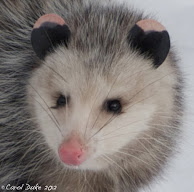
| This Virginia Opossum Didelphis virginiana |
This creature cannot seem to make up its mind . . . going up . . . or going down?

 |
| Bobcat Lynx rufus |
One of my most amazing visitors . . . you can see my earlier post on this Bobcat along the side bar. He takes my breath away!


 |
| Coyote Canis latrans |
I am happy to finally see this fellow in the light of day. We have known each other in the garden at night . . . he or she growling at me, when suddenly realizing I was nearby. The frightful sound pierces my solitude and I do not feel quite welcome, as I jump out of the hammock . . . from my quiet moon watching meditation . . . shouting towards him while clapping my hands. I can see a form running away, but that night I did not have my flashlight.

I would like to think that my presence just makes her uneasy, as I am so quiet and the wind may be blowing in the wrong direction for my scent to be detected. We have another encounter the next night in a different part of the garden. Perhaps she is just caught off guard and her growl is more from fear. Equipped with my light this time . . . I can see her form more clearly . . . with those eyes lit up staring back at me. Wild creatures such as Coyotes and Bear run away when frightened then stop and turn around . . . looking back at what it was that scared them off. Finding this rather disconcerting I always walk with a quick step . . . not running. . . back towards the safety of my house. Alas, I have given over the night garden to the wildlife. Most likely this Coyote would not harm me, but it is a wild creature and I respect its right to be here too. Often there is a pack howling and carrying on in the garden. Their chilling calls are thrilling. This one seems to be a loner. This gardener/farmer greatly appreciates their skills at hunting rabbits and voles. I worry for the little fawns and yearlings, while knowing there is a balance at work here. Coyotes are native and have been wandering the land for millions of years.
 |
| Least Weasel |
I am very grateful for this little critter too. I only wish he or she would not raid bird nests. Weasels do enjoy dining on rabbits and voles as well. There is the danger with all these predators . . . for the larger ones to kill the smaller predators. I think Weasels and Ferrets might be better at controlling Rabbits. I hope they are more clever than the Coyotes.

Catbirds are rather brazen at times . . . here they challenge the Least Weasel.
I love that my gardens and land are home to so many different wild creatures. I do sometimes wonder just who is the visitor here. It is Blooming Friday over at Katarina's Roses and Stuff be sure to visit to see other garden visitors from around the world.