Showing posts with label Smith College Botanical Gardens. Show all posts

Sunday, March 13, 2011

Birds in Review Part XXVI 'A Bird Parade' American Redstart With Surprise Spring Bonus


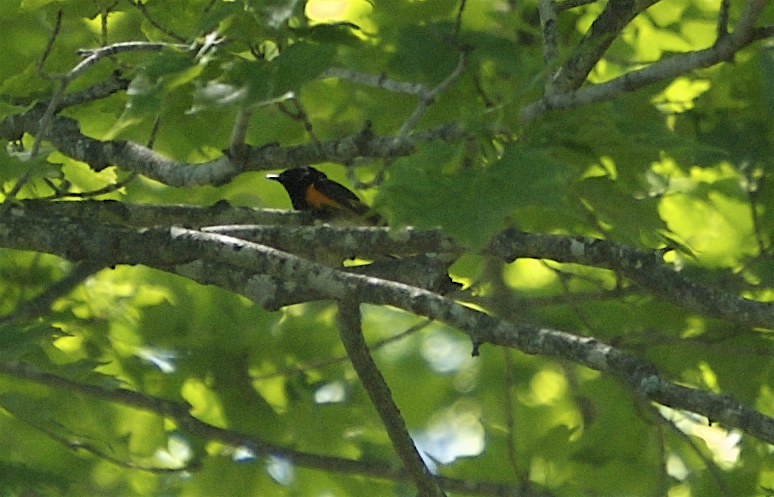
Continuing on with the promenade of Flower Hill Farm birds captured over the last two years . . .  allow me to introduce our resident American Redstart (Setophaga ruticilla). The male American Redstart flashes about the gardens and forest with his brilliantly painted tail fanning out then consuming confused and frightened insects. While working in the gardens, I will often catch a glimmer of his orange tail feathers glinting in nearby trees and shrubs.


Male American Redstart


Here is a good example of why I should go into my Metasequoia and clean out the dried dead twigs.

Male American Redstart

American Redstarts sing high pitched tweets, which are depicted by ornithologists as "Wee-see, wee-see, wee-see" or "tsee, tsee, tsee, tsee, tsway." When I hear and recognize his songs and calls, I will spin in all directions to espy the small black hooded warbler with splashes of reddish-yellow feathers about his body. Sometimes he stretches to espy me too!

Female American Redstart


The female wears a more dull gray coat with yellow trim. 


Female American Redstart

I identify this photo as a female American Redstart but it could be a immature male too. It takes two years for the male to produce his bold patterns of orange and black.  A young male may try to attract a mate but it is most unlikely he will succeed, until his plumage perfects its more colorful presentation during his second fall. He may become polygynous . . . perhaps he feels the need to make up for lost time . . . once his first female has a secure clutch, the American Redstart will find another territory and mate. He is a very energetic little songbird and perhaps it is not too much of a strain, to care for two mates and broods. 


An American Redstart coming so closely, allowing me to capture this portrait, was perhaps amazed and curious about my presence as well. I look forward again to eyeing their quick flashes of yellow-orange flitting by. Gardeners and birders in Florida, Georgia and parts of South and North Carolina may be seeing these songbirds migrating from Central and South America soon. Many neighboring states will have them as residents all through the breeding season. They breed over a wide range, covering a large area of the eastern and middle United States, all the way up into eastern and western parts of Canada.


Here in Western Massachusetts, we have a great way to escape the still chilling mantle of days by visiting  the Smith College Conservatory, where a splash of spring awaits! It was a special treat to step into a carefully assembled garden of spring bulbs simultaneously abloom! 


A glimpse into one section of the Smith College bulb show. These vibrant colors are such a healing tonic for the longing psyche. 


This morning there is a surge of song across the large sweeping sky above and spilling down into the landscape of Flower Hill Farm. Bluebirds are chirping to one another . . . especially the male, Robins are finding bits of bare earth to stealthy stalk, a Cardinal is singing his heart out towards his beloved, Mourning Doves are cooing and many of us are up an hour earlier, as we spring ahead into spring. The river below is raging and rushing over rocks . . . its unbridled roaring music is so alive and invigorating. Several seasonal streams that crisscross my land are churning up debris and layers of leaves of yesteryears. The sounds of gushing and flowing water makes my blood flow faster and energizes my winter tired soul. 

This is surely the most remarkable time of the year, when we stand before burgeoning rivulets and flourishing rebirth within the landscape. Trees are awakening, releasing vital energy via sap that rises from the lower protected cores, defying gravity as the life fluids race upwards towards tips of branches, soon to be swelling and bursting forth in buds and blooms. Our imaginations blossom to meet this renewal. Creative energy soars with the canopy of clouds and takes flight on wings of birds excited for the new season of promise and vigorous growth. Nature does not seem to be always kind and I know that for many there is a great struggle ahead . . .  be it due to natural disaster or inner depths of despair. I hope this coming spring may lighten loads and open new channels of love and creativity for all life. 
Our calendars may not say spring but nature is shouting it in many corners of the globe. The stirrings to our spirits and waking earth are a mid March occurrence that brings about a near smile to the stretching gardener preparing to be set free from frigid fasteners of winters grasp. We in the northeast are nearly free for the birds and waterways are singing so!


Wednesday, June 16, 2010

Full Blown Pergola Update!!! Wordless Wednesday


The flowers are making so much noise! Shhh! To learn more about this luscious pergola just scroll down to my June 12th post.

Saturday, June 12, 2010

Smith College Capen Garden Seasonal Sharing With Eva and Blogging Friends

Smith College's Capen Garden is a garden of rooms to discover.
In the winter all is cold and quiet.
The Laurel and evergreen mystery hedge with a pruned archway become enlivened in spring.
I love the mysteriousness created by the hedges and lattice archway within the gazebo. Visitors are lured from room to room through these living walls.
Hundreds of Tulips are planted by Smith College botanical students in a formal way around the gazebo honoring Jill Ker Conway . . . the first woman president of the college (1975-1985.) It only took a hundred years for an all woman's college to finally have a woman president.
The old rustic pergola is lovely all through the seasons. It is hard to imagine what will come from these naked thorny stems.
When the roses begin to exhale in the spring . . . 
it is truly phenomenal!
A lovely garden to show visiting blogger friends Liisa of Green Mountain Gardener and Jean of Jean's Garden.


We could not find the names of the various varieties, but I do know who to call and ask, when I get my pergola in place at Flower Hill Farm. One must have dreams and work towards them.


We rested for awhile on these tree stools and admired the gardens. When suddenly a new visitor arrived.
The garden kitty took a liking to Liisa.
The lovely beds along the base of the pergola begin with spring bulbs and continue on till frost with perennials. There are also learning beds to the right with iris of many varieties all labeled with rather large markers. I was surprised to see the Iris and many Peonies had gone by, when we visited.
Another step back in time to see the astounding difference of the seasons.

I am enchanted with this rustic pergola and its exuberant display of climbing roses. It was so delightful sharing it with you Liisa and Jean! 
A Clematis looks gorgeous with a climbing rose in the background. Next posts will be about our visit to more gardens at Smith and Emily Dickinson's Homestead. 

Thursday, January 28, 2010

Smith College Winter Conservatory For Liisa

Winter can be lovely with it's canvas of white and startling shadows, yet we long for more light and colorful blooms of spring. The Smith College Lyman Conservatory allows visitors a peek at their Spring Bulb Show in its infancy right now. A walk through the Conservatory is delightful and a feast for all the senses. I was to be sharing this day with Liisa from  Green Mountain Gardener  but studies did not allow her time to travel down from Vermont. So Liisa I will dedicate this post to you and hope it will inspire you for your spring visit. I met Liisa over at  Blotanical  and find her blog filled with inspiration and understanding of nature's wisdom and beauty. Her posts are always beautifully written and a great resource for gardening ideas. If you have never visited her, you are in for a treat!
Several weeks will pass and this room will be filled and overflowing with fragrance and blooms of hundreds of tulips, hyacinths, daffodils, freesias and more. A riot of color will knock you out when you walk in the room . . . personally it always feels overwhelming to me and I believe I prefer the more subtle time of beginnings . . . buds showing colors and nearly bursting at their seams . . . with others just opening, spilling out their luring scents. These Cineraria are lovely to me just as they are.


I love the different stages of growth in these primroses! The freesia plants behind them will offer an array of colorful blooms and a delicious bouquet.
Now we are standing in what will be the entrance to the Spring Bulb Show. . . the walls will be filled with flowering branches that will stand brightly blooming above the dazzling colors of tulips. You can see through the door the room we were just visiting . . . note the tall freesia in the back all lit by the sunlight. The late afternoon light is fading and the Conservatory will close soon . . . so lets move on into other rooms where many blooms await us.
Walking out of the cooler rooms into the corridor there are lovely Camellias in bloom.
 There is no doubt an interesting story behind these sculptures and column but I forgot to ask . . . I will update this soon. Perhaps a link to Dionysus or Demeter?
Here we are in the 'Stove House' (once heated by a wood stove) which is filled with orchids, bromeliads and epiphytes. There is a water tank in the center of the room that I will present in a later post. 

Phalaenopsis (Butterfly orchids) are hanging over the center water tank, along with many other orchids I cannot identify. Along the side table are various flowering Paphiopedilums (Lady Slipper orchid).
We will quickly walk through the 'Warm Temperature House' on our way out of the Conservatory, as it is four o'clock and the doors are closing. I will bring you back inside on another cold winter day.
We can sit for a moment in the sun before walking around the botanical gardens and the Smith College Arboretum. You might remember this dramatic Camperdown Elm from an earlier post on these gardens.
This majestic Gingko tree was also featured in my earlier Smith College Botanical Garden posts. If you follow that link you can see many views of the gardens along with the Chrysanthemum Show and last years Spring Bulb show at night! This post will show up on the link too . . . just scroll down. Next time I will take you along this walk to share some other incredible trees and then we will return to the Conservatory to warm up and see more of that marvelous indoor paradise. It is the last Blooming Friday of January 2010! Visit Katarina's Roses and Stuff to see other blooms from around the world!
Related Posts with Thumbnails