Showing posts with label Turkey vultures. Show all posts

Friday, April 13, 2012

Nature's Black Knight ~ Raptor of the Dead


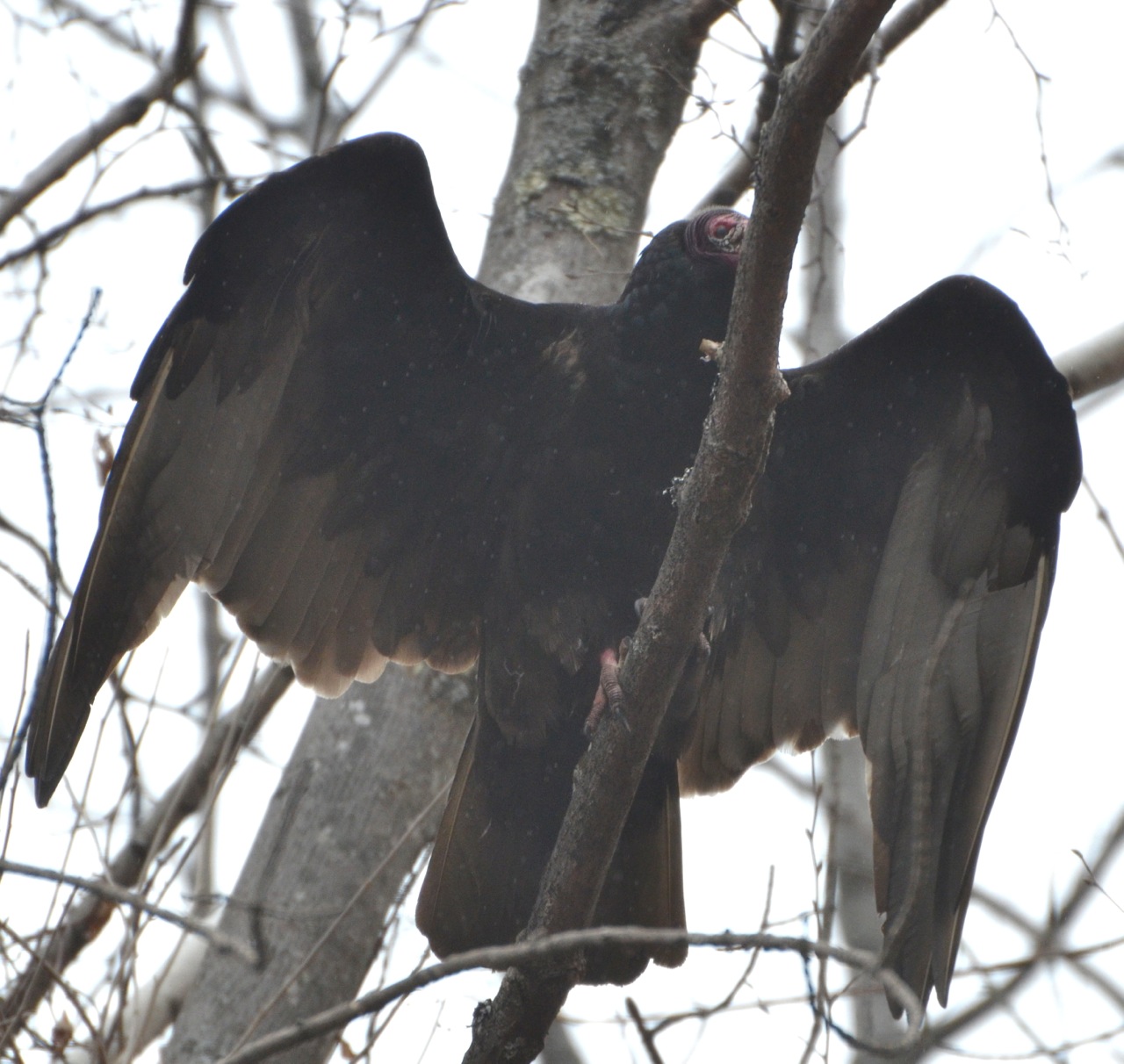
Dark as a moonless night, this new world vulture . . .  nature's silent black knight Cathartes aura, emanates mystery, while evoking macabre images from the minds of many that view him. 
Turkey Vultures are truly remarkable diurnal creatures, preferring carrion to fresh meat and purifying our world as they dine. If you were to change the 'C' in its scientific name for a 'K' you would have the Greek derivative Kathartes meaning cleansing or purifier. Carthartes aura means purifying breeze. 
It is hard to imagine our world without Turkey Vultures or vultures of any kind.


I feel the intent, glaring stare upon me here, but do not fear for I know that these dark lords of the sky do not attack the living. Perhaps it is only a curious stare after all. 


Spring is a time of song but not for this magnificent being, who makes only sibilant sounds . . . a sibilance of hisses . . . air streams emerging from deep within. 
This Turkey Vulture is letting me know he or she is annoyed with my approaching too closely in the south field. The sinister sound is meant to frighten me away and the Turkey Vulture seems piqued by my persistence. 
They are known to grunt, cough, rattle and if really upset, vomit might spill down upon me. 
Singing is out, for they are not endowed with adequate vocal organs. 
Smelling is keen however, for unlike other raptors, vultures have super sophisticated olfactory organs. Note the rather large nostrils. 


A rapacious raptor . . . perhaps when feeding, but otherwise they get on quite well with one another and can migrate in flocks of up to a thousand individuals. Turkey Vulture roosts are sometimes as large as one hundred. 
What a sight that must be and to hear that many hisses at once . . . creepy yet thrilling.


Vulture comes from the latin vellere, to tear, and this princely bird of prey comes equipped with a sharp hooked ivory beak. 
I find it very impressive especially as it is not built to kill.


Misunderstood and even mistreated vultures are revered in some cultures where 'sky burials' are favored and vultures play a key role in their beliefs for releasing the spirit or soul of the dead. 


If hisses do not frighten you away . . . here is another way to let you know that I am big and fierce. 
This is a WOW experience. 
It must be a challenge to keeps ones balance with wings spread up to six feet. 
A first fauna encounter after being off the farm for a week and it being suggested that I do not use enough black and gray in my paintings. 
I have read that the TurkeyVulture is really more black-brown but being this close up it appears black enough to me. 
Never having encountered a perched Turkey vulture before, I feel very lucky to have eyed its large form in a young oak along the south field. 
Luckier still that the vulture allows me to approach so closely and take over three hundred photographs. 


Are you not frightened yet??


Oh Well. 


I will be off then . . . to heights you cannot but dream to reach!
Even though I speak kindly and with great admiration for the majestic grace of this Turkey Vulture, he finally spreads his wings for flight . . .  instead of fright . . . and soon was soaring out of sight. 


Vultures die when they eat the remains of poisoned critters. Yet another good reason to never . . .  ever use poisons. 
All vultures are actually aseptic animals and do not spread disease. 
I should love to have an immune system such as theirs . . . these cleaners of our dead keep our world safer and sweeter. 

Hellebores are poisonous but used to cure madness. 

Spring is a sweet time of year and buds are beginning to burst here at Flower Hill Farm. 

Dark apple trunks dancing in the mist . . . contrasting gray birch.

There is ever mystery in the process. 


The Turkey Vulture would not have been moved by flattery from a fox as was a fabled crow, but perhaps you might enjoy my latest installment to my bestiary over at Native Plants and Wildlife Gardens. 

Update: April 15, 2012
Another very valuable black/brown creature has returned to Flower Hill Farm . . . I sighted my first bat last night!! Finally the fungus that is killing our bats has been marked as the real killer and hopefully now a cure can be found . . . before it is too late. You can call congress and the white house and demand funding for this important research. I have called and I hope you will too. We do not want to have a world without bats.


Monday, March 26, 2012

Flower Hill Farm BUTTERFLIES OF 2011 - OTHER LEPIDOPTERA FAVORITES


Hummingbird clearwing Hemaris thysbe, also known as Hummingbird moth, is out in the gardens and fields sipping nectar during the day and often at dusk. 


People sometimes confuse Hummingbird clearwings with a real hummingbird due to its habit of hovering while feeding with its long proboscis. Host plants include honeysuckle, hawthorns, plums, cherries and snowberries.


Note the difference in the two species above and below. 


Snowberry clearwing Hemaris diffinis is more black but its coloration can vary. 
As its name implies . . .  this clearwing relies on snowberry. Other host plants are honeysuckle and dogbane.  Snowberry clearwings also fly about in the daytime and are more often seen in the summer months. 


All of the clearwings or Hummingbird moths are spritely flyers and like many butterflies they depend on our not being too fastidious with our clearing of debris, for they need leaves to spin within their cocoons and detritus along the ground offers protective covering through the cold winter months, while the pupa wait for spring. 


The lovely pale green Luna moth Actias luna, is one of the largest moth species in North America and is only active in the dark hours of night. Females can lay up to two hundred eggs. Here at Flower Hill Farm our Shagbark Hickory, White birch, Walnuts and even Sumac act as host plants. The caterpillars munch on leaves and shed their skin five times, as their relative butterflies and then overwinter in their silky cocoons beneath the chosen host plant. 
The adults have no mouth parts . . . imagine a simple life of sleep, flying and mating for one week only and you have an idea of the life of an adult Luna moth.
I forget to turn off a light the night this Luna moth comes to visit. Early next morning I carefully carry the sleeping moth inside, so that the birds will not have an unfair advantage. He sleeps all day and when the curtain of night falls, I hold him out to the dark air and watch as the beautiful creature takes his ghostly flight into a night of pursuing pleasure.  
They have amazingly strong wings but sometimes fall prey to our beloved bats.


A member of the Saturniidae family, Luna moths only have one brood here in the northeast. I usually see them in May but the one above was found in June. It looks like it might be already a few days old.


Another member of the Saturniidae family, the Rosy maple moth Dryocampa rubicunda also has no need of a mouth for they too do not eat as adults. Much smaller than their Luna cousins, the Rosy maple moths will also be attracted to a light and then will sleep through the night and next day. If a light is accidentally left on, I try to get them to fly into nearby plants in order to hide from birds. Females lay eggs on leaves of oak, sugar maple and other maples. The caterpillars spin a cocoon and sleep through the winter months. 


A mystery moth in the clutch of a flower crab spider. 
Moths can be very beautiful and their caterpillars can be very striking too. 


White Spotted Sable Moth Anania funebris, can be found in our fields and gardens in the daylight. 
The host plant is Goldenrod.


Intricately patterned mystery moth found on tree peony leaf.


Lovely white mystery moth with a yellow line through both wings found on iris. 

I missed Katarina's Floral Friday because I was enjoying a break with a dear friend by the sea . . .  and studying color with a fabulous expressionist painter and teacher through Provincetown Art Association and Museum.
Though there is not a wildflower within any of these photos the moths are pretty wild and hopefully considered wild enough for Gail's Wildflower shadings. 


The light and colors in Wellfleet, North Truro and Provincetown were magical! 
Wildlife was wondrous. 
I came home to spring but tonight is dipping down into the teens. Ouch! 


I think it fitting that upon arriving home . . . my first wildlife encounter in the gardens would be this magnificent Turkey vulture. (An amazing encounter I will share later.)
My teacher has encouraged me to use black paint in my work. 
Black can surely evoke power.
Turkey vultures are certainly more 'photogenic' than I had imagined. Attractive might be a stretch but truly . . . what a magnificent creature. 
Happy Spring to All! 


Wednesday, November 2, 2011

Haunted Perceptions of Nature's Creatures Scary Climate


Turkey Vultures Cathartes aura (cleansing breeze) soaring high in the air are quite beautiful and majestic with a wing span of over six feet. They are intelligent and extremely important in preventing the spread of disease. Friends to farmers and gas utility workers alike for cleaning up dead carcasses and locating gas leaks, the Turkey Vulture's role in our ecosystem is unique and valued thus protected under the Migratory Bird Treaty Act of 1918. 
Still many find these vital carrion consumers repulsive and even harbor haunting notions of fear regarding them. In fact they rarely kill live animals, are non-aggressive and can become fond of humans . . . while still alive. I read of a story about a young boy, who had an enduring endearing relationship with a Turkey Vulture that would walk along with him to his school bus each day and when the bus drove off the vulture would fly off to hunt for food, returning to meet the boy in the afternoon. 
Perhaps their bright red faces are not classically beautiful, but they can boast being equipped with the largest olfactory organ found in any animal perusing air or land. They have good eye sight as well, making them well equipped for finding dead animals . . .  if conditions are right . . . within a twelve mile range soon after their demise. We all save tax dollars by not having to pay workers for the removal of road kill. Purification has been a symbol and synonym throughout many cultures in classifying these raptors. Vultures cannot call out or sing lovely trills, for they have no voice box. These gentle birds must get by communicating in hisses and grunts or if they feel threatened they may hurl 'vomit' towards any intruder. Admittedly when I listen to this hiss I do find it a bit spooky. 
Pumpkins along with some fruit and vegetation are also acceptable to their palate.  
I enjoyed watching several Turkey Vultures this spring as they gracefully glided above Flower Hill Farm each morning. I had never seen them come so close . . . at times only ten or twenty feet above where I stood camera in hand. 
There are those that have a great fondness for Turkey Vultures and you can learn a good deal from visiting their site. 


What I find really scary is the climate! I was out during the storm shaking shrubs and small trees to release snow . . . luckily there is not much damage here, but down in the valley where more trees had leaves there were hundreds of limbs and trees down on power lines.
After digging out of the epic October snow storm and enjoying the return of power . . . I do so appreciate running water and not having to read with a flashlight . . . I ponder the oddity of a landscape wearing green and colorful leaves, while beneath the canopies . . .  thrown far and wide . . .  rests a two-foot pile high snow carpet.


Watch out below! Avalanches of heavy snow fall fast from the roofs. 


After a morning of sunshine the landscape begins to look almost normal . . . until you look down.


The warmer days are melting the snow and hopefully before the weeks end the white carpet will melt into the earth as 'poor man's fertilizer.' This overdose may intoxicate the plants and trees! 
Our perceptions of what Autumn brings here in Western Massachusetts and beyond are forever changed as our climate surprises and haunts us with what may yet come. This was our second snow storm in October . . . a month that had not seen accumulations of snow in one hundred years. Very freaky storms . . . especially this last one.
Let's all act towards thinning our carbon footprint in our daily lives and demand that our leaders stop wasting time and money developing dirty energy. 
Please Call the White House today and say NO to the Keystone XL Pipeline.
Why not encourage more investment in green energy too! 

Wednesday, January 5, 2011

Birds In Review Part lll Two by Two Sometimes Three Sometimes More


When I saw these two Baltimore Orioles engaged in a feather duel, I was stunned. This is not their first appearance on my blog . . . this encounter is from a June or July in 2009 . . . the year I began writing this online journal of my land, gardens and wildlife habitat. As I approach the two year mark, I am wading through thousands of images to create these bird review posts. I cannot help but think of a lovely dancer with fans spread wide . . . flowing fabric around her ankles (even though these are males) as she leaps into the air towards her partner. Mother Nature is a marvelous artist. It is easy to see which male is in charge and pursuit. Every feather on his body is spread out to give him a larger and more threatening appearance. We all have the tendency to defend our homes. These birds were in conflict not far beneath the Baltimore Orioles nest! This photo happened by pure chance . . . well, I was paying attention to what was going on around me and was ready with my camera. It is not great in quality of pixels because they were too far away. Whenever we crop a photo to zoom in closer we lose resolution . . . therefore I could never make very good large prints from this image. Still just seeing this small drama in the garden was a great gift to me . . . having the birds in frightful flight to share . . .  an added joy.


It was truly amazing to me to capture a Cardinal behaving in the same way in that growing season. We cannot see the other male but this one's meaning is clear. I did see another male fly away in haste from the site or sight!


Then there are avifauna that seem to do quite well in each others company. These Cedar Waxwings and American Robins (below) mass together in large flocks. The Waxwings were observing Nate and myself pruning  two days ago . . . we were giving more air and light to the center of one of their favorite shrubs. I have several Viburnums that birds enjoy, planted in a cluster or hedgerow manner. Cedar Waxwings, Catbirds and others love this arrangement for the food and the protective cover the leafy shrubs offer their nests. 


American Robins remain here all winter and feast on the many tart rose hips and crabapples.


Some birds enjoy hanging together by threes in trees. Along the trunks and on the many leaf less branches. These young Yellow-bellied Sapsuckers were most likely raised here and might be siblings.


These darling Bluebirds perch together in a Rock Maple, above a wild rosebush wearing hundreds of tiny rose hips. They were happy when I stepped in and asked or insisted that the Robins stop being bullies and that they were not to chase the Bluebirds away. 


I had my camera set up in an open window to get these shots. It was so sweet how they all came down after I had come out to speak firmly with the Robins. You simply cannot please everyone I have learned . . . for the Robins were appalled and just flew away. There is plenty to go around I just asked that they share.  The Bluebirds delighted in the juicy hips.


Oh, there seems to always be something to spar about. 


Just as I was preparing this post . . . yesterday . . .  I caught these two Bluebirds. I believe they might be two males, as they both appear to have a good amount of blue coloring. Then again, it could be a male and a female having a dispute over the accommodations. He might think the box quite good enough, where she finds it far too rustic. 


I have seen this behavior before with a perfectly happy Bluebird couple. These very poor images are taken through glass but do offer yet another glimpse into the daily life within the world of birds, when the peaceable kingdom is not so at peace. Having said all of this, I will add another possibility . . . perhaps it is a type of courtship dance??  Perhaps it is a male and female and the male is so happy that the female has settled on a house that he flies over to her and they dance! Any expert advice would be appreciated.


I have wanted to capture this dance for many years. I believe these are siblings and they are mostly experimenting with the whorl of feelings within. 


We all know how territorial male Hummingbirds can be. I have seen them flying high in a water spout fashion using their bills like swords. I observe them often swimming through the air in large smiles or semi circles over a terrified or perhaps indifferent hummer hiding in a shrub or such. This behavior I believe is both territorial and a form of courtship. Who can keep it all straight! I suppose the birds do. I find them so very precious and I love their plucky spirits. I have even seen a male flying after a hawk!


Now for the most gracious flyers of all. When the Tree Swallows return in the spring . . . I run out and spend time just watching them fly. I traveled in Europe for a year in my youth . . . I bought a guitar in Spain from the man who made it . . . and taught myself to play. One of my favorite songs was 'The Swallow Song' by Mimi & Richard Farina. It is a beautifully haunting song. I love the line ". . . watch the swallows as they fly . . . There is no power like the freedom of their flight."


Tree Swallows are unique in many ways. It is the female here that is chasing the other female away. It seem that way to me at the time. I was very nearby . . . actually that year the couple who settled in this house were very tolerant of me and I got many shots of them throughout the breeding season. 


These two are not being hostile towards another bird . . . they are angry at me. It was very odd that after having been so close all summer they suddenly turned on me. I was certain it was a different female. She looked very different from the one that had been caring for the young ones who reside in the box.  Here I believe she is coaxing the male to dive bomb me and so he did! 


Soaring Vultures always seem to stir up disgust in many. They are truly important birds and play a key role in keeping the world free of carrion. I believe that maggots bring out the same horror to most of us, but they too help keep nature smelling sweet.


This morning I was so blessed to walk out at the right moment and to see these magnificent creatures in their courtship dance. They were pretty far away . . . but I felt sure they saw me. The dance did go on for nearly ten minutes or so. 


Standing perfectly still I took over one hundred fifty shots. It was amazing and I have a post on the side bar sharing more of their choreography. Can you see the second bird's head behind the stump? This one jumped up on the stump a second later. Pileated Woodpeckers mate for life . . . I wonder if they do this dance every year to keep their bond fresh and more alive.


The rock they are standing on had just been placed the day before by an artist with a backhoe. 


I considered their choosing the boulder a blessing for my hiring Phil to dig up from the fields some of these huge rocks so that my friend, who cuts the fields in the fall will not hit them with his machine. 
Creating a habitat that will attract birds and other wondrous wild creatures is really rather simple. I will share my practices with you in a later post. Next time I will offer Nesting Birds! I hear it is National Bird Day today. That is Great! For me everyday is a day to think about how I can help all wildlife both near and far. 
Defenders of Wildlife is one of my favorite advocacy groups. I cannot imagine my life without all the wild beings that share this land with me. 


Related Posts with Thumbnails