Friday, March 12, 2010

Pink Peony Noses Roses Opossum and Other Blooms

The spectacular pink sunrises have faded now as the sun is rising further northeast. 
It is winter's gift to us to brighten each new chilling day.
Pink noses of peonies will swell and grow, as spring marches on towards the north. I cut them back last fall and was not able to spread the composted manure which awaits nearby with a case of tarpitis!
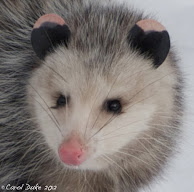
Another pink nose about the garden! This one is busy nosing about!


Virginia opossum (Didelphis virginiana) 
Our very own native link to the mammals of the Marsupalia . . . yes like the Kangaroo! What a sweet face and the pink mirrored in its ears and nose is close to many of our roses. But certainly not our own delicate schnoz!


Hydrangeas and Sedum too have a pink tone similar to this small, ancient, marsupial's muzzle. 
Fossils have been found going back 70 million years . . . so many scientist believe these docile creature's ancestors might have dared to walk among or more likely . . .  to have hidden from dinosaurs! Rosey pink is also echoed in the pads of their paws. Their claws look a bit scary and witchy like (as does this profile!), but they are mostly used to dig and climb . . . all five toes wear one except their inner rear toes, which are thought to be like our human thumbs. You can see this in the second photo of the opossum above. She is such a good model to illustrate her thumb-like digit so well for me. They are able to grasp with their handy hairless tail, but are not known to hang from it . . . more prehensile to help their balance. In researching for this post, I was most astonished to learn that the opossum only gestates her babies for two weeks! She will lick them into this life, when they are only about the size of a honeybee . . . a bit smaller! Her young will blindly and nakedly crawl out of her womb, with the aid of her tongue exit her body and crawl up into her soft warm pouch, where they will find waiting for them tiny milky teats lined up in a horseshoe design. There are only thirteen teats (my lucky number) so bad luck if there are more than that number of babies that make it to the pouch. Once they latch on to the teat it will become a swollen permanent fixture in it's tiny mouth, for about two months. At this time their eyes will open and they may begin to explore the silver, fury realm outside of the pouch. Imagine that these little ones will be independent of their mother at around three months. Opossums are solitary and supposedly nomadic . . . they do not build nests or set up any sort of housekeeping but this one has been around for a few weeks. I have eyed it going under my barn studio . . . and I do wish it may consider the small rabbit lodging there fair game. It may have moved on now, for I was able to go outside and take the first photo shown here . . . only a few feet away from her. I confess I did wonder if she would play possum . . .  secretly hoped she would by my coming so close . . .  but I did not provoke the modest . . .  rather pretty small being. She must not have seen me as a predator or feared me that much, though she did amble off to some rocks beneath an old White Pine. Opossums are not assuming like raccoons and other shameless critters but they may partake of birdseed or mindlessly crawl into an open cellar. They seem to be strong in their immune systems (unlike some humans I could mention! Maybe I should start eating earthworms and carrion.) and rarely ever carry rabies . . .  so not to worry if you are lucky to be close enough to admire the beauty of the little opossum. Opossums . . .  or you might write possums . . . are mostly nocturnal and move about quite slowly, they do tend to meet their death too often by the bumper of an automobile. If you should see a dead opossum you think to be a female . . .  ( I have not the faintest idea how you would know from a distance.) she may be carrying a pouch full of live young that were not hurt in the accident. The little one featured here maybe carrying young now. Here is a link to give you more information and numbers to call if you find orphans . . .  The National Opossum Society. Now to a more flowery subject . . . it is 'Blooming Friday' and you can visit Katarina's Roses and Stuff to see other gardens from around the world.

Monday, March 8, 2010

A Perennial Spring Ritual Maple Sugaring... A Story of a Gentle Steward


For a few weeks now the Maple trees have been awake and the sap has been flowing. I have noticed birds along the limbs of my large trees where broken branches leave openings for sap to run out of. Blue birds and Chickadees are enjoying a sweet treat. Those that harvest the sap for maple syrup have been busy in their sugar bush and sugar houses. Last year I did a detailed post on this delicious subject and I hope you will forgive me for posting it again here, as most of you would not have seen it. I do not know how I might improve on it and since I am still on recovery mode ... I am glad to be able to copy it for you to see. Last year at this time I was only a month old as a blogger and did not even know how to post properly. I hope you enjoy this account of one man's sugaring experience since a child. 


There are numerous announcements of spring... sprouting green shoots, tiny drips of snowdrops, clocks set ahead into warmer longer days and returning woodcocks to open fields, and fields of dried up old stalks of hay. There is another stirring within the trees... especially ones I hold dear for they are so near to my old house and wherein live a hive of wild honeybees. I speak of the rock maple also known as sugar maple, and as I walk up a close by neighboring hillside, passing neatly cut and stacked wood and buckets hanging from many rock maples, my eyes follow the sugar steam trailing from the cupola of a country gentleman's sugarhouse.

Spring is nearly here and maple sugaring season is upon us.

Roger is the 'gentle'man's name and as a child he would tag along with his father, while he used a bit brace to drill holes into rock maples about hip height up the tree, and then place a tap into the drilled hole, hang a bucket and move on to the next tree. In the old days after chores were finished his father and uncles would hook up sleighs to their horses and load storage tanks onto them then drive the horses into the sugar orchards. They would walk up to the farthermost trees wearing a hand carved, basswood sap yoke fitted over their shoulders, with ropes and hooks that held gathering pails. Emptying buckets into pails and then carrying them to the storage tanks was very labor intensive. After all the buckets had been emptied, they would ride back down to the sugarhouse and boil the sap in an old iron kettle hanging from a beam that Roger and his siblings helped push back and forth over the fire via the holding chains. They would do the final refined boil in the house and then bottle the syrup. In those days there could be two runs, the second being gathered in the afternoon. Nowadays, gathering the sap is mostly done only once around tea time and the boiling continues into the early evening.


Roger's wife Anne did help him out in the past, but today Roger sugars alone and with the help of modern tubing he is able to harvest from about 400 taps and 36 buckets. One hardly notices the plastic lines in Roger's sugar orchard nearest the sugarhouse, for there is just one very long solid tube visible out back that runs very neatly deep into his sugar wood from a small storage tank room. The tubing run from the sugar orchard to the storage tanks and into the evaporator. Everything is clean, orderly and aesthetically pleasing. All around his sugarhouse buckets hang from spigots... a joy to see the old fashion authentic way of gathering sap. The dripping sap from each tree creates a different tone and tempo when falling into the individual buckets, creating a musical sugar orchard for anyone who cares to bend over and listen... that is if one happens to be visiting soon after the buckets have been emptied.


In his tidy sugarhouse that has been expanded slightly since his father's and uncle's days, Roger is busy keeping the fire stoked and just at the right temperature to bring the sap to a boil. It takes a great amount of wood to get through the boiling season and Roger has plenty perfectly stacked around to get the job done.

Sugarhouses dot the New England country landscape but I think my friend Roger's is a particularly charming and instructive one. It is not a place to join others... to stand in line for a yummy pancake breakfast... it is very cozy and only meant for the art of creating maple syrup. If visiting at the right time one might be offered a tiny cup of fresh hot syrup and a look about the small sugarhouse and sugar woods that surround it. Roger's sugarhouse is a bit of a museum showing a collection of relics from years past that in part tell the history of sugaring, an art he has taken part in most of his life.


The small main room feels like a warm steam bath and lusciously sweet to inhale. The boiling bubbles make their own music and nearly spill over the edge of the large evaporator Roger uses for boiling. Just when the bubbles are about to burst over Roger tosses a drop of cream into the foam and it instantly recedes into submission. The bubble beast is tamed by a tiny bit of fat within the drop of cream. Each time it is quite startling to witness how rapidly the change takes place simply from a dash ... a dot of cream.

Roger controls the movement of the sap through the different compartments of the evaporator, allowing it to flow in from the storage tanks and moving it through a refining process. In the last evaporator compartment he holds up a flat metal ladle to see how thick the syrup is. If the syrup forms little beads on the edge of the ladle and hangs down like a sheet, it is ready to be released into a stainless steel pail and immediately poured into the final syrup filtering tank. Roger pulls a lever and it flows out into containers that will end up in our refrigerators. This is the time when the tiny cup of hot syrup is offered to a guest with seconds encouraged. The warm rich sweet drink is like a tonic... delicious. The earlier runs offer a lighter amber color and flavor, where as later on in the season, the color is more dark amber and richer in flavor.

The sugar season will last as long as the days warm to about 45 to 50 degrees and chill at night to around 20 degrees. We can enjoy the sweet syrup for months to follow.

As I leave Roger to his labor of love, for it truly is a great deal of work, I chance to see him thru a window gently moving the ladle through his sap. I feel grateful for knowing this kind native New Englander and for the honor of being able to saunter through his handsomely maintained sugar orchard. I walk down the hillside stopping at several elegant trees to hear the sap tunes and notice a gurgling brook and a blue bird's soft call. We are kindred spirits Roger and I in our shared sense of reverence towards the land... towards nature.

Spring's call to the rock maples to - 'let it flow' - is a welcome seasonal ritual and the beginning of fresh new stirrings in songs and growth.

Friday, March 5, 2010

Marching Into Change Remembrance of Seasonal Bliss

There is never a question as to why . . .  days merely move into night as moons wax and wane.
Snowstorms pass by, linger and gently pile perfectly etched ice crystals . . .  six pointed star petal-flakes  fill the naked chalices of branchlets. 
As it falls I recall luminous colors of spring, summer and fall.
All through the night and into the morning light . . . 
Clouds of heavy snow-petals become unwanted chattel, as branches and limbs give way and are splayed.
Shrubberies bow down under an oppressive Snow Queen. Now native serpentine Black Cherry is seen where before hidden behind a ten foot tall screen.
Snow blossoms of Weeping Crabapple and Viburnum bring to mind spring's mantle of white perfumed bouquets. 
Imagination can fill a cold white landscape with vibrant life and warm color.
Refreshing with changing seasons.
Change is always our escort morphing within and in all directions around us. 
Snow melts revealing supple naked limbs . . .  and alas . . .  others that were not so yielding. 
The lavender lilacs will not be so plentiful come spring for nature has changed . . . has pruned them to her fancy . . . by chance . . . an ongoing change of things.
Landscapes filled with layers of cold white pillows in time give way to lush hues that lull the psyche in green . . . here we are invited to dream.
Girls change into fully blossomed young women, who grow into the world and Barrister for the better.
Seasons change colors where a person can have a change of heart. A bright day changes into a dark cloak of night . . . while some life is active through every hour of light . . . others wait for the curtain to fall before taking flight. We cannot swim in the same mood twice . . . remaining soft our hearts may float through any challenge . . . knowing truth is seen by many eyes that hold their own true. To discern with compassion we march into understanding instead of shattered loss. Petals fall but reveal hidden life wherein folded petals are held within folded petals infinitas. A sickness of mind, heart and body will morph into renewal from cleansing and rest . . .  blossoming into fresh liveliness. How I long for it! I know that change is coming . . . that March is the escort of Spring and all will become lively again. Visit Katarina's to see other blooming life around the globe.

Friday, February 26, 2010

What is the Blue So Out of Place?


Here is the blue behind the bluebird in my last post! My composted manure pile that did not get spread around last November, when we were hit by a few feet of snow. Most of February was mild but we have been hit by heavy snow this past week so this blue tarp is covered again. I would not have thought to share this faux pas with you but for Grace's post on 'tarpitis'. Glad you could see a bright blue sky in it though.

I am not up to posting and visiting blogs so I have opted to visit blogs instead of posting. I hope you might visit the last post below for my Blooming Friday contribution to Katarina's meme.
Related Posts with Thumbnails