Sunday, February 6, 2011

'Anniversary Post' Birds in Review Part XV 'Living Bird Feeders'


 It was on a cold gray day . . . very much like this day . . . exactly two years ago . . .  I clicked 'Publish Post' and thus began this blog. This is my three hundred forty fourth post. You have honored me with six thousand two hundred sixty seven comments. I treasure each and every one of your thoughts, and all the dear people following Flower Hill Farm. Thank you for your continued support and the enduring inspiration you give through your gardens and words. 
In honor of becoming two years old, I have given my blog an additional page. Just under my header photo, you will see Flower Hill Farm Beginnings and I have just added Media Scrapbook. These pages give more history and meaning to the creative process and stewardship of my land and gardens. The offshoots that have formed into small modestly profitable enterprises . . .  in flower arranging, photography and a B&B Retreat . . . have allowed me the privilege of continuing to work with the land in creating this humble . . .  yet magical . . . garden and habitat . . . for wondrous wildlife and gracious guests from around the world. 
For the last thirty years, my life has truly been formed by the dirt on this hillside. It is hard to assimilate . . . to fully determine . . .  if I am creating the garden or if the garden is creating me and the way my life has unfolded. The land has been my muse . . . my guiding light giving me a sense of place . . . of connectedness to a deeply cultivated part of my being . . . ever entwining with the intricacies and marvels of the natural world surrounding me. It is my duty and responsibility to be a wise and caring steward.
So I step into year three of blogging with equal joy and excitement . . . with a deeper understanding of why I am sharing my stories and love of this land. Thank you so for sharing the journey with me. It is remarkable to me that I can scroll down my blog list or visit Blotanical or Best Garden Blogs and discover countless, incredible people sharing their love of nature . . . then enter your worlds with a simple click. Knowing you all . . .  has greatly enriched my life. You have given me hope . . . in times when it seemed there was little to hope for and inspiration when I most needed it. Gardeners the world over are pretty amazing folks! How lovely to connect across continents . . .  often without a common language and with many cultural differences . . .  which adds a richness to the tapestry . . .  through our woven threads of mutual respect and love of gardening and wildlife.


And now . . . without further ado . . . allow me to introduce a lavish living bird feeder - Sambucus racemosa L. Red Elderberry. Her fruit is off the charts in favorites for Grey Catbirds and Cedar Waxwings. The Catbirds are frequently flying over to this shrub in animated anticipation, as soon as the buds begin to swell.  A member of the Honeysuckle family, this Elderberry offers lovely, fluffy blooms in early spring.


The berries will disappear long before they might become red, for the Catbirds will work on the clusters at a frantic pace. I can never get a photo of the ripened fruit. The birds have planted a few other bushes around the gardens. I would love to have a hedgerow of them . . . then perhaps I might just get to see a few in their brilliant scarlet skin.  To have many more would allow other birds to enjoy them as well, for the Catbirds are very greedy, when it comes to Elderberry fruit.
 This little House Wren is not interested in the berries . . . unfortunately for the Chickadees . . .  he is eyeing their little nest within an old replaced light hole that was carelessly left uncovered. A pair of Chickadees have enjoyed raising their young in the tiny hole for years. The year featured here, they grieved the loss of their babies for the Wren would not allow them to live. Nature can be so hard to understand sometimes. 


Moving further south along the middle-terrace garden, a much beloved Magnolia stellata glows before a brightly lit Paper Birch. This dwarf variety is a lovely feature in this part of the garden. She is the first to bloom and is covered with a cloud of star-like, multi-petaled, snow-white blooms. Star Magnolia is another name often used when referring to this jewel of a tree. 


A light fine brush stroke of pale pink graces each thin petal. The whorl seems to dance around the center crown . . .  which holds a secret . . . beginning to form for feisty Flickers. There is a subtle sweetness lingering in the air around this unique and ancient flower. We are old friends, these twenty-five years, by now. A gift from Japan to these United States . . .  an offering of peace. I transplanted this Magnolia and her sister, all those years ago, from a lovely, neighboring plantswoman's garden. She had become overwhelmed with the size of her garden and was selling many small specimens like these. 


It is about this time of the stellata seed pod's growth Northern Flickers take notice. 


They flock to the small tree and literally shake the stellata up, while harvesting these oval, orange fruits. 


I saw a number of Flickers all over the Stellata last year and it was a startling sight, with sound effects as well . . . fluttering of wings against leaf! They were so quick and in such constant motion, that I could not capture any photos, but one. This beauty perches in the old apple, whose branches reach out towards the Magnolia stellata. It is rare for me to see the Flickers flocking in one tree this way. The fruit or seeds must be a tasty treat. The fact that I was lying in the hammock, trying to rest, made it all the more difficult to get any good photos. I had to pretend not to notice, so as not to frighten the Flickers off.


Fragrant and lanky English Hawthornes are lovely, spring-blooming trees. They are highly prized for their bountiful blossoms and generous crop of fruits in the summer and fall.  Cedar Waxwings are particularly delighted with the fruit of Crataegus L. English Hawthorne, also known as Haws and thorn-apple. 


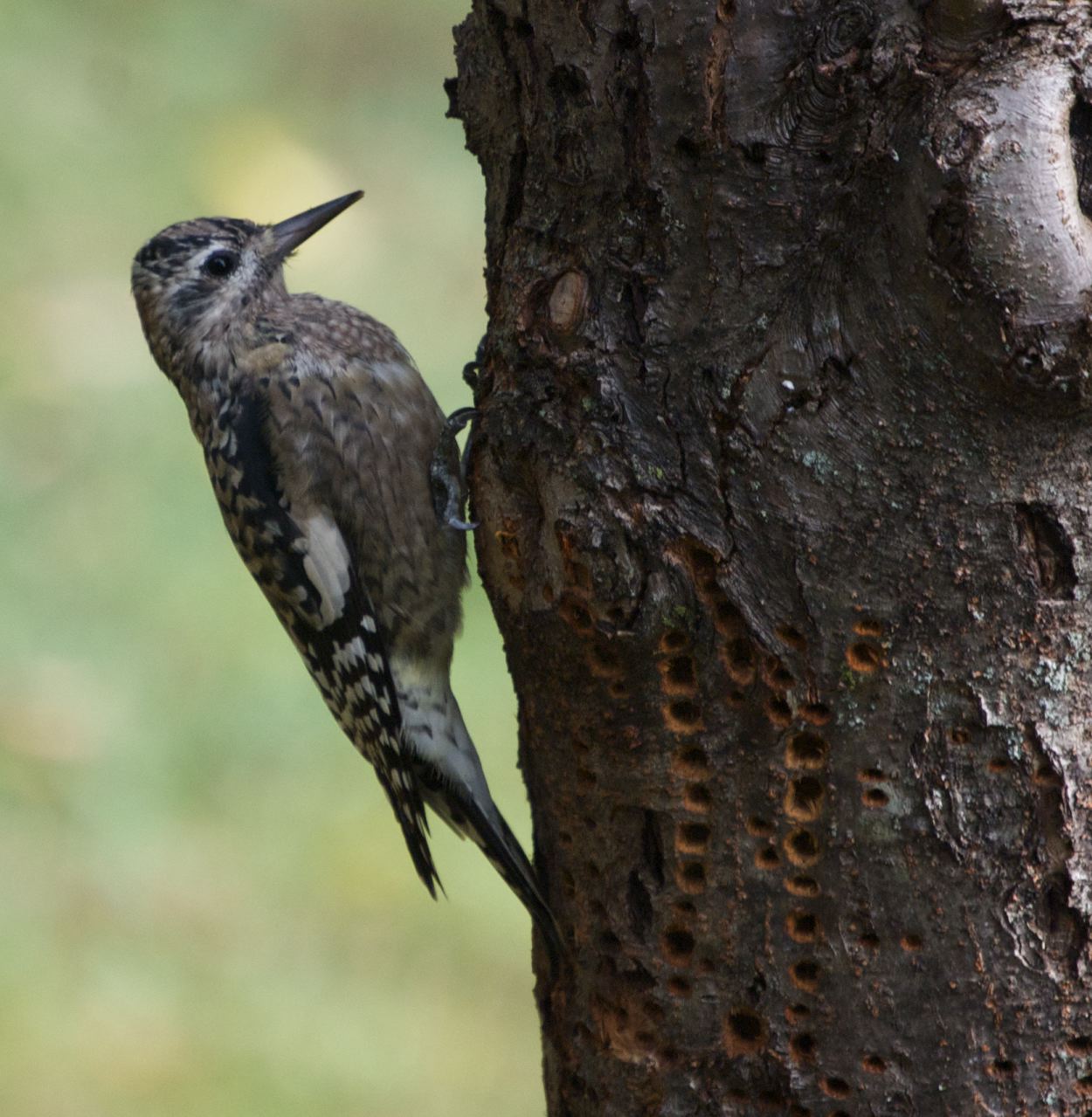
I am using this Crabapple trunk to illustrate what goes on constantly along that of the white and pink Hawthornes. The immature Yellow-bellied Sapsucker (thanks Randy!)  loves to drill up and down the trunks of both trees belonging to the Rose family. After years of this, there does not seem to be any damage to the trees. I like to think that his beak work is a bit like tattoos, which so many seem to love these days. There is either sap or insects beneath the bark . . . inspiring this activity and offering nourishment for the woodpecker. 


Profuse blooms attract countless, small insects that then entice many birds to comb the flowers for food.


A Chipping Sparrow has found a snack. Sometimes the birds remind me of large flowers, for they are so often within the Hawthorne blossoms, as this little guy here.


Hundreds of Honeybees visit the unfurling florets. Standing beside the tree, you would think the entire hive were there due the extreme buzzing volume.


Now is the time for the Cedar Waxwings to fill the trees, fetching the medicinal fruits. The English Hawthorne is another non-native but with attributes aplenty. The tree can live up to 400 years, reaching 25 feet and spreading nearly that distance. A great beauty and a fabulous feeder, just be careful for the sharp thorns, for they prick and hurt! I marvel at how a plant or tree makes a conscious effort to create thorns for defense. Our plant world is over flowing with remarkable creatures.
Just to give you an update . . . a pair of Bluebirds came by this morning for their breakfast on the fly. So dear!! Have a lovely week. THANK YOU again for making my two years of blogging so rewarding and memorable. 

Friday, February 4, 2011

Birds in Review Part XIV 'Living Bird Feeders' More On Viburnums


In my last post I introduced my berry bountiful Viburnums and wish to elaborate a bit more on these valuable shrubs. The fuzzy one here in the background is the same doublefile Viburnum plicatum tomentosum from the previous posting. It reaches about eight feet towards the sky and stretches over into other shrubs of Viburnums and a Lilac creating a dense leafy habitat for birds. I show this one again to point out the contrast to another doublefile Viburnum of a different growth habit in the south upper garden area. 


The facade or hedgerow of the upper garden has a few Viburnums planted along with Lilac topiaries, Honeysuckle and tree Wisteria to create a wall around the garden. It is also favored by some birds who love to nest within the thick canopies. This doublefile Viburnum is only about four feet tall and spreads out to eight feet. 


Stepping inside the upper garden and looking out  . . . the  Viburnum does not block the beautiful view of Carey Hill and High Ridge. Her fluffy flowers are food for many insects and add contrasting beauty to the splendiferous spring green.


Midsummer displays another contrast and brings more bird food to the garden table.


Going further within the upper garden we find the delicate Viburnum sargentii 'Onondaga' growing along the eastern edge. 


The lace cap flowers attract many bees, butterflies and other insects that birds consider light protein snacks.


Goldenrod blooms about the same time the berries ripen. 


Bright red fruit and colorful fall foliage add to the beauty, interest and wildlife value of the garden . . . another example of Viburnums as prolific living bird feeders.


Viburnum carlesii also known as Koreanspice fills more than its possible six to eight feet height and spread. Its perfume can reach a person thirty feet away. It is a delightful shrub and feeds more than just my soul.


One can easily understand why the Goldfinches would consider these to be tiny crabapples! After learning to eat the larger and tougher fruit, these bright red morsels of buds must seem specially made for the Goldfinches sharp beaks. Alas! It becomes a battle between us, for I am just as keen that they learn the difference! Luckily they are quick learners.


For I love these tiny florets that spill sweetness into the garden air. Butterflies and bees benefit as well from my berating the bratty finches. Goldfinches are most enjoyable and welcome in the gardens, when they are well behaved. 


 Many birds then may freely enjoy the juicy clustered berries that cover the Viburnum in summer.


Another great bird feeder and a native Viburnum, as well, is American cranberry bush or Highbush-cranberry. It is scientifically known as Viburnum opulus var. americanum. I have pruned this shrub over the years into a weeping-like form, to keep it from growing too tall thereby blocking the view from the studio. The lace cap flowers are visited by bees and butterflies. 


Later glossy fruits tempt birds and chipmunks.


Winters past I have seen six or more Bluebirds, Robins and Cedar Waxwings all together on this one shrub. With candy like this . . . I can understand why.


Now for a reality check and a harsh contrast to the warmer days represented above. These time consuming bird review posts have been a wonderful escape from our very cold winter landscape. This photo of the Crabapple along the edge of the orchard was taken yesterday a few minutes after a very sweet visit from a pair of Bluebirds. The Crabapple is closer than it appears in this image.


I mentioned recently that I had noticed a Bluebird coming up to the barn studio window trying to catch a large black fly. In the winter for some reason flies hatch out inside and naturally fly towards the light. I opened the door to shoo a few flies out and was pleased . . . even elated . . .  to see the Bluebird immediately come to the snow beneath the barn to pick up her fresh meat.


Now the Bluebirds come up and wait for their snacks. This female even allowed me to open the door and take her portrait, when less than ten feet away. I did get some flies to exit right after this photo shoot. I never imagined I would be longing for more flies!


She was a bit curious about what I was doing . . . as the camera clicked I imagine . . . and seemed to be so trusting.


This photo of a male Bluebird was taken after he had flown down and back again once capturing a fly morsel.


I am amazed at how I was able to be so close to this felicitous fellow. I could not help but wonder . . . might he know me from another time. 


When he was just a little tot! I can never be certain if there is a knowing or if it is the freezing temperatures causing the birds to throw off their usual cover of caution. The contrast is very welcome. I worry perhaps I should do more for them this year . . . mealy worms perhaps. Later yesterday . . .  around four in the afternoon . . . I did see a few Bluebirds fly down to the nestbox behind the farmhouse and go inside. I assume to cuddle during the chilly overnight hours.
A flock of Cedar Waxwings were in the Crabapple orchard today but no sign of a Bluebird. The Cedar Waxwings also let me open the door to take a few photos. They too are usually very skittish. Perhaps the arctic cold gripping winter has altered their fear of me to more of an accepting . . . for now . . . nature.
In a land far away with mutual freezing temperatures and a love of gardening . . .  Katarina hosts Blooming Friday. Be sure to visit her  Roses and Stuff  to see other contrasting thoughts and images from around the world.

Tuesday, February 1, 2011

Birds In Review Part XIII 'Living Bird Feeders' Throughout the Year


In my last few posts I have been focusing on winter feeding. Now lets see how the crabapples play an equally important role in feeding birds throughout the growing season. This may be a familiar view to many of my readers, for it is the eastern corner of the Crabapple Orchard, where numerous Robins, Goldfinches and Cedar Waxwings were revealed feasting on the tiny crabapples in my last several posts. Now we are stepping ahead into spring . . . whilst in the middle of two severe winter storms . . .  a profusion of spring blossoms unfurl and it is not long before birds begin harvesting insects the flowers attract. Of course countless bees depend on the nectar too . . .  there will be an upcoming post about the bees that live here.


It is so magical coming out of the long winter months to the sudden symphony of birds calling, singing and flying in and amongst the numerous shrubberies and tress. Thousands of fragrant and colorful blooms fill the little orchard and delight both the gardener and a variety of wildlife. Here a Scarlet Tanager is not only admiring the beauty but seeking out his lunch too.


I am not sure who this fellow is . . . perhaps a flycatcher of one sort or another. I do not believe it is a Phoebe. It must be lovely up there with the copious canopy of florescence. 


Indigo Buntings return with the unfurling Crabapple blossoms, for as the flowers awake so too many morsels of protein in the forms of tiny insects that reside in and about the flowers. Many birds are seen in the flowering trees gleaning the abundant arthropods. What great garden helpers they are!


All through the spring, summer and fall months birds harvest insects that favor the dense foliage of Malus . . . the mystery Crabapple. I wish I could share the species with you. Today I would buy native crabapples . . . then again . . . perhaps my orchard is made up of hardy native stock, for they were grown locally and planted over twenty years ago. The bird pictured here appears to have something in its beak. Alas I cannot be sure of what to call this bird either. Any suggestions much appreciated. Maybe a young Vireo?


In the winter months the apples are a vital food for many birds. This Goldfinch watched other birds eating crabapples and then one day . . .  well . . . this molting fellow seems to be enjoying his snack. It is always good to be open to trying new things. 
The Crabapple's fruit hardly looks like a 'crab' so how it came by this name is another mystery to me. All apples are in the rose family . . . that is no mystery to most of us. Here at Flower Hill Farm the orchard grows right across from one of its distant cousins.


Rosa rugosa 


During the summer, roses spill a delicious perfume within the gardens and are a great feeder of bees. I have often seen Hummingbirds visit these lovely flowers too. Perhaps they were the youngsters attracted to the beauty and sweet fragrance.


In a good year with plenty of sun and rain Rosa rugosa will produce a bounty of hips rich in vitamin C. As we saw in my last post, the Cardinals will enjoy dining on the fruit during the winter months.


The hip will turn bright red when fully ripened. I never notice the birds eating them until the hips are dry and somewhat shriveled up as they are in the winter.


The prickers of Rosa rugosa do not seem to bother this female Northern Cardinal.


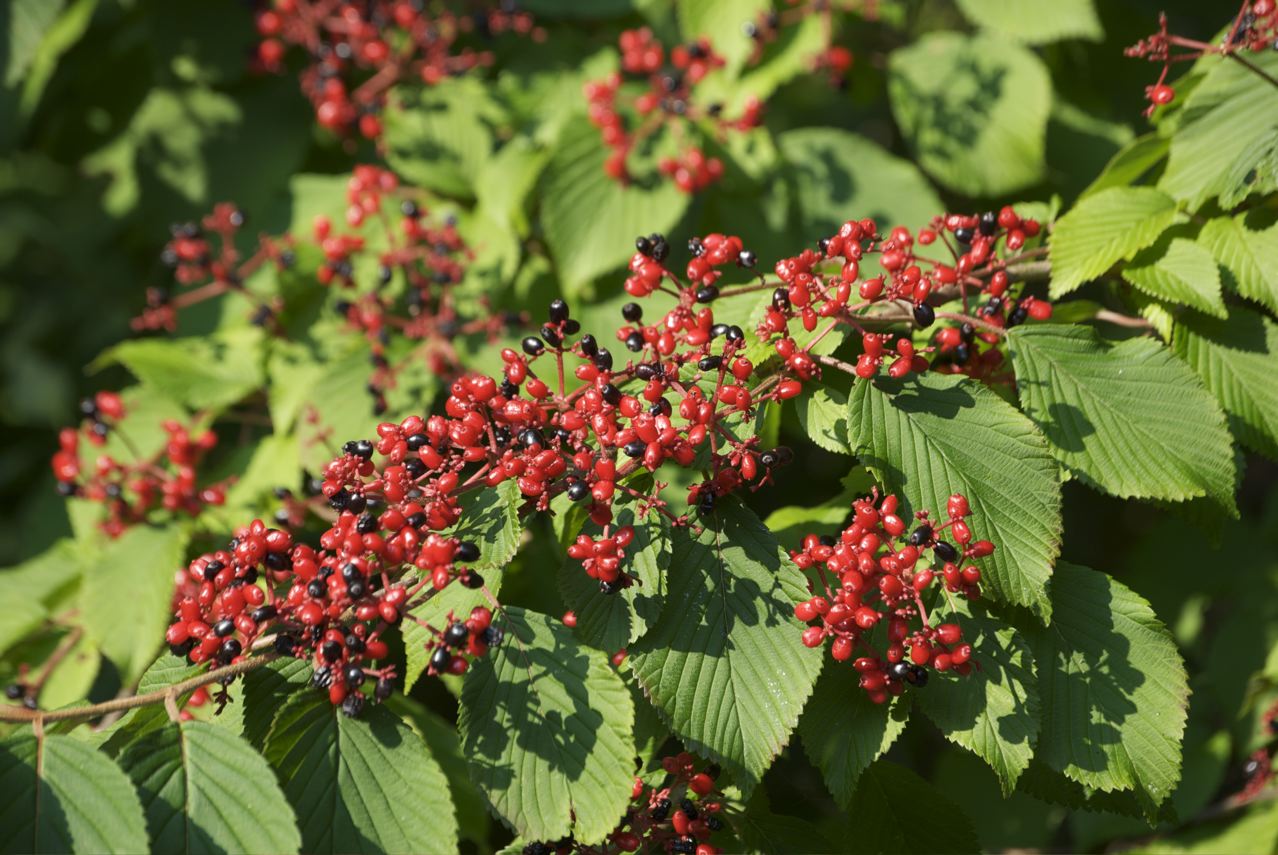
Spreading sumptuously out beside the Rosa and a Lilac is a favorite Viburnum showing its splendid habit of stretching horizontally with an abundance of bloom. Butterflies and bees will sip these then later the berries entice a medley of birds. I have two planted in this cluster of shrubs to assure a hearty crop of fruit. I believe it is a variety of Viburnum plicatum tomentosum. 


It is rare that the berries last this long for the fruit to mature to its black color. The two photos above may be from another doublefile Viburnum that lives out in the front garden . . . the leaves do look a bit smaller than those on the shrubs below. The flowers and fruit are very similar.


The second Viburnum shrub in this cluster planting peeks out from behind a Viburnum burkwood and an old fashion Hydrangea bush. The red berries make quite a stunning show . . .  but one must not get attached, for after all, they are food for the birds. I do enjoy both the drama of the color and the birds coming and going as the vibrant berries disappear. 


Gray Catbirds are extremely fond of these clustered shrubs and often build their nests inside the leafy cover. They are then most conveniently located to these luscious berries. You may have to look carefully twice, but there is a Catbird in this photo.


I have not noticed the Indigo bunting eating them often. It is possible he was just checking the berries out to see what all the fuss was about. Note that I have left a dead branch on the Viburnum . . . this gives the birds a place to perch and is a great spot for me to see and photograph them.


Cedar Waxwings find these berries very much to their taste buds delight too! The fruit is ripening just at about the time the blueberries are going by. Or I should say about the time the birds have eaten all of their share of the blueberries! The garden is an ongoing living bird feeder. I will share more shrubs, trees, and plants in my next posts that are also great food for birds. 

Related Posts with Thumbnails