Saturday, March 10, 2012

Flower Hill Farm BUTTERFLIES OF 2011 ~ Sulphurs and Whites


Orange Sulphur on Aster

We now enter the family Pieridae, of fluttering Whites and Sulphurs, found in the gardens and fields here at Flower Hill Farm over the last few years. 
Orange sulphur Colias eurytheme and Clouded Sulphur Colias philodice, can be confusing to identify, but not to the female Orange sulphur butterflies, who are attracted to the ultraviolet in the male Orange sulphur upper wings. 
I enjoy these bright buttery and paler butterflies mostly in mid to late summer and fall, though their flight may begin as early as May. 
The Orange sulphur and Clouded Sulphur female butterflies will lay a single, yellow-white morphing into deep red, egg on numerous legumes but prefer alfalfa, vetches, and white clovers. It seems the Orange sulphur caterpillars enjoy dining mostly in the dark. One would have to enter the meadows towards evening . . .  to see the caterpillars wearing green and white-striped pjs munching their leafy legume supper. 
Both Orange and Clouded Sulphurs overwinter in their chrysalis forms.

Orange or Clouded on Vetch
Clouded Sulphur on Aster
Clouded Sulphurs flutter though these images of the south field . . . full of New England Asters.

There is always a great chase scene in every good story.


The Cabbage White Pieris rapae, and I share a common delight. We both love Brassicas. Planting peppergrass and mustards may encourage the female to fasten her yellow-green eggs on a more diverse group of delicious plants, so there will be enough to go around. 
Unfortunately the green and yellow-striped caterpillar is blamed . . .  and I guess rightfully so . . . for much agricultural damage. Poisons have not worked but only brought more angst to the human community. 
Cabbage Whites overwinter in their chrysalis stage. 
Introduced to Canada from Eurasia in the eighteen hundreds it may also have caused the decline of other native Whites. 


Spring is still harnessed and held back by winters frosty grip out in our New England gardens and landscapes, but the Smith College Bulb show is on, giving all a whiff and whirl of what is soon to be set free. These photographs from last March are as close as I have been able to get this year . . . so far. 


Bluebirds are giving a 'wing up' to our new birdhouses!! 
Snow is melting and next week will be in the high 50's and even 60's! 
Snowdrops are still perky after the heavy carpet of snow . . .  I thought surely had crushed them. 
Ah, to be so supple!
I have seen a few dead honeybees caught out in the cold after the warmer days last week. The Monarch Butterflies are leaving Mexico!

I am late for my flight to Sweden and Katarina's charming world. I am happy to share my garden jewels today!

From the fragile wings to beasts . . . you can see my latest piece on the Eastern Coyote from my Bestiary over at Native Plants and Wildlife Gardens. But beware . . . it is a chilling tale.


Tuesday, March 6, 2012

Flower Hill Farm BUTTERFLIES OF 2011 ~ Mourning Cloak and Red Admiral


Mourning Cloak Nymphalis antiopa is the first butterfly to appear in April here at Flower Hill Farm. It hibernates as an adult and will awaken sometimes earlier, when the temperatures rise and stay warmer for days . . .  as they often do in March.
They might crawl out from under a piece of bark or out of a small hollow opening in a tree.
I was surprised to learn that a Mourning Cloak butterfly can live up to ten months.
This male or female is perched on the ground and as you can see, there is hardly a sprout of green up yet. 


Mourning Cloak butterflies lay their eggs in such a way as might alarm those who care for their preferred host trees or shrubs. Their off-white ribbed eggs are fastened in large numbers of up to 250 placed often in rings around the main stems of host plants or trees. They prefer willows, poplars and birches but will also feed on maples, ash, roses and other trees and shrubs.
The caterpillars remain together chomping on the leaves and it may cause a most unaesthetic appearance for a small time, but the tree or shrub will not die from these native caterpillars that must not be confused with the invasive non-native gypsy moth caterpillars.


Red Admiral Vanessa atalanta is also a migratory species like its cousin the American Painted Lady. I rarely see one of these lovely creatures. This May portrait is the only capture I have made, and it, sadly, is not a very good one.
If the migrating period is a success and you have nettles growing about your land or gardens, you might just have a visit from a Red Admiral . . . once referred to as Red Admirable.
Here on our hillside, these butterflies will lay a single egg, finely crafted into an exquisite green dome, upon the leaves of a variety of New England nettles. The caterpillars fasten the outer edges of a leaf together with silk and feed within the protected enclosure.
It will also make its chrysalis using this method . . .  hidden within the last leaf it folds. When it emerges as a butterfly, its sustenance tastes vary greatly from tree sap to decaying fruits and excrement. As my photo reveals, these butterflies also indulge in sipping nectar from flowers.
This Red Admiral might be a male that has migrated up from the south and has yet to find his mate. I truly have no knowledge for identifying the male from the female. Males will find a good look-out perch to wait and eye an area for a female. After three generations here the fall butterflies will again fly south but there is not enough research to know of their successful migration flights to a warmer climate. We know so much about the Monarchs migration, so hopefully more research will result in understanding these beautiful butterflies too.
You might help by going to the link above and sharing your information. 


Winter is a time for watching the sun and noting the remarkable turning and tilting of our earth, as we notice the sunrise moving from south to north painting brilliant sky paintings as it goes.
The Winter Solstice . . . around the time of the photograph above . . . and the Summer Solstice . . . close to the time of the photograph below . . . mark the times when the sun has climbed to its lowest and highest positions in the sky. The shortest and the longest days of sunlight occur on the solstices. 


Sunrise over the northern part of Walnut and Carey hill nearly one month after the Summer Solstice.


Now, the sun is spilling a wash of light stretching longer each day, as it continues to move farther away from the Winter Solstice towards the Spring Equinox, where light will be equal to night and onto the longest day with Summer Solstice.
These images showcase a few minutes as the sun rises over Walnut hill a few days ago. It is a winter ritual to stand and watch this new beginning and celebrate the amazing brilliance of color splashed across the clouds and sky.


You can still see the edge of blue belonging to the Mount Holyoke range in the bottom right corner of the photo above.
 In December the sun was rising more to the right, directly over the Mount Holyoke Range, as seen in the photo further above . . .  just below the Red Admiral photograph.
Now in March, the sun is cresting more to the north and left . . . climbing over the southern part of Walnut Hill.


We are in that time of year that is akin to a bucket filled with uncertainty like piling a stack of wood in the dark and when placing the last few small logs the entire pile tumbles down. You might believe you could feel your way through anything . . . but March, with the fluctuating degrees of chill and heat, can drag you down at times . . .  casting off a sudden six inches of snow that soon turns to hard packed ice.
The waxing moon pulls the mercury in the thermometers down into the single digits.
This years rising and falling of temperatures has been kind to our Maple Sugar Industry here in Western Massachusetts. It has been an early and lasting season so far, according to my friend and neighbor Roger (seen above in a 2010 photo - today we have much more snow.)
The sweet sap is running and before long spring will have her say and kindly bid farewell to winter . . . until another day.
Old man winter does so like to tease and may step back into the waking landscape with its frosty touch.
Hopefully Mourning Cloak butterflies will not be caught without their antifreeze!


Friday, March 2, 2012

Flower Hill Farm BUTTERFLIES OF 2011 ~ Favorite Viceroy


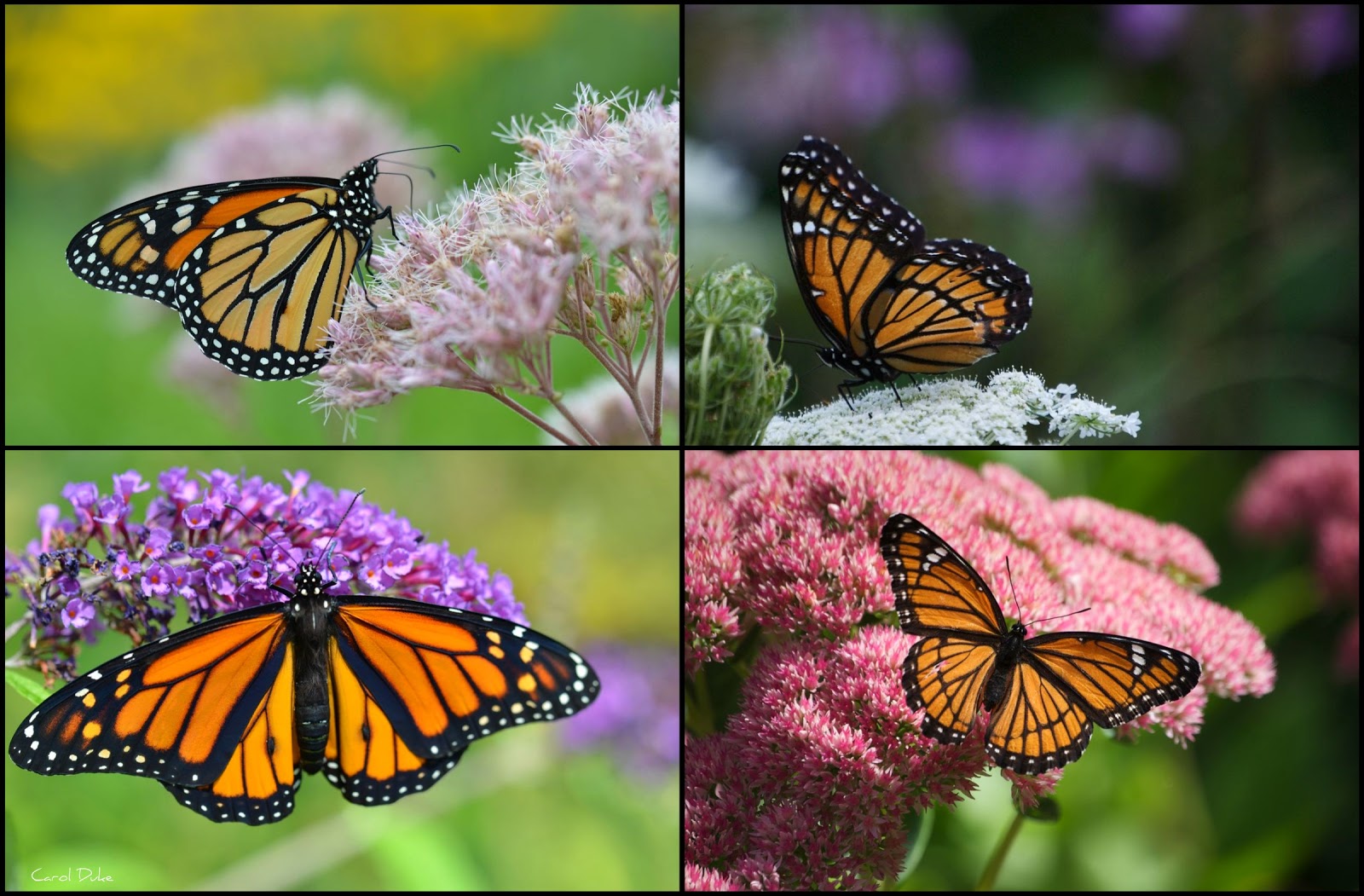
The Viceroy Limenitis archippus, is a bright orange butterfly with black veins, cleverly mimicking the bad tasting and tummy aching (for the birds) milkweed butterflies. It is classified as a Mullerian mimic of the Monarch butterfly.


Therefore upon first sighting the Viceroy, an observer may believe it to be a Monarch butterfly. There are many differences, however . . .  such as size and hue intensity . . .  but the easiest way to identify the Viceroy, is to note the thick black vein drawn horizontally through the hind wings. The monarch, as illustrated above, does not have this trait. Also, notice the drops of white. . . the color of milkweed sap . . .  are quite different in numbers and shapes.


The Viceroy may not be very tasty either but that does not keep the birds from trying to find out the hard way.


When spotting these beautiful butterflies further out in the gardens and fields, it is harder to determine the differences. One sure way to know a monarch from a viceroy . . . even faraway . . .  is in the unique and graceful soaring flight of the monarch. 


Viceroy butterfly on wild carrot Flower Hill Farm 2009


Viceroy on sedum Flower Hill Farm 2010

Viceroy butterflies may have up to three broods during May through September. Females lay beautifully intricate pale green eggs . . . that mimic plant galls . . . on the leaves of willows, poplars and even apple and cherry trees. The third instar caterpillar of the last brood will fastidiously fashion a leaf, of its preferred host plant, into a safely fastened silk-lined shelter and wait out the fall, winter and early spring months here in the northeast. Mother nature has protected these little critters by adorning them in the most unappealing garments . . . resembling bird poop. Come spring, when sap begins to stir and rise up through veins of crusty trees . . .  reaching for extremities . . . tiny leaves begin unfurling, awaking sleeping caterpillars, who stretch and begin anew on their journey towards becoming rather dull, dark-brown and white chrysalises. The first boldly painted butterflies may emerge before many plants are flowering and find nourishment where they can . . .  in pools of water, decaying flesh, excrement and even by shrewdly sipping aphid honeydew. 


The sun sails a bit further north each longer winter day.


Robins fill the crabapples and reap the benefits of dried fruit.


 Marching towards spring is always unpredictable here in the northeast. Soft snow began falling on the hard frozen ground Wednesday afternoon continuing throughout Thursday . . .  the first day of March.


 The soft bluish landscapes above were taken just at dusk on Thursday. 
It is still very much winter here and all the overwintering caterpillars and chrysalises continue to dream while the farmers and gardeners long for spring. 
Luckily we have thousands of butterfly photos to edit and other gardens to visit. 
Friday is for flying away to Sweden to visit Katarina's Roses and Stuff.
Clicking into Katarina's and other wondrous gardens does help soften the hard cold fact of winter's continued chill.

Related Posts with Thumbnails