We all stand in awe of rainbows and other miraculous happenings in our world. More often we miss the smaller miracles quietly hidden from view. One such is the truly remarkable metamorphosis of the beloved Monarch butterfly. I am happy to continue sharing my experience of raising the caterpillars that create the butterflies. We left off last post with our caters molting and munching and nurturing their inner "imaginative cells" . . . of that which is becoming a butterfly.

Caterpillars grow up really quickly . . . a toddler becomes a teenager in just days! This little mask next to an aphid . . . is not a toy that was tossed out . . . it is a protective face capsule and the only part of the cater that remains behind until the last molt into a chrysalis, for it is not eaten as the discarded skin, each time the cater molts. Toddler and teenager are not the words of choice in the scientific community. I am simply anthropomorphizing for a story effect, which I hope you will not mind. The monarch and other caterpillars are called 'instars' throughout their molting phase. With each molt they graduate to a higher number until grade five, when they become a pupa or chrysalis.

This little fellow or lass has just freed itself of yet another girdle of form fitting skin and is now most likely a full fledged teenager. A proud fourth instar all wet and tired from the ordeal of getting out of that tight skin. Lets call him Sunny. Note the tiny face mask on the leaf behind the fragile lad and the delicate painted toenails on his first three true legs near his cheery yellow face. There is such intricate beauty in all of nature's creatures.

Stay with me and Aria while she goes through contractions and contortions pulling herself out of this old skin. Mind you the skin is only a few days old . . . can you imagine growing out of your clothes so quickly!? Breathe Aria! Now push! You can see the older face mask cupped on to her face.

How exhausting just to watch her laborious task. Her long tentacles are wet and slicked back just free of the old skin. Just a bit more to go now Aria. Ladies remember those girdle days . . . now called foundation garments . . . well imagine . . . no hands! Perhaps Aria's legs help move the skin.

Free at last! Aria is thankful to be rid of the old charcoal colored skin and neatly piles it at the end. Is she not lovely? I like to think of the dots of white on her legs and prolegs, as tokens towards the milky white liquid in Milkweed (The white dots reappear on the wings and body of the butterfly.), that somewhat protects the caters and later the butterfly from prey. Since I have seen all birds going after the monarchs and the caters having many prey too I am not convinced the toxicity is full proof. Adaptation at play no doubt. Aria will lie here for a bit now and rest . . . she is very vulnerable, but I will remain and watch over my now near adult fifth instar ward.

When she perks up, she will turn around and begin to dine on the rich skin until it is all gone and there will be no trace of her former self . . . she is almost all grown up now and over the next few days she will have a ravenous appetite chomping away towards her final caterpillar chapter. I will have to gather many Milkweed plants to help her reach her goal.

Her skin offers important protein and nourishment . . . after her labor she is a very hungry caterpillar.

The Monarch caterpillar houses beneath its skin a silk gland, heart, stomach, intestine, colon, brain and tracheae or air tubes connected to spiracles or holes along the thorax and abdomen enabling the caterpillar to breathe. Aria has tentacles on the front and end of her body, which often are mistaken for antennae. These tentacles or filaments grow larger and more animated as the caterpillar grows. Sometimes called horns, their tentacles can help scare off predators in the wild, especially flies and wasps that try to lay eggs on their body. The caterpillar can turn and try to strike invading insects with their tentacles. These expressive black lines are constantly drawing circles and assorted scribbles in the air. They may reveal moods and perhaps play a role in how the caterpillars communicate with each other. When fourth and fifth instars, the manner in which they sometimes hold their tentacles reminds me of goats with long ears falling down around their faces. There are also microscopic hair-like tactile setae, for sensing touch and hearing, dispersed over the body of the caterpillar. Aria is highly equipped to feel and express herself.

Now it is serious business of eating and building . . . with no time to think about ingesting too much toxicity of the Milkweed juice. To avoid this Aria will go to the base of the leaf next to the stem and carve out a notch-like portion . . . somewhat like the slice of wood foresters take out of a tree before cutting it. She is actually craftily cutting off the flow of the milky latex substance to the leaf and can go all out eating without taking any rests, for there is an important date she must keep . . . coming up soon.

These two might be Cass and Polly named after Castor and Pollux the twin gods hanging in the heavens to the left of Orion. They mostly harmoniously share the leaf down to the nub. Occasionally they grow intolerant and 'bark' at each other with their animated tentacles. They sometimes deliberately collide, like walruses or sea lions on a beach engaged in a challenge. This bit of conflict is very short lived and they go back to sharing the leaf and taking turns carving. In my orderly commodious community of six, the caterpillars seem mostly forgiving and compatible. Some prefer the solitary life and chew alone, while others like these two enjoy dining together.

Well with all this eating you can imagine there must be a goodly amount of frass falling about. You are right for indeed there is. When I go through the process of tidying my caterpillar community, I am reminded of a children's book I would read to my son by Ernst Kreidolf . Dream Garden has many short stories and poems with enchanting illustrations. One poem is titled 'The Caterpillar Garden'. A gentle moth named Mr. Ermine has a caterpillar garden and loves it very much. A dung beetle carries a miniature wheel barrel into a picket fence area, where various kinds of caterpillars are kept. The beetle shovels all the droppings and wheels its nearly full load towards a compost heap. The owner asks him to be sure the caterpillars do not escape, but as always, they all disappear one day. Clearly the beetle caretaker was not aware of a signal to watch out for regarding the droppings. The droppings are noteworthy, as they change in shape with the different instars. At first the form is but a speck of black, then with each molt it takes on a more solid shape corresponding to the structure of Tootsie Roll candy. As the caterpillar progresses towards its final molt, the frass gives a clue. By the final molt, there are four segments to the fresh green droppings, alerting me that the caterpillar may soon wander from the community, if it does not find a suitable stem for unveiling its chrysalis. One to go for Aria. What a lot of words and fuss about a bit of frass you might think. I jokingly mention to friends that I will bag and sell the caterpillar droppings as fertilizer.

Sure enough after noticing Aria's frass change, I made sure she was content with my offerings of stems.

Aria is now spinning her own destiny with the silk threads she brings forth from within herself. Her head turns from the left to the right measuring out each thread, like a silk-filled bobbin a weaver throws back and forth through a looms warp. Her forelegs carefully shape the mound of wet silk like an adept sculptor working with clay. Hundreds of minute nearly invisible threads meld together to build the node.
Aria is securing many other threads up, over and around sedum flower branches, the leaf her silk node is attached to and the sedum stem, to help hold the silk mat and node. Her life depends upon her skilled craft in creating a secure toggle. Aria’s tentacles seem to aid in this process. They remind me of a typewriter arm that I once used to push back and forth while typing. Each time she moves her head to the left pulling out a piece of silk thread, her right tentacle makes an exact up and down movement. Her left tentacle repeats the exact movement, when her head moves towards the right. It is very amusing and intriguing to watch.
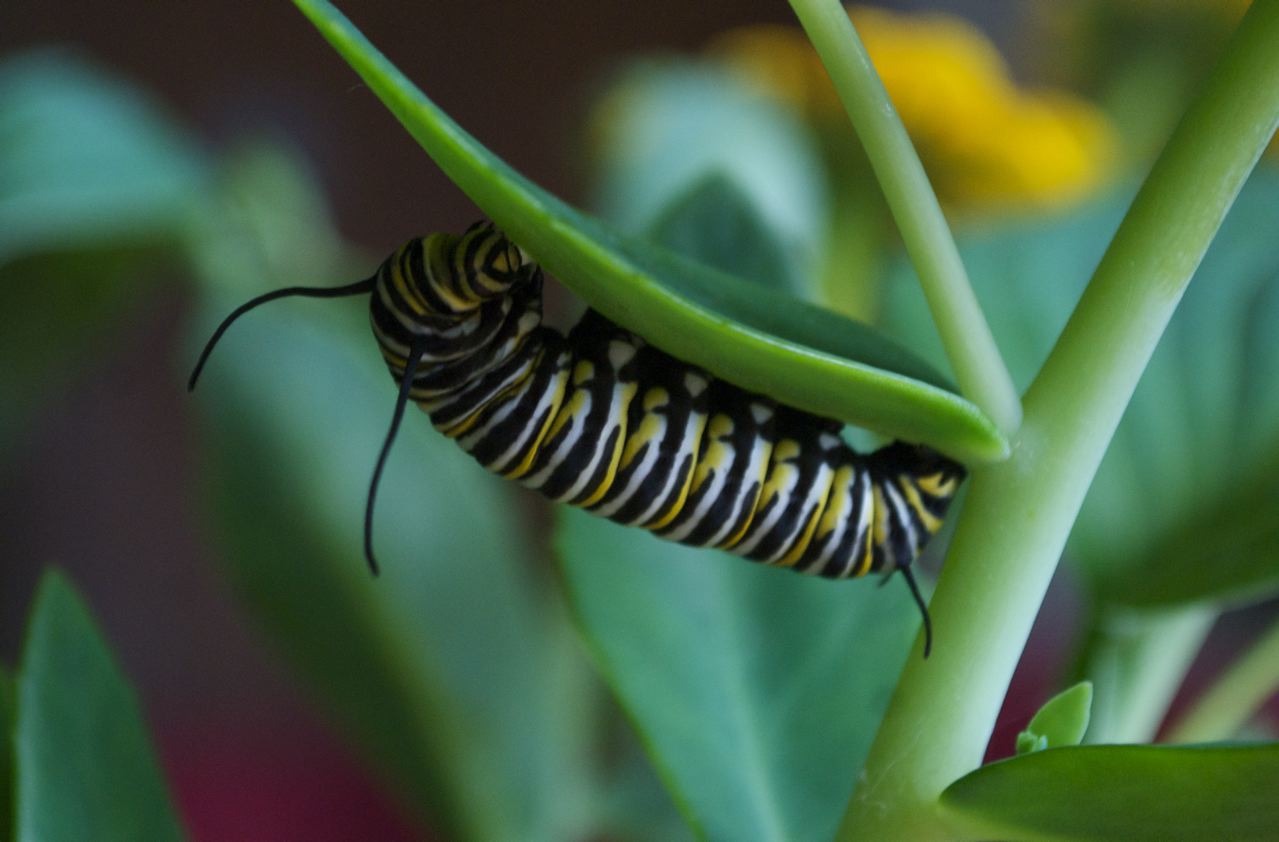
I always feel a bit sad at this time . . . I will miss Aria's animated antics and her superbly stripe body. I wonder if she will remember me when she becomes a butterfly. While attending to my small caterpillar community, now mostly preparing for their fall to J formations, there is another question I mull over regarding remembrance. I wonder if the true essence of the Monarch caterpillar continues living in the transformed butterfly. The experiences a caterpillar endures may remain with the butterfly, when it takes leave of its earth bound body. Will Aria remember being a caterpillar when she is a butterfly? How does this 'essence' manage all the change? This line of thinking brings Lewis Carroll’s Alice’s Adventures In Wonderland to mind. In particular the scene where Alice comes upon a large mushroom the same size as herself. It reads, “...her eyes immediately met those of a large blue caterpillar, that was sitting on the top, with its arms folded, quietly smoking a long hookah, and taking not the smallest notice of her or of anything else.” (This is a mood I often sense in some of my caterpillar wards.)
“Who are YOU?” said the Caterpillar.
Alice replies that she is not sure who she is, as she has changed so many times during the day. She tries to explain “...being so many different sizes in a day is very confusing.”
“It isn’t,” said the Caterpillar.
“Well, perhaps you haven’t found it so yet,” said Alice, “but when you have to turn into a chrysalis - you will some day, you know - and then after that into a butterfly, I should think you’ll feel it a little queer, won’t you?”
“Not a bit,” said the Caterpillar.
So perhaps these courageous creatures simply take on change with this same attitude, whereas we humans are not so adapted to change for some reason or other. Maybe we can learn from these little guys. What do you think?

For now I am happy to be able to observe Arias talent in making her perfectly crafted silk button and her skill in finding it while turned around. When she feels her fastening is firmly fixed, Aria begins to gingerly release one pair of legs at a time. I become anxious for her watching each pair slowly set free from its hold.

Then finally she lets go! Swinging like a little flying trapeze artist, Aria, held by her claspers, hangs and catches herself. This takes some amount of pluckiness and trust in her ability to get it right. Her head is curving up creating a J, and her six true legs are again held close to her mouth as seen each time the caterpillars molt. Aria’s head is nodding up and down as if conducting an internal orchestration. I can see the blue green of the chrysalis beneath her skin. This is the time I must say goodbye to my little friend, for I will not recognize her in her new shape and togs. I say goodbye to the expressive tentacles and the triangle in her mask. I will miss her yellow, white and black body and all her funny ways. She like Cass, Polly and the other Monarch caterpillars, has completed a remarkable journey and is giving birth to a new form that will carry her on yet another journey. Surely her future flights are no more astounding than her accomplishments as a caterpillar that was able to change, let go and grow wings.

Meanwhile the more social bunch are getting settled under a Hosta leaf. Holding on with his prolegs this fellow . . . I have not named . . . reaches down to be sure there is room to hang. There must be room enough for the chrysalis beneath the skin you see to hand plus room for the butterfly to fall out.

These guys are still working on their silk buttons . . . I am sure there is no contest . . . each creates his own in his own way and time. Just as each will let go towards their shared destiny in his or her own caterpillar time.

Truly when we look at these caters we think we are seeing caterpillars, but just beneath the thin layer of skin another form is already predominate. They are more chrysalis now than cater. It is an amazing masquerade. The final curtain call is coming very soon.

Here we find Cass and Polly finishing their silk buttons too.


You can see that the tentacles are at different stages on each of the twins. Cass is closer to becoming fully her new self, for her tentacles are spiraling and lifeless, where Pollys are still smooth and straight. This is an important sign to look for, so that you will not miss the unveiling of the chrysalis. The tentacles have remained expressive throughout the life of the caters and ends with the telling of the moment the caterpillar gives way to its chrysalis.

Inside Aria’s, Cass's and Polly's bodies along with the other three muses, many alterations have been happening preparing for their new wardrobes. Throughout their caterpillar bodies are what scientist call ‘imaginal disks’ or cell constellations, which create the formation of their butterfly structure. Since their first days as caterpillars, their caterpillar cells have, caringly cultivated these hidden treasures or ‘imaginal’ cell groups. In the last days of their caterpillar life, these cell clusters speed up their work of merging or melding together into their butterfly components. Perchance their nodding heads are engaging in the final churning of the pot, blending the ingredients of the chrysalises.

As Cass and Polly hang upside down from a mass of silk threads, their bodies go between stillness and sudden waves of contractions, creating the illusion of flux or a mother in labor. They are giving birth to their new form, which is showing through their skin. Where once their colors were yellow and white covered by her black striped cuticle skin, a blue green color is visible, especially around their heads. There are still yellow and white stripes covering their suspending body, though they are receding. They will hang this way for several hours before their final curtain call revealing their beautiful chrysalises. Polly pulls up suddenly towards her hind legs or claspers holding fast to the silk node, as if doing a sit up. I startled him when I brushed against the Hosta stem by mistake. This quick movement might be a defense mechanism, for he does look as if trying to curl up in a protective manner. After a minute, he relaxes back into his J position, and continues to hold his first six legs in a prayer position near his head, which is moving up and down.

It is time! Cass's skin is splitting just behind his head and the moment has come for the chrysalis to emerge. Next time we will see the varied magical stages of the chrysalis. It has taken a long while to share all the many details of the Monarch caterpillar. I am wishing you all many viewings of this marvel of a metamorphosis. Until next time. . . Happy butterfly watching!