Sunday, March 6, 2011

Birds in Review Part XXIII 'A Bird Parade' Chestnut-sided Warbler


Buds and birds will return soon and I will welcome both with a joyous heart! To continue the on going parade of Flower Hill Farm birds, I would like to introduce another striking warbler. Chestnut-sided Warblers (Dendroica pensylvanica) have been choosing this habitat for many years now. 


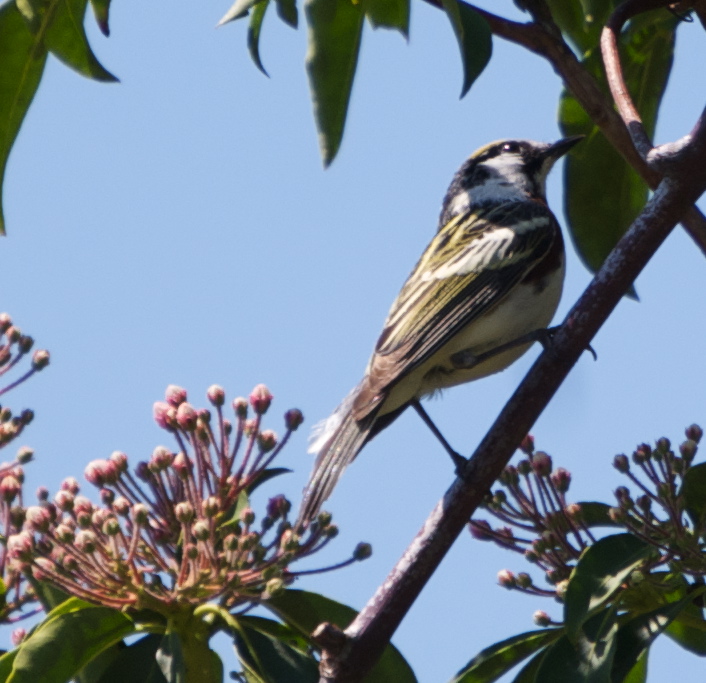
Chestnut-sided Warblers can be sighted high up in the trees such as this Rock Maple, or in lower shrubs like the Blueberries below. 


The songbirds particularly enjoy the Blueberry bushes and one day I happened upon a bit of a duel between two Chestnut-sided males. The only 'deadly weapons' they hold would be their sharp beaks, but truly they do not fight to the death.


These images of male pursuing male clearly shows why these birds have the given name of Chestnut-sided Warbler. A streak of chestnut or reddish-brown is like a brushstroke painted along their side. 


Breeding males will not tolerate one another within a small territory. The bright yellow-green cap they wear is enhanced here by the sunlight.


Eventually they will settle down . . . and get on with the more important business of spring.


 Singing their tiny hearts out to attract a mate is what both little warblers would rather be doing. One of their sweet songs is a series of high pitched notes that some hear as "pleased, pleased, pleased to MEETCHA." Many birds have more than one song and do improvise, as well as, have a variety of communicating calls. The Yellow Warbler I introduced earlier has a very similar voice to the Chestnut-sided Warbler. When I hear their melodious twitters in the gardens, it is most confusing trying to determine the warbler the song belongs to. Only by seeing, whilst I am hearing can I be certain.


 The female Chestnut-sided Warbler does not have the solid chestnut streak but dons small patches of the hue. She also lacks the bolder black lines through her eyes and face. She, as with most females of the bird population, simply prefers a duller frock. Note the two yellowish wing bars.


Like other warblers the Chestnut-sided Warbler enjoys gleaning the leaves and blossoms of shrubs and trees for insects. 


A female Chestnut-sided Warbler seems quite relaxed in this moment . . . 


until . . . she notices my large black eye upon her. Then she stretches into a more concerned form. 


For the end of the Chestnut-sided contingent, a male beautifully displays his vivid patterns and prowess for hunting arachnids. I so look forward to the return of green and these precious garden friends.


For now this is what our March looks like, though today is warmer with rain and melting snow!


Most winters bring about some tragedies in the gardens and landscape and this one is no different. It is particularly hard to see my beloved native Black Cherry ('Michael's Tree') lose half of its canopy. I wonder if the Baltimore Orioles will nest there again or might they feel the tree is greatly altered. They usually nest on the far side of the remaining canopy. Of course my greatest concern is for the long lasting health of this beautiful tree. 

The Bird Parade marches on in my next several posts. 

Friday, March 4, 2011

Birds in Review Part XXII 'A Bird Parade' Palm Warbler


I readily recall the excitement I felt when eyeing this beautiful Palm Warbler (Dendroica palmarum) for the first time in the lower branches of a waking apple tree. At first glance . . . more a flash . . . I mistook it for a Yellow Warbler until the more soft brown back and chestnut crown revealed themselves. It was the chestnut streaks in its breast that fooled me. 


This colorful warbler is often seen in the lower branches of shrubs, trees and even on the ground chasing down insects. Palm Warblers are known for the constant bobbing of their tails but frankly I do not recall so much motion there. He was, however, hard to follow at times, as he flew from shrub to shrub. 


Canadians and Southern United States gardeners and birders will most likely know this songbird well. Palm Warblers tend to breed all across Canada and winter in the southern United States, as well as points further south. While I am writing this post, in fact most of my bird posts, I have another window open to allaboutbirds.org and have the song of the Palm Warbler playing. This would be a fun way to view these bird series post, if you have time. I do a good amount of research using my bird books and visiting other sites, but I always come back to this great bird site to help me share information regarding the different birds in my gardens. Perhaps some of you are seeing this sweet bird in your gardens now. Migrations are happening now and I must step up this promenade in order to get onto my butterfly and other wildlife parades, before spring finally arrives here. Monarch migration is happening too! Folks in Texas will be seeing many butterflies by now! Outside my windows it is still very cold and white with a deep carpet of snow stretching far and wide all across the land and forest.


Here in New England we are all beginning to feel burdened and bent over by winter's heavy load of cold and icy snow, though it is beautiful and I have a safe, warm place to create and feel free. Important and historic events have been occurring in so many countries, while I have had the luxury to create all my 'Birds in Review' posts. I want to dedicate this post and all of my 'Birds In Review' posts to those who are bravely standing up for their freedom and dignity. It is but a very small gesture. It feels very silly to complain about my winter inconveniences, when so many are losing their lives, while peacefully demonstrating for freedom or fighting for their rights to voice their concerns over working conditions and more. Frankly I am very excited for the movement of people the world over demanding their rights. If all people become truly engaged as citizens, we can make the world a better place. I am thankful for the freedom I have . . . to be able to create a wildlife habitat that so many beautiful creatures call home. I will continue voicing my concerns in letters and calls to Congress and the President, demanding protection for these precious lives and all life on our beloved earth. One would think that by 2011 we might have evolved as humans beyond the needs of peoples anywhere, to have to stand up for basic rights and democratic freedoms. If we are not careful and do not pay attention, we could lose our own. I am sharing something small and big today. Visit Katarina to see other gardens around the world.

Wednesday, March 2, 2011

Birds in Review Part XXI 'A Bird Parade' Yellow Warbler


The Yellow Warbler (Dendroica petechia) is a very pretty little passerine that enjoys gleaning our shrubs and trees for insects. My encounters with these pure yellow fellows has mostly been seeing them high up in the trees, therefore hard to get a great shot. If you see a Yellow Warbler you will know it, for it is the only warbler that is solid, bright yellow with its top and back feathers being mostly a yellow- green color. The mature male songbird is easily noted for the reddish-brown streaks on his chest. Their song is composed of sweet rapid trills . . .  no doubt quite thrilling lyrics to their intended mate. 
Cowbirds are truly a problem for the Yellow Warbler, though the clever yellow ones have learned of their parasitic ways and now will build a new nest atop a Cowbird egg. I have read that there could be up to six . . .  nests upon nests for one Yellow Warbler pair to successfully raise their own young!
Migration is beginning and you lucky southerners may well begin seeing any number of warblers visiting your gardens soon. Thanks to All About Birds for great information, photos and recorded songs!

Related Posts with Thumbnails